
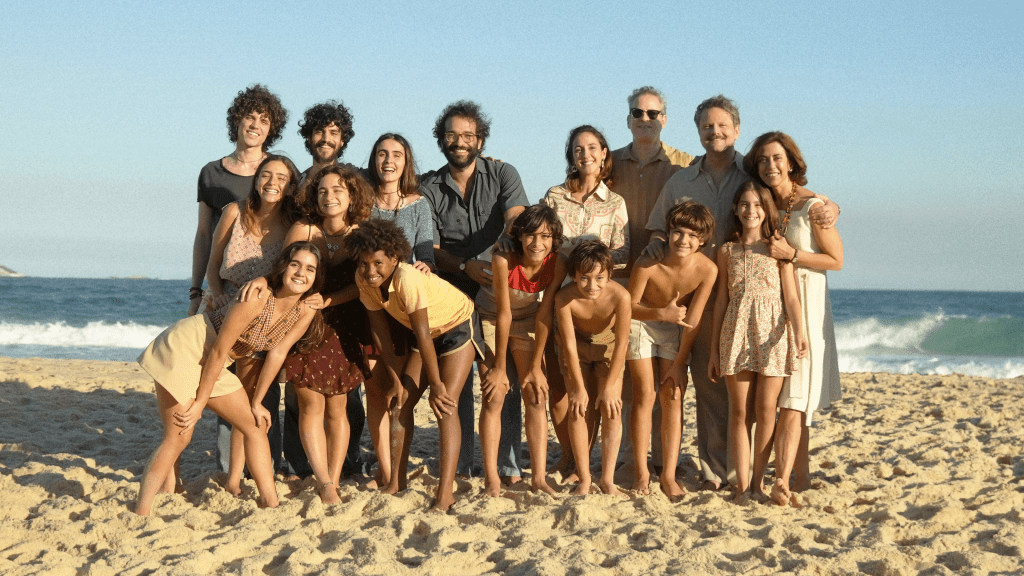

As the memoir’s title would tell you, this is a portrait of someone who has continued looking out for their loved ones despite the rise of fascism. Being a film all about the Brazilian military dictatorship as witnessed from the perspective of the author’s mother, Walter Salles’s film adaptation of this biography, being the Brazilia filmmaker’s first film in twelve years, is made with a sense of urgency. It’s urgent in the sense that you can really feel Salles cares deeply about the people whose stories are being told, while also being conscious of the circumstances that allow people to become radicalized. This just so happens to be what happened with Eunice Paiva, in telling her own story of how she kept her own family together during a time of crisis.
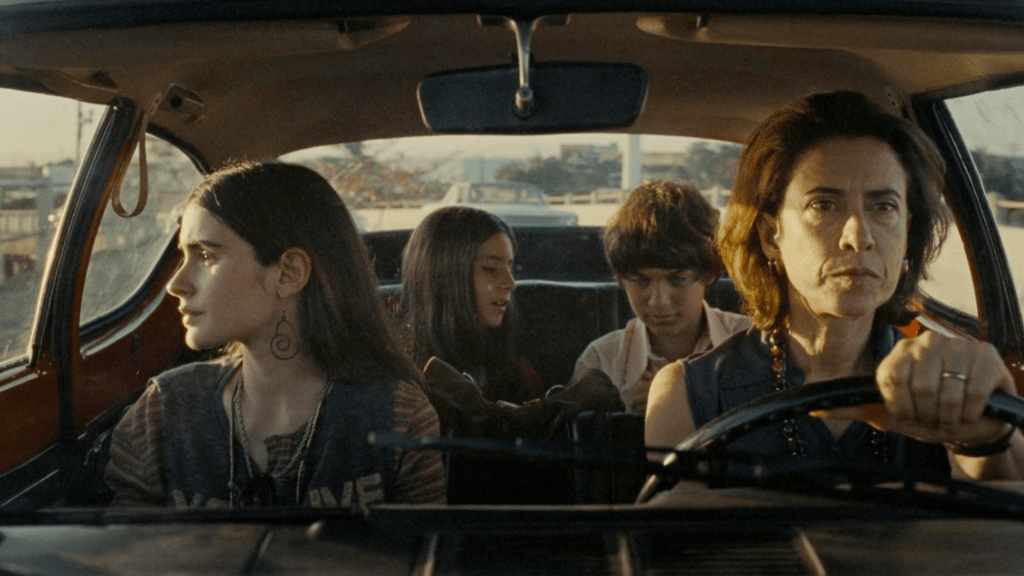
In this biography of Eunice Paiva, Paiva is portrayed by Fernanda Torres. Eunice Paiva is the wife of former politician Rubens Paiva (Selton Mello), who has mostly lived a civil life ever since his tenure had been revoked as a result of Brazil’s military dictatorship. The two of them have raised five children together in an idyllic life near Leblon beach, until their house is targeted by a military raid in January of 1971. Rubens is arrested and disappeared by his own government, leaving Eunice in a position of trying to figure out what could the military want with her own husband during this time – leading to the arrest of herself and her teenage daughter. Upon her return, she tries to do the best she can in order to ensure her five children are receiving the best that they can, without knowing what could possibly happen to Rubens during this time.
Walter Salles’s choice to direct I’m Still Here not as a political drama but as a domestic family drama ends up becoming a call to action. This film is a story all about resilience in the face of fascism above anything else, especially while Paiva’s own family do not know what else would be in store for their future. But even in trying to keep everyone resilient in this time of crisis, that alone might be where a powerful political statement is made, because Walter Salles never ignores how a moment like this could just as easily radicalize the entire Paiva family into taking a more active stance against their government’s oppressive regime.
Fernanda Torres is carrying this whole movie on her shoulders, but this performance is one that really captures such immense anger all throughout. Just as Salles had directed Torres’s mother, Fernanda Montenegro to an Oscar-nominated performance in Central Station, he allows Torres the room to show the anger and uncertainty in a regime that takes upon inhumane measures to silence its dissidents. It’s a performance that is filled with uncertainty, immense sadness, and anger, because we’re put into her own shoes so that we can better understand how people had felt as a result of Brazil’s military dictatorship, so as to give a better picture of how a woman looking out for her own family will transfer these same principles onto a new generation so that these mistakes will never be repeated in the future.
Yet it’s evident that Walter Salles is not building off I’m Still Here from the big moments that can just a easily ruin a family, so as to create a more immersive experience. We’re seeing a very psychologically complex portrait being accomplished in I’m Still Here by manner of these very small moments slowly building up as Eunice Paiva is trying to do the best she can for her children while military helicopters circle over their home and trucks carrying soldiers are moving through the streets. At any point in time, the family themselves could be a target, but Salles’s choice to frame these small moments at the center allows the anger we’re feeling inside to slowly bubble up into something so quietly devastating.
Of course, the response to I’m Still Here in Brazil from the rise of the far-right as a result of the recent presidency of Jair Bolsonaro was to try and organize many failed boycotts. Though it also makes a case for how ordinary citizens can stick up for one another in such times as oppressive right-wing politics continue to rise up in the world. Salles is doing so much heavy lifting with telling this story from memory, especially when one can only imagine how something so traumatic can only stay a part of you through your final days (as shown through the film’s heartbreaking final moments). Nonetheless, I’m Still Here presents a very powerful case scenario in which fascism may try to break you from the inside by disappearing those you love most, but your memory still remains and will be enough to be the forefront of a revolution.
Watch the trailer right here.
All images via Sony Pictures Classics.
Directed by Walter Salles
Screenplay by Murilo Hauser, Heitor Lorega, from the biography by Marcelo Rubens Paiva
Produced by Maria Carlota Bruno, Rodrigo Teixeira, Martine de Clermonte-Tonnerre
Starring Fernanda Torres, Selton Mello, Fernanda Montenegro
Premiere Date: September 1, 2024
Running Time: 138 minutes




 Cinema from the Spectrum
Leave a comment