
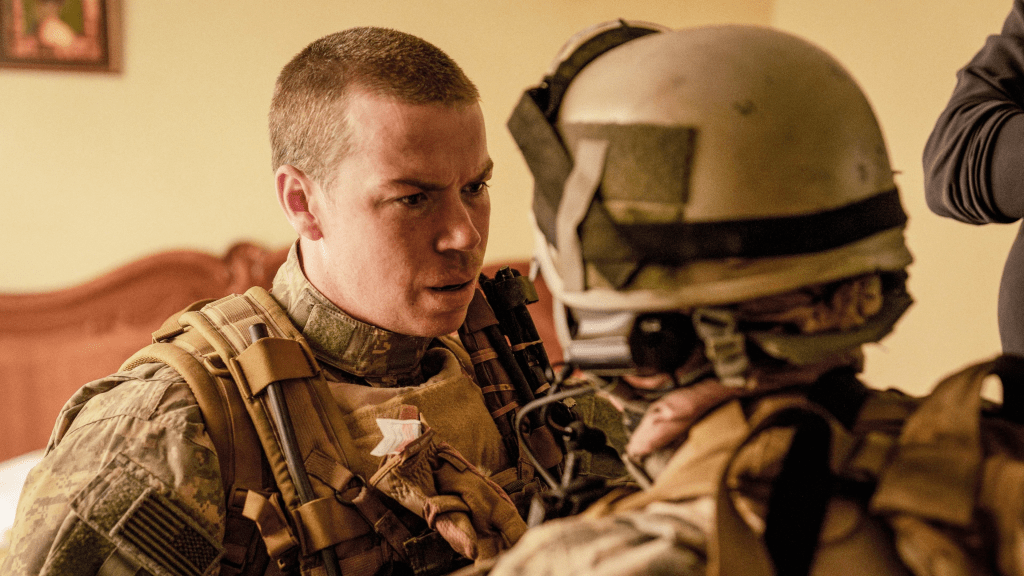

The primary hook for Warfare, the newest film directed by Alex Garland – is that it is a film telling of the experience within the Iraq War as told from the memories of a veteran. Thus, an actual veteran, Ray Mendoza, serves together with Alex Garland as co-writer and director. With a former veteran at the helm, one could only expect that Garland would have some curiosity to have said perspective reckon with any regrets that they had about their own missions, especially with knowing that this mission would have taken the lives of so many innocent civilians, just as Oliver Stone had done so with his 1986 film Platoon. Instead, Garland insists upon an “objective” approach which strips away humanity as much as possible; which only feels inappropriate for telling a story where so many people were killed.
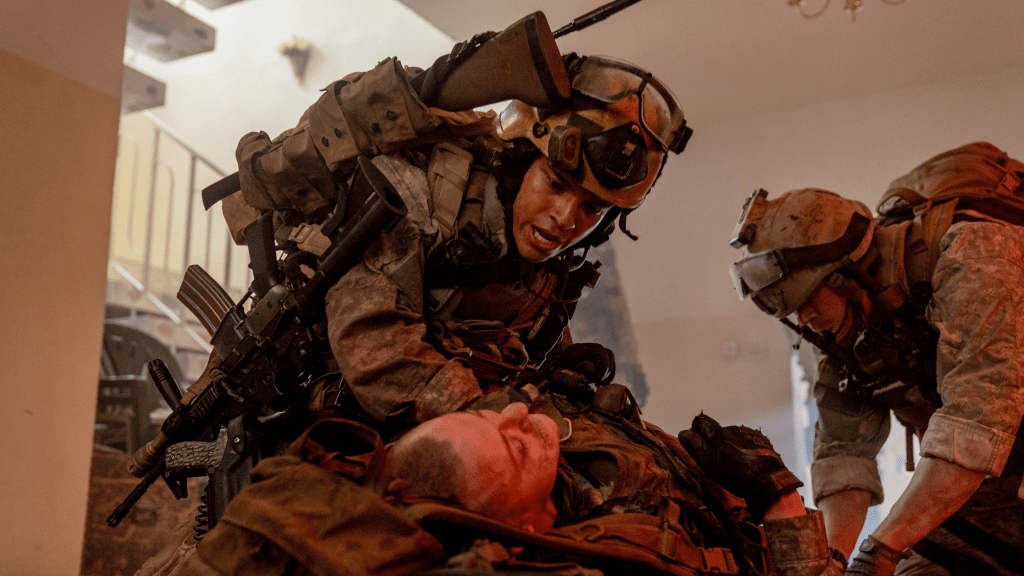
Most of Warfare unfolds in real time, as Ray Mendoza’s story is one that begins with his own platoon of Navy SEALs taking control of a multi-story home in Ramadi where families are present. Mendoza himself is played by D’Pharaoh Woon-A-Tai, but Mendoza himself is not a distinct character in the same mannerisms that one may expect from war movies. Instead, each character feels like a composite based around fellow soldiers whom Mendoza new within the battlefield – so as to make their own experience into something that we’re witnessing in real time after an improvised explosive leaves them trapped wtihin this neighbourhood. Fittingly enough, it all feels very visceral, as if one were actually in the battlefield itself too.
While the craft of Warfare undeniably is very impressive, in that it places you within that same headspace these soldiers are occupying, the lack of introspection ultimately reduces this story into nothing more than shallow spectacle. Garland’s insistence on the “objective truth” about the experience, without any interest in interrogating the political circumstances which would have led to these soldiers to possibly risk their own lives for a mission that may very well be a failure. Do any of these people have any pride in America because of what they are doing? Do any of them have anything else to live for? There’s absolutely no curiosity as to what would motivate them to take on something so dangerous and run the risk of potentially being unable to return back home.
In his own criticism of Schindler’s List, Austrian filmmaker Michael Haneke notes that “The entire idea of creating entertainment of this [regarding the shower sequence] The mere idea of trying to draw and create suspense out of the question whether out of the shower head, gas is going to come or water, to me is unspeakable.” But this also extended itself into a broader conversation about making films about wartime experiences in general, especially when many films centering around American soldiers are often filled with their own regrets as veterans hope to confront their own roles in tragedies that led to the unnecessary deaths of innocent civilians. It’s something that was on my mind all throughout Warfare, because it seems like Garland’s own strive for capturing “objectivity” puts ourselves at a distance from this conflict – turning it all into a shallow spectacle.
Like Garland’s Civil War before this one, Warfare is not a film that seeks to carry any sort of political stance – which might be most egregious in a case where we’re watching soldiers move through a mission during the Iraq War. Are we supposed to believe that these soldiers are brave men who are working for the greater good? There’s no answer, but it’s also hard to come to any other conclusion when the Iraqi family whose house is being used as a shelter for these soldiers is never given the chance to feel like fleshed out characters either. It’s most egregious when we know that the George W. Bush era might be one of the biggest blights on the legacy of the United States as it continued to carry on into the Obama years, as Islamophobia has only become all the more rampant following the September 11 attacks.
So what’s left to be taken away from Warfare? It might very well be that this film knows we as the audience members would never want to be trapped in such a situation like these Navy SEALs were. But supposedly in the recreation of memories from being part of a pointless mission, it might seem as if Garland’s conscious choice to forgo any sort of introspection about the collateral damage that the Iraq War had brought on forth only feels disingenuous. Much like Sam Mendes’s 1917 which unfolds in real time through the employment of a single-shot gimmick, Warfare finds spectacle in the excruciating pain of not being able to move out. Yet when Oliver Stone brought forth his own experiences within the Vietnam War to allow a sense of reckoning in Platoon, you might wonder why Alex Garland didn’t let Ray Mendoza speak more than he does.
Watch the trailer right here.
All images via A24.
Directed by Alex Garland and Ray Mendoza
Screenplay by Alex Garland and Ray Mendoza
Produced by Andrew Macdonald, Allon Reich, Matthew Penry-Davey, Peter Rice
Starring D’Pharaoh Woon-A-Tai, Will Poulter, Cosmo Jarvis, Kit Connor, Finn Bennett, Joseph Quinn, Charles Melton, Noah Centineo, Michael Gandolfini
Premiere Date: March 16, 2025
Running Time: 95 minutes




 Cinema from the Spectrum
Leave a comment