
For the first time since 2006, Richard Linklater has two movies opening within a short timespan. It’s always fascinating whenever any filmmaker has two movies (or more – looking at you, Steven Soderbergh) opening in the same year, but with Linklater, it’s especially notable since he’s still one of the most eclectic and versatile American filmmakers that we have. And the two films he has this year—Blue Moon and Nouvelle Vague—find him pushing himself in different ways, even as they share some similarities with one another. They’re both biographical pieces that revolve around iconic figures in artistic history. One revolves around the ending of a career, while the other revolves around a new beginning. And as someone who’s always interested in whatever Linklater is up to, I figured kicking my TIFF off watching both Blue Moon and Nouvelle Vague made sense. Double the Link, double the Later. So, why not review them together rather than separately? It’ll be more fun that way.
Blue Moon
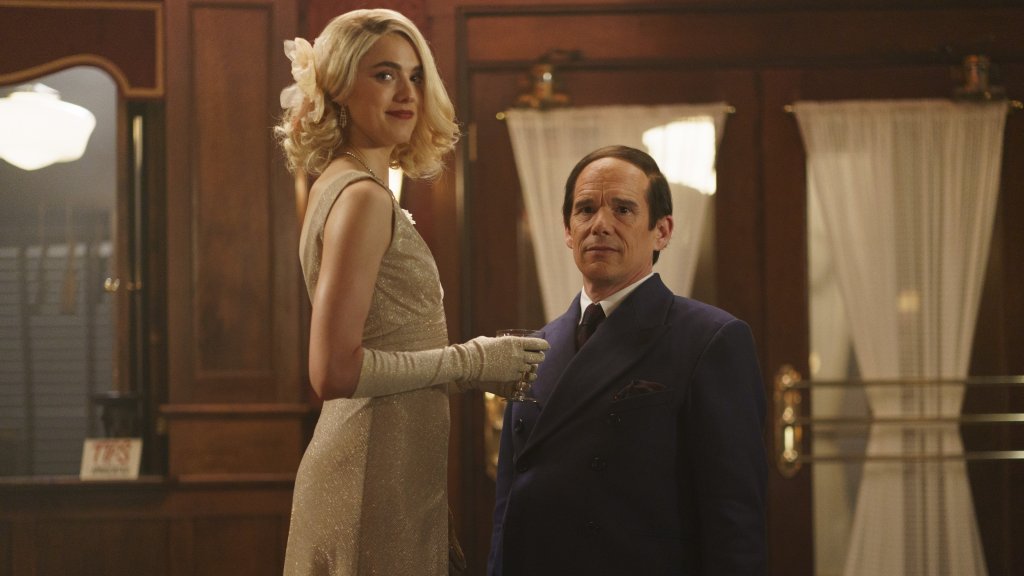
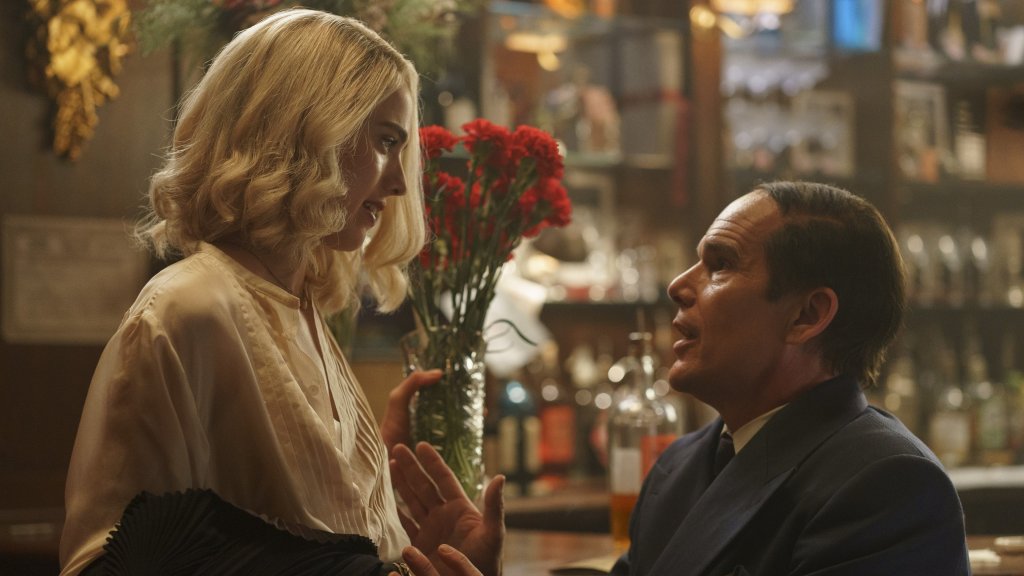
The first in Linklater’s time-travelling double feature takes viewers back to 1943, a year when the Golden Age of Broadway was about to begin. In fact, it largely takes place on the very evening it happened, and how it essentially impacted one individual for the worst. Written by Robert Kaplow (whose novel Me and Orson Welles was adapted into a film by Linklater previously), the film finds the great American lyricist Lorenz Hart (Ethan Hawke) reflecting on his life and career on the opening night of Oklahoma!, the first of what would become a long-term creative partnership between Rodgers (Andrew Scott) and Oscar Hammerstein III (Simon Delaney). At the legendary restaurant Sardi’s (where the afterparty will take place), we see Hart bitching about the smash hit to barman Eddie (Bobby Cannavale, amusing) and the resident piano player (Jonah Lees), both sympathetic to his troubles. We see as he struggles with his alcoholism, which increasingly hangs over the film like a cloud the more he loses his battle with the bottle. His semi-closeted status additionally gets a spotlight, especially whenever his infatuation with young Yale student Elizabeth Weiland (a grounded and striking Margaret Qualley) comes up.
One of the most important thing to note about Blue Moon is that it’s a chamber piece through and through, the kind that’ll probably remind at least a few Linklater devotees of his work on 2001’s Tape (which also starred Hawke). While this isn’t based on an existing play like that film was, it undoubtedly unfolds like one, and Linklater has no problem leaning into the old-school theatricality that’s already present in Kaplow’s banter-heavy screenplay. It can run the risk of feeling a bit too stagey, but both cinematographer Shane F. Kelly and editor Sandra Adair (each frequent collaborators of the filmmaker) bring enough flair to its proceedings to keep the story moving without overshadowing the dialogue or performances – which films like this essentially live or die on. Luckily, those two aspects manage to crackle as well.
Another important thing to note is that this is – front to back – a showcase for Ethan Hawke and his continuing versatility as an actor. In his ninth collaboration with Linklater, Hawke effortlessly strikes a fine balance between delightful scenery-chewing (particularly with his many monologues he’s tasked with) and heartbreakingly quiet introspection, effectively communicating how complex of an individual Hart was: endearing and difficult, almost in equal measure. It’s enough to rank as one of his best performances in an already esteemed career. But don’t think that the film’s supporting players don’t know how to keep up. Andrew Scott particularly stands out as Rodgers, constantly toggling between patience and frustration in his messy, tense and ultimately heartbreaking interactions with Hart. It’s really no wonder why he won the Silver Bear for Best Supporting Performance at the Berlin International Film Festival earlier this year.
Though Blue Moon can be a little too light on its feet, which can lessen the overall impact of the tale it’s telling, Linklater still leaves enough for you to chew on regarding its musings of art, jealousy, and legacy – packing as much as possible into such a tight space. It’s a solid example of how to pull something like this off without it feeling monotonous.
Watch the trailer right here.
All images via Sony Pictures Classics.
Directed by Richard Linklater
Screenplay by Robert Laplow
Produced by Mike Blizzard, John Sloss, Richard Linklater
Starring Ethan Hawke, Margaret Qualley, Bobby Cannavale, Andrew Scott
Premiere Date: February 18, 2025 (Berlin)
Running Time: 100 minutes
Other Writers Say…
Jaime Rebanal
Jack Cox
Nouvelle Vague
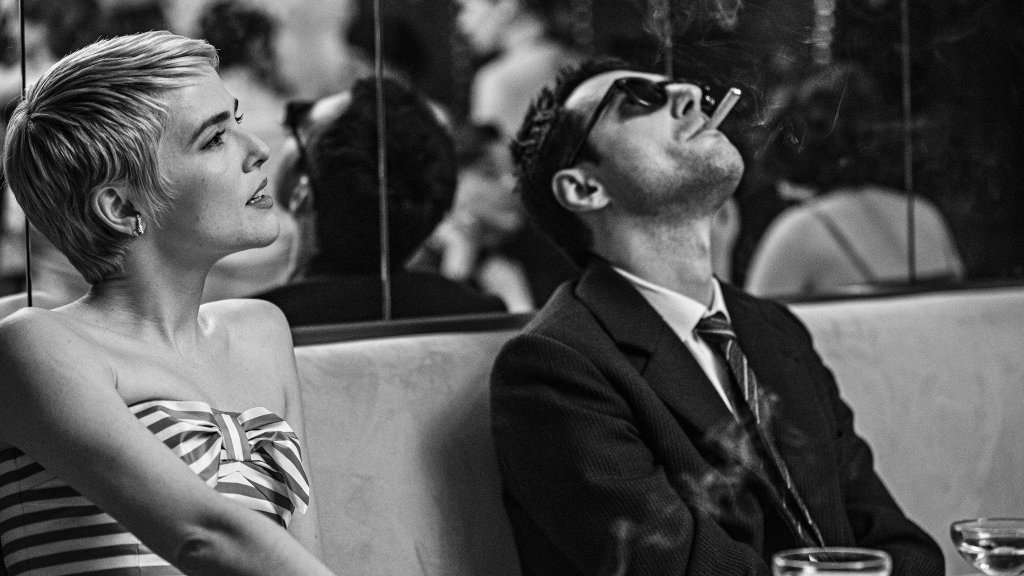
On the other side of Linklater’s time-travelling double feature, there’s Nouvelle Vague, which retells the story of how Jean Luc-Godard’s storied debut Breathless came to be. We’re transported to 1959 Paris, where the French New Wave cinematic movement was continuing to thrive, with a handful of filmmakers (most of whom wrote for Cahiers du Cinéma) having made their mark. Godard (as played – with by Guillaume Marbeck) has not yet made his when we meet him early in the film, but he desperately wants to. He feels that the time is right. So, after convincing producer Georges de Beauregard (Bruno Dreyfürst) to green light a story written by fellow critic and filmmaker François Truffaut, Godard gathers his collaborators – which include American movie star Jean Seberg (Zoey Deutch) and amateur boxer Jean-Paul Belmondo (Aubry Dullin) – and it’s off to the races. However, it won’t be without complications.
Linklater has always been open about how Breathless inspired his filmmaking approach, certainly he was making his debut film Slacker, which helped kick off the American independent film movement of the 1990s. So, you can feel the fun he’s having in re-creating that specific period as faithfully as possible, from cinematographer David Chambille’s black-and-white cinematography (in a 1:33:1 aspect ratio no less) to the many short introductions he gives to even the most minor of the movement’s players.
It’s so aesthetically faithful that one wonders if it could’ve done more to replicate the unpredictable, innovative spirit narratively. Because while the film is pleasurable as a whole, it feels more boxed in by its biographical trappings than Blue Moon does (to make comparisons, of course). And because it lacks some sort of genuine emotional throughline, it’s a little difficult to truly invest in its proceedings, especially when you know things will out very well. There’s just not a lot to chew on as a viewer. Still, though, even lesser Linklater has its charms and the playfulness on display is hard to resist whether you have an appreciation for this era as a film fan or not. There’s worse ways you could spend your time.
Watch the trailer right here.
All images via Netflix.
Directed by Richard Linklater
Screenplay by Holly Gent, Vincent Palmo, Michèle Halberstady, Laetitia Masson
Produced by Michèle Pétin, Laurent Pétin
Starring Guillaume Marbeck, Zoey Deutch, Aubry Dullin
Premiere Date: May 17, 2025 (Cannes)
Running Time: 106 minutes


 Cinema from the Spectrum
Leave a comment