
✯✯✯✯✯
Many cinephiles would associate Hirokazu Kore-eda as a filmmaker known for making “slice-of-life” dramas, but I find that is not a wholly accurate descriptor for his work. With Monster, he takes a very vulnerable look at childhood and the differences in perspectives that both adults and children have about the world around them. Still, it’s easy to see why Kore-eda finds himself identifying more with the filmmakers who’ve made themselves known for “kitchen sink” dramas during the 1950’s especially within his later work. But here is a case where Kore-eda turns in what might be his most psychologically complex work to date – where his usual tricks lead into something more devastating underneath. Kore-eda is no stranger to evoking this feeling, but Monster is a brand new challenge for the Japanese auteur.

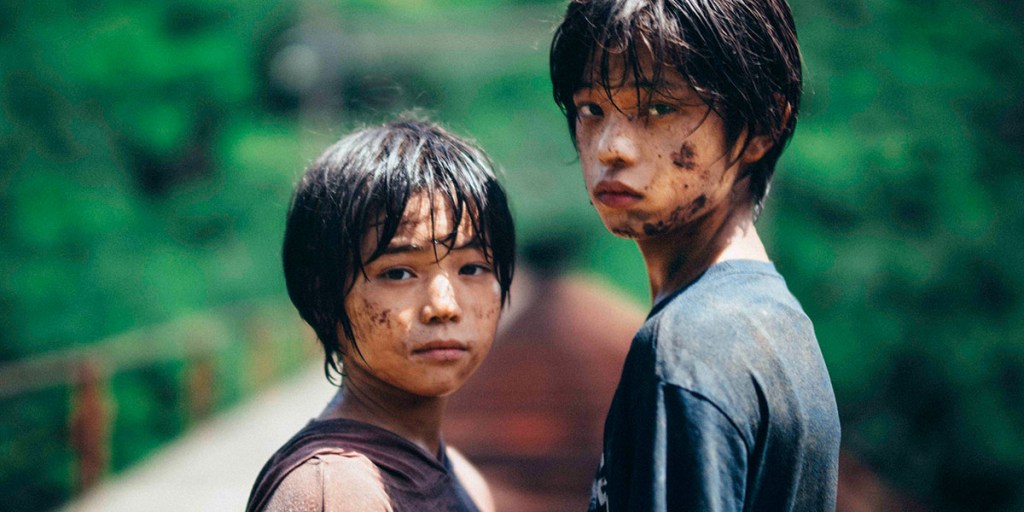
The film is built around the life of Minato Mugino (Soya Kurokawa), a bullied schoolboy who begins to exhibit strange behaviour out of the blue. When his mother Saori (Sakura Ando) catches on, he blurts out the name of his teacher, Michitoshi Hori (Eita Nagayama). Suspecting that Hori might be involved in what’s going on with Minato’s wellbeing, what happens next is a series of misunderstandings about that end up sending their lives down a whole other spiral. What comes forth is arguably among the most tragic stories that Hirokazu Kore-eda has brought to the screen, and one of his most innately shattering films to date.
What Kore-eda understands is that within the scope of this story, there are no “bad” people – but very limited understandings of the circumstances at play. Saori is a very dedicated mother to her young Minato, but of course, she lives her own life – and everything is filtered through what she understands about him. Screenwriter Yuji Sakamoto utilizes these differing perspectives all throughout Monster in order to create what could amount to the Japanese filmmaker at his most compassionate: its storytelling ensures that every perspective on a story where the lines are blurred becomes heard. Sakamoto uses a structure that highlights three differing points of view: the mother, the teacher, and the child, and its emotional impact comes forth from how we understand what the previous one cannot. They’re not only clever, but they speak to how children when they’re young can hide so much from adults, knowing that the world around them will not understand.
Before his passing, this was also the final film to be scored by the great Ryuichi Sakamoto – who arguably might have been the finest Japanese composer of our time. The score itself, which consists of new recordings from the master himself but recognizable archival material is among the year’s very best. But I think that the pieces of the late Sakamoto’s score that you’ll hear throughout the film only state the complicated emotions that the film shows you so beautifully, because it has an aura of sadness to it that lets you take in the nature of what’s going on. Because what Monster ultimately is about, is what we can and cannot see. It’s all about the way “monster” can be defined, are adults made into monsters for not understanding children? Better yet, are the children themselves monsters for being different from other kids around them?
Right off the bat, you may have an idea what to expect following the film’s receival of the Queer Palm at the Cannes Film Festival this year. For Hirokazu Kore-eda, Monster dives right into what children experience at school with relative ease, but it’s also clear that he understands what they keep secret from the adults around them. Minato’s strange behaviour in front of the adults around him could be attributed to many things, but I think that the way in which Kore-eda shows us a world that adults understand versus what children do feels like it’s very telling on the viewers too. It’s telling on viewers who know that their children harbor many secrets, but are also afraid of what happens when the truth is revealed in some form. And ultimately, it’s the children who have the final say in their own future, not the ruling adults who will continually push forth the social stature that keeps bullying so prevalent in their environment.
After I watched Monster, I couldn’t get Sakamoto’s score out of my head. I felt my eyes fluttering, because I think that when the full picture comes into play, it’s easy to think back to a moment in your own childhood where you were holding a secret that you couldn’t let the adults around you know about. Monster is a film all about how we’ll never truly understand even those we love most, but we must ask ourselves, should we become monsters in our own lives because of that? Monster is a brilliantly acted film, with all three of its central performances being incredible in their own way, but perhaps the most shattering aspect of it all, is the way that Hirokazu Kore-eda shows that the circumstances shouldn’t be so much a mystery anymore – the end result is one of the year’s best and most empathetic films.
Watch the trailer right here.
All images via Well Go USA.
Directed by Hirokazu Kore-eda
Screenplay by Yuji Sakamoto
Produced by Minami Ichikawa, Ryo Ota, Kiyoshi Taguchi, Hajima Ushioda, Kenji Yamada, Tatsumi Oda
Starring Sakura Ando, Eita Nagayama, Soya Kurosawa, Hinata Hiiragi
Release Date: September 10, 2023 (TIFF)
Running Time: 125 minutes


 Cinema from the Spectrum
Leave a comment