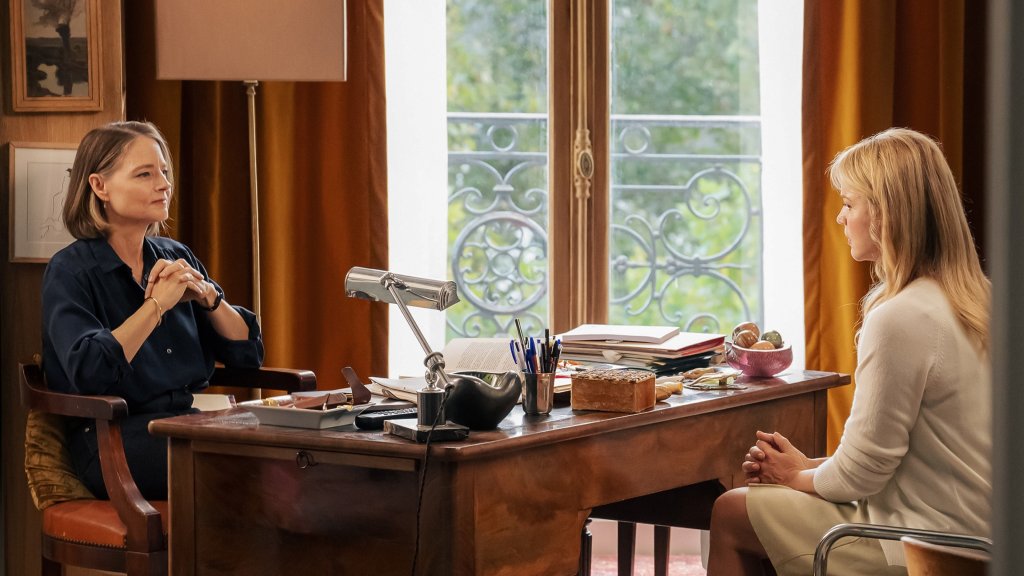

Rebecca Zlotowski’s A Private Life begins as a quiet drama of grief and then tightens, almost imperceptibly, into a paranoia thriller. Dr. Lillian Steiner (Jodie Foster), a Paris psychiatrist, loses a patient and finds that mourning is not something she can simply endure. It becomes something she must solve. The more she reaches for certainty, the more the film reveals its central trap: the ethical boundaries of her profession make truth both intimate and unreachable.
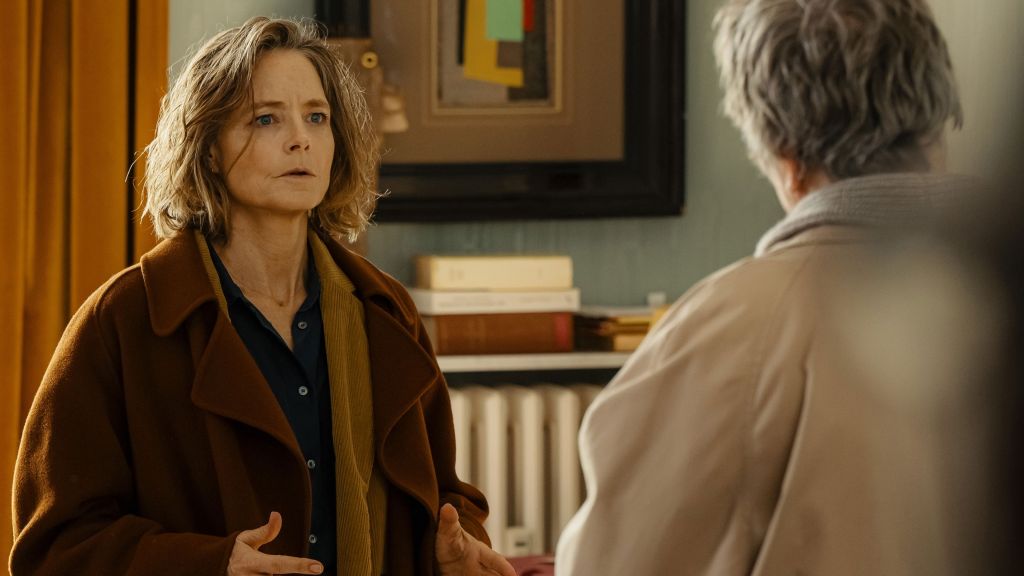
Foster makes that trap feel physical. Her performance is all composure under pressure, a woman trained to contain other people’s pain suddenly unable to contain her own. The film’s bilingual structure sharpens the divide: Steiner speaks French as her professional surface, but her private thoughts are in English, as if her most essential self can only emerge when the world is not listening. The language switching is not stylistic decoration. It is the film’s clearest sign that containment is failing.
Virginie Efira’s Paula, the patient whose death unmoors Steiner, is the film’s absent center. She appears only through recorded sessions and recollection, so Steiner is left piecing her together from evidence and longing. Efira makes those fragments feel vividly human, but the point is that Paula can never be retrieved completely. Confidentiality keeps her unreachable, even as Steiner can’t stop reaching.
Zlotowski stages the rest of the cast as pressure points on that boundary. Gabriel (Daniel Auteuil), Steiner’s ex-husband, is the closest thing the film has to an anchor, a relationship that exists outside the patient frame and threatens to become another form of dependence. Simon (Mathieu Amalric), Paula’s husband, brings grief close to menace, embodying the film’s fear that intimacy and threat can share the same face. Valérie (Luàna Bajrami), Paula’s daughter, complicates suspicion without ever becoming a simple thriller suspect. Julien (Vincent Lacoste), the son Steiner shares with Gabriel, is the domestic cost of her emotional discipline, the person most shaped by the way she has learned to keep love at a distance. Even the detours into other forms of “treatment” sharpen the argument: Sophie Guillemin’s hypnotist offers a surreal promise of access, while Dr. Goldstein (Frederick Wiseman), Steiner’s mentor, represents clinical authority and professional judgment. Each encounter tightens the same question from a new angle: what does it do to someone to hold other people’s secrets and remain sane.
The film’s motifs function less like symbols than like symptoms. The MiniDiscs Steiner uses to record herself suggest an archival approach to feeling, as if documentation can substitute for experience. Wind chimes and falling snow return as signals that Steiner is crossing out of rational procedure and into obsession, fantasy, and compulsion. Even a phrase like “pain in the ass” becomes an echo of perception hardening into self-description as her restraint erodes. Zlotowski’s tonal control is equally precise: dryly funny when it can be, deadly serious when it must be, and never overwrought even when the film grows abstract.
What Zlotowski captures, more sharply than most thrillers, is how obsession can disguise itself as responsibility. Steiner’s pursuit does not read as mere curiosity or even suspicion. It reads like compulsion, a mind trying to turn grief into something orderly and actionable. The film keeps returning to the same uncomfortable truth: for someone whose job is to hold other people’s private lives, the temptation to turn a person into a narrative, a theory, a case, can become its own form of damage. Obsession is a very strange thing, and A Private Life understands that it does not always announce itself as instability. In Steiner’s case, obsession becomes almost indistinguishable from care.
If A Private Life frustrates, it is in the way it refuses full closure. But that refusal is bound to the film’s subject. Obsession does not resolve neatly, and the ethics that define Steiner’s life ensure that some answers remain permanently unreachable. For viewers who like mystery as a psychological condition rather than a puzzle to be solved, Zlotowski’s film is tailor-made: unpredictable scene to scene, anchored by one of Foster’s finest performances, and haunted by the idea that confidentiality can be both protection and prison.
Watch the trailer right here.
All images via Sony Pictures Classics.
Directed by Rebecca Zlotowski
Screenplay by Rebecca Zlotowski, Anne Berest, Gaëlle Macé
Produced by Frederic Jouve
Starring Jodie Foster, Daniel Auteuil, Virginie Efira, Mathieu Amalric, Vincent Lacoste, Luàna Bajrami
Premiere Date: May 20, 2025 (Cannes)
Running Time: 103 minutes



Leave a Reply