

✯✯✯½
One look at the synopsis for Concrete Utopia would have you think that it could be South Korea’s answer to the disaster films by way of Roland Emmerich or Irwin Allen. But Concrete Utopia presupposes something else, where you’re seeing a spectacle that tries to engage with how humans behave in the face of danger. It’s a survival film first and foremost, but what makes Concrete Utopia stand out from your typical Hollywood disaster film is that the filmmakers very much insist that this is a film all about the humans in the face of the imminent danger they have experienced. And of course, when everyone is reduced to nothing after an earthquake destroys all that we know, only a lucky few can really make it out okay in the end.
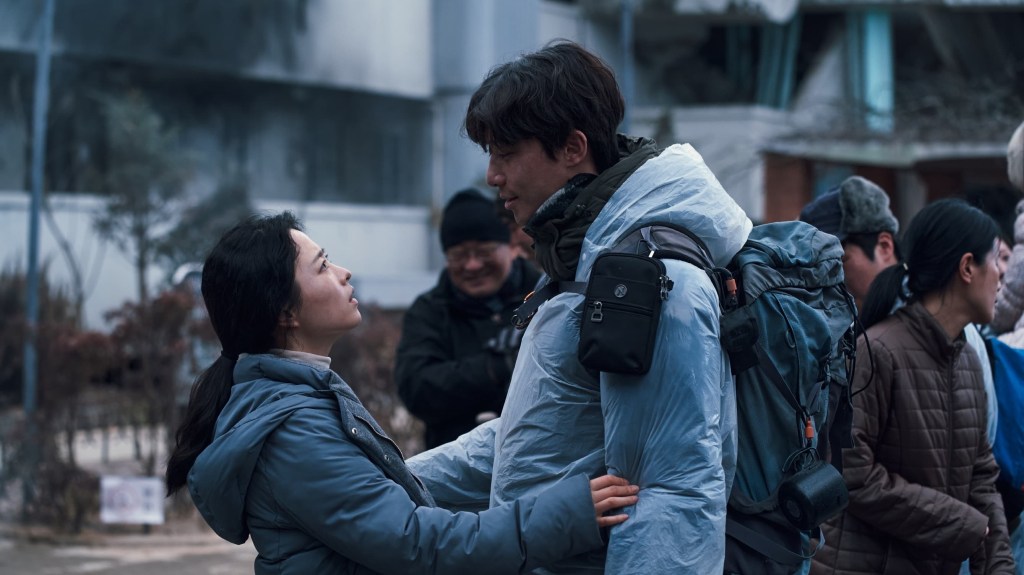
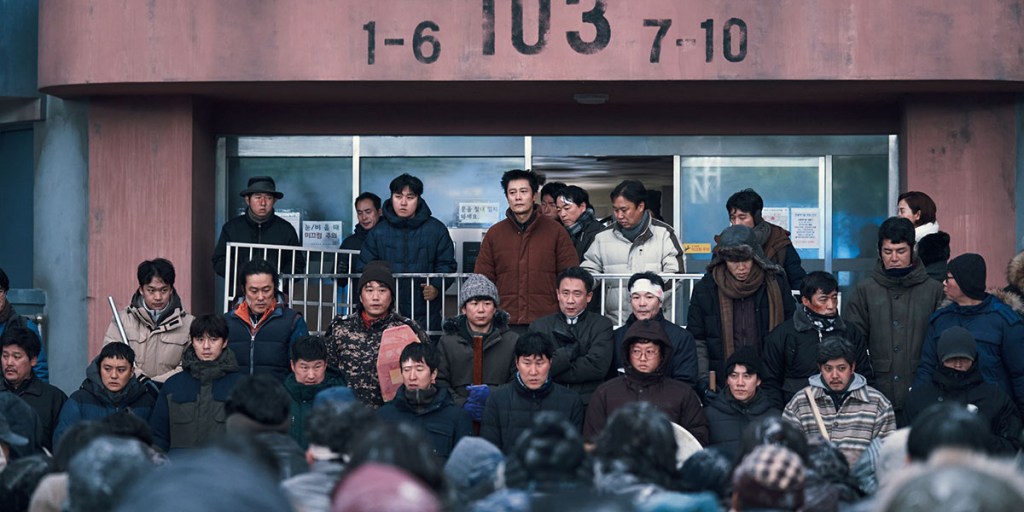
Set in what remains of Seoul after a devastating earthquake, Concrete Utopia centers itself around the residents of the still-standing Hwang Gung apartments. With what seems to be the whole world around themselves now in ruin, the tenants of the Hwang Gung apartments are now left fending for their property – electing the Yeong-tak (Lee Byung-hun) as their leader. Without rescue teams in sight, a couple living inside the apartment buildings, Min-seong (Park Seo-jun) and Myeong-hwa (Park Bo-young) take a stranger and a child into her home – but as supplies start dwindling, so must their approach to taking care of survivors. It’s from here, an allegorical tale is born – putting this far above most modern American disaster films.
From the first moment where you see the devastation laid upon South Korea as a result of the earthquake, it’s a hard moment to forget. Whether it just be from boasting some of the most stunning visual effects work that puts most recent American disaster films to shame, the way in which it all comes together after the film’s title card drops makes it a hard moment to forget. It’s all clear from the fact that Um Tae-hwa understands how the scope of a disaster like such can only be felt properly by showing the way people can try and cling onto survival instinct after the disaster. On a technical level, this film happens to be a marvel – whether it just be this sequence alone or the production design of it all, you feel the scope of a world in ruin around yourself.
Because Concrete Utopia abandons most traditional disaster movie tropes in favour of a post-apocalyptic story about humanity’s survival, it opens itself more to exploring the cracks of human instinct. The film itself tackles many very timely social issues going from immigration, the aftermath of capitalism, and the bubbles that rich people create for themselves. For this alone, it really allows the wonderful cast to play off one another – in an ensemble that includes Park Seo-jun and Lee Byung-hun delivering some incredible work, now serving to deconstruct the foundations upon which governing forces are built. The end result is a tale about humans continually fighting against one another in the name of maintaining a sense of “order.”
Despite “utopia” being in the film’s title, Um Tae-hwa makes it clear that this isn’t so much a film all about a sort of paradise still standing. In fact, the film shows itself to be the opposite: the still standing Hwang Gung towers are not a symbol of hope as much as they are the remnants of people excising a sense of privilege upon those who’ve already lost their homes as a result of the earthquake. They live in bubbles, where only the fellow residents matter to them, and anyone from the outside is now seen as a “cockroach” that’ll feed off what little they have in order to survive. So thus begins their own need to go out to look for resources that fellow residents can live upon. The commentary here isn’t really anything revelatory, especially because it’s such a common theme in South Korean media – although the lack of nuance probably might be something that may take yourself out.
Still, the elements of Concrete Utopia that work happen to be very strong. I think that Um Tae-hwa’s ambitions of creating a cautionary tale in the face of death are admirable, all aided by the fact he’s working with a brilliant premise at that, and even making room for some clever dark comedy. A lot of this film is very much steeped in Christian imagery, which could easily have led into something more heavy-handed, but that’s not the case here. Where I think the film doesn’t work all the way through might be best stated in the fact that its middle section ends up becoming its most repetitive section, and some of its narrative twists don’t quite work for me (although there’s a brilliant moment leading towards the climax).
There’s a great movie that could be found within the foundations that Concrete Utopia is working within. In the film’s opening earthquake sequence is a spectacle unlike any other, but it’s the way that Concrete Utopia builds itself from that point onward that makes it stand apart from the obsession with the destruction present in many American films. Where it goes in between that moment and its ending feels very rocky, building itself from social commentary that you’ve probably seen done better in films like Parasite (although that might be unfair to this film’s case, given how high up the bar had been set by Bong Joon-ho’s film). But its ending especially rises this up above the rubble.
Watch the trailer right here.
All images via Lotte Entertainment.
Directed by Um Tae-hwa
Screenplay by Um Tae-hwa, Lee Sin-ji, based on the webtoon Pleasant Bullying by Kim Sung-nyung
Produced by Byun Seung-min
Starring Lee Byung-hun, Park Seo-jun, Park Bo-young, Kim Sun-young, Park Ji-hu
Release Date: August 9, 2023 (South Korea)
Running Time: 129 minutes



 Cinema from the Spectrum
Leave a comment