
✯✯✯✯✯
This piece was written during the 2023 SAG-AFTRA strike. Without the labour of the actors currently on strike, the film being covered here wouldn’t exist.
In the months leading up to the release of Martin Scorsese’s Killers of the Flower Moon, I’d also read David Grann’s book about the murders of members of the Osage Nation within the 1920’s. It is a chilling read, but the scope of the story is one that lends itself to endless coverage. But even knowing that this story were to be brought to the screen by one of America’s greatest working filmmakers, Killers of the Flower Moon would still feel like it would be doomed. The main creatives in command of the film are not Osage, let alone Indigenous, so the skepticism can be felt. But it’s also something Scorsese is reckoning with, which results in a complicated but otherwise beautiful effort all throughout.
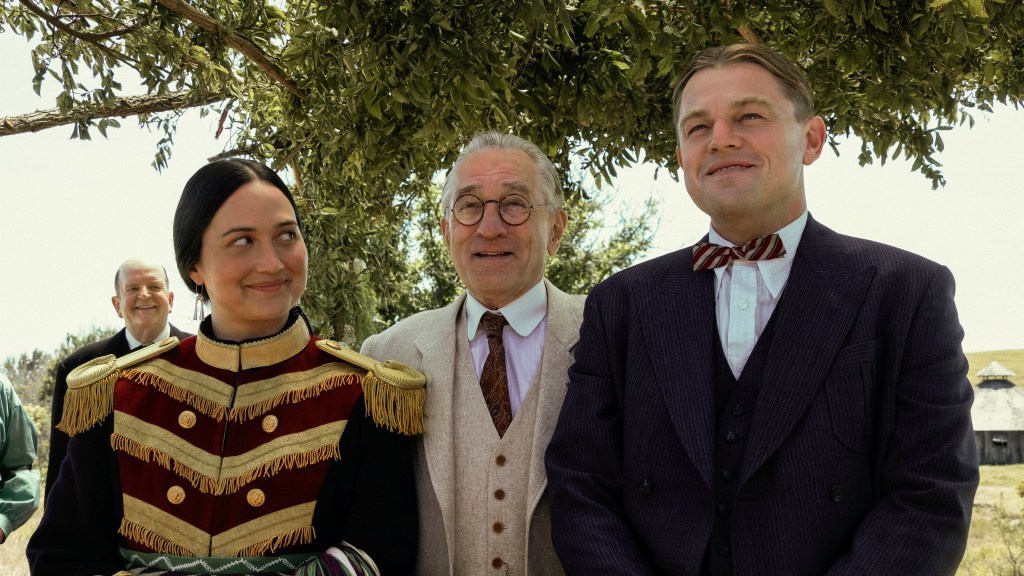
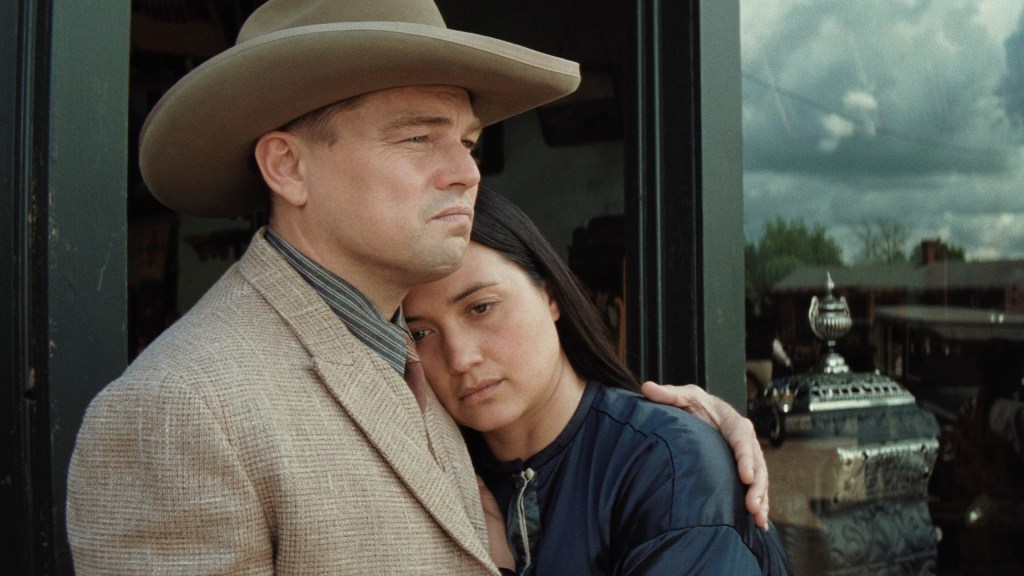
Killers of the Flower Moon is very clearly a late-period Scorsese film – in that Scorsese has taken an introspective stance with approaching a tragic story that changed American history forever. But finding the perfect voice to lead that story, especially given its scope is already a challenge in and of itself. With how Scorsese brought it to us, we’re seeing things unfold through the eyes of Ernest Burkhart (Leonardo DiCaprio), a World War I hero caught within the moral conflict out of his love for his Osage wife Mollie (Lily Gladstone) and his rancher uncle William “King” Hale (Robert De Niro). That alone would make way for how a story like this is a complicated one to tell, but Scorsese does so with great care.
Even with Martin Scorsese at the helm, a story of this scope would still have a very limited perspective – as it’s already been passed from generation to generation for many Native Americans who had witnessed all of this happening to their families. But Martin Scorsese also makes it clear that he’s aware of his own limitations because he cannot capture an Indigenous perspective on the screen as he is not Indigenous himself. This alone sets Killers of the Flower Moon apart from most other American films who try to tackle a complex issue like systemic racism and then it plays out like a pure wish fulfillment fantasy. And of course, telling a story like this one responsibly would mean not shying away from any of that.
Noting that Martin Scorsese and co-writer Eric Roth have both worked extensively with Osage people in order to keep their language prevalent within the film, and had them heavily involved behind-the-scenes, it keeps Killers of the Flower Moon from becoming a white saviour narrative. With how David Grann’s book had told this story from the point of view of Tom White, the agent who was sent to investigate what went on, a welcome change is present in how Ernest Burkhart’s point of view – shifting away from making a case for the “noble white man” in telling a story like this for audiences today. Of course, the days are far more socially conscious than ever as we hear of something like this now, but Scorsese’s choice also boxes you in to reckon with how these stories are continually told to white audiences through the years.
Many have commented about the film’s long running time – and like The Irishman, there’s no doubt that Scorsese has tested the patience of his audiences. But the long running time also gives viewers the space to ruminate about the way that evil of this sort masks itself. Scorsese isn’t one to waste time, but it becomes clear that the more time we spend with Burkhart, and see how he weaves his way into a system that favours his own kind, a more horrifying portrait is brought to the screen.
It also allows us to find a moment to realize how a system of evil is built. Every moment where the violence is shown on the screen lingers in our heads, even with it being shown at distance. But even those moments end up becoming so haunting because these are people who aren’t thought of as humans, so we see their deaths at bay. Seeing things from the perpetrator’s point of view only adds a very uncomfortable layer to how we end up seeing tragedies that primarily target minority groups, in that for their white perpetrators, they almost seem unremarkable. It’s knowing this alone that Scorsese forces his viewers to reckon with, because it also becomes emblematic of how white supremacy works its way into the American consciousness.
Some can also lament that because Ernest’s point of view is centered within Killers of the Flower Moon, the Osage point of view does not have as much weight. But it’s also clear that Martin Scorsese is aware of his own limitations as a filmmaker with regards to the point of view that he can capture in Killers of the Flower Moon. Even with Ernest Burkhart’s point of view at the center, there’s a clear heart and soul to be found in Mollie’s presence – and in an already incredible cast, with Scorsese regulars Leonardo DiCaprio and Robert De Niro, Lily Gladstone shines above them all. In a story like this, being told about how such a horrifying tragedy is nothing more than an afterthought for the perpetrators, Gladstone commands the screen for the humanity she brings to her role as Mollie, in a performance for the ages. She embodies all the good that still survives in a world where the Osage were being killed off one by one, especially as we see it happening so cruelly and coldly.
Even with everything that’s been laid out, I think we’re only bound to see this same story come to the screen in more forms – especially told by Native American storytellers. But with the limitations he has with his point of view considered, it’s clear that Martin Scorsese is leaving his viewers with something to ruminate about, given how stories of such a tragedy get thought of as nothing more than an “everyday occurrence.” The reality of such a situation is that for the Osage people, it will be more than just that, and even as white viewers will remember this story one way, Scorsese makes it clear he wishes for the viewers to reckon with how we see them told in a one-sided manner. The end result of all this is maybe one of Martin Scorsese’s most beautiful films, and a heartbreaking look into the core of what America is founded upon.
Watch the trailer right here.
All images via Paramount Pictures.
Directed by Martin Scorsese
Screenplay by Martin Scorsese, Eric Roth, based on the book by David Grann
Produced by Dan Friedkin, Bradley Thomas, Martin Scorsese, Daniel Lupi
Starring Leonardo DiCaprio, Robert De Niro, Lily Gladstone, Jesse Plemons, Tantoo Cardinal, Cara Jade Myers, John Lithgow, Brendan Fraser
Release Date: October 20, 2023
Running Time: 206 minutes
 Cinema from the Spectrum
Leave a comment