


✯✯✯✯½
Released as the follow-up to his widely celebrated Academy Award winner Drive My Car, Ryusuke Hamaguchi’s next film, Evil Does Not Exist feels a lot more closed in. The stakes are much lower, everything about Evil Does Not Exist also feels distinctly smaller. But that’s not a bad thing, especially when it feels every bit as meditative as Hamaguchi has shown himself to be at his most thoughtful. At a certain point while watching Evil Does Not Exist, you might be wondering why this was chosen as its title, but you also begin to feel at home with it too.
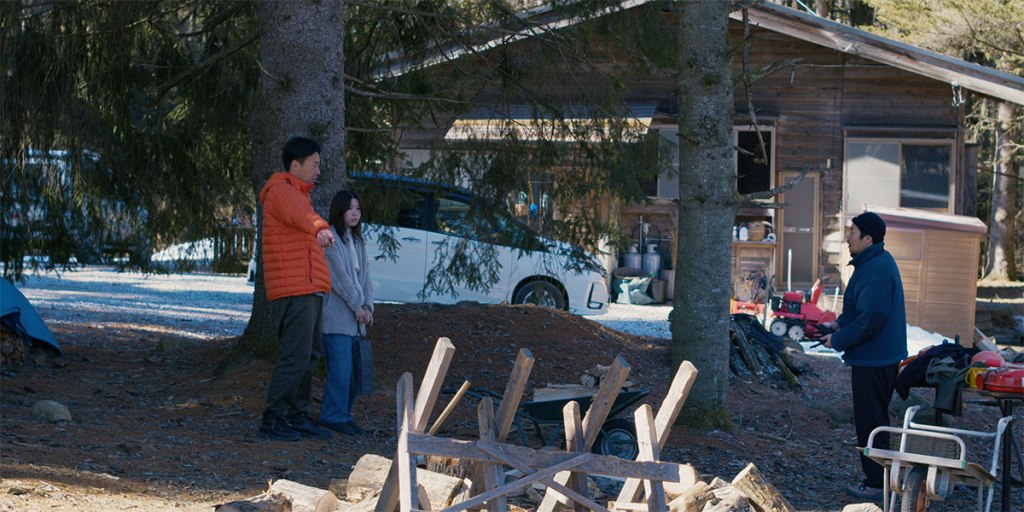
Set around the village of Harasawa, we’re introduced to a very serene and peaceful community of people where everything almost seems like it’s in order. Takumi (Hitoshi Omika) is a single father living deep in the forest together with his eight year old daughter Hana (Ryo Nishikawa), taking odd jobs for other residents one after another. All this order gets disrupted by a pair of agents from a company named Playmode, with the intention of starting a “glamping” (glamour camping) project, which is met with scrutiny from the locals. The dissonance between these two lifestyles seems like there would be more of a clash, but Hamaguchi brings the two of them closer than ever – especially with them occupying the same space.
What’s always been particularly admirable about Ryusuke Hamaguchi is his ability to create the feeling of serenity in seeing people from a rural community maintaining order. It becomes very homely, because Hamaguchi is more interested in letting the images of peacefulness speak above all else in Evil Does Not Exist. But of course, the clashing views of the world defined by the urban and rural ways of life end up throwing everything off the course. Yet as Hamaguchi sees it, there’s an intertwining in knowing that these are human beings living their lives.
Evil Does Not Exist feels like there’s a question being posed about where the concept of “evil” can possibly originate. It all begins to arise when you see how the agents almost feel out of place in a very peaceful community like that of Harasawa, and even brush off any potential environmental disruptions that will be brought up. They can’t speak for the people who they work for, they’re only presenting an idea but because the corporatism is entirely mechanical, it’s clear where a sense of humanity can be felt. In doing so, there’s a sense of anger felt from Hamaguchi, as if he were living in Harasawa as one of the residents.
Then there also comes a very sudden shift in tone that defines the entire second half of the film. It’s a sudden shift that feels like it’s the perfect way for all these small moments in Evil Does Not Exist come together. Whether they be coming forth as a result of the villagers or the agents, the sudden shift in tone perhaps gives the whole film a new sense of meaning. But it feels like the perfect way for everything to coalesce, because it feels like we’re hearing calls for help – especially while the world once known feels like it’s ready to collapse.
Although it probably might not have the same sort of power that was felt in watching Drive My Car or the five hour long Happy Hour, this new venture for Ryusuke Hamaguchi shows that his meditative form of storytelling retains its effectiveness with a much shorter period of time. It also feels like this might as well be the most gorgeous of Ryusuke Hamaguchi’s films purely on a visual level, especially when you’re considering the origins of this film as a silent short film that was made as a collaboration between him and Eiko Ishibashi. It’s simple, serene, and even shocking – but knowing what Hamaguchi has been known for over the years, it’s all just so beautiful.
Watch the trailer right here.
All images via Janus Films.
Directed by Ryusuke Hamaguchi
Screenplay by Ryusuke Hamaguchi
Produced by Satoshi Takata
Starring Hitoshi Omika, Ryo Nishikawa, Ryuji Kosaka, Ayaka Shibutani
Release Date: September 7, 2023 (TIFF)
Running Time: 106 minutes





 Cinema from the Spectrum
Leave a comment