
✯✯✯✯
It feels a bit funny watching a coming-of-age movie built around a period I still remember very well. Perhaps that also might have been what made Dìdi an interesting experience for myself, despite the fact that I’m also a bit burnt out on seeing this recent wave of Asian-American cinema centering around the same ideas about family. That’s not to say I don’t like said movies, but it’s become so commonplace to the point that I feel it’d be exhausted sooner rather than later. But if one of these is well-made, I’m in for it, and Sean Wang’s feature directorial debut had quickly won me over.

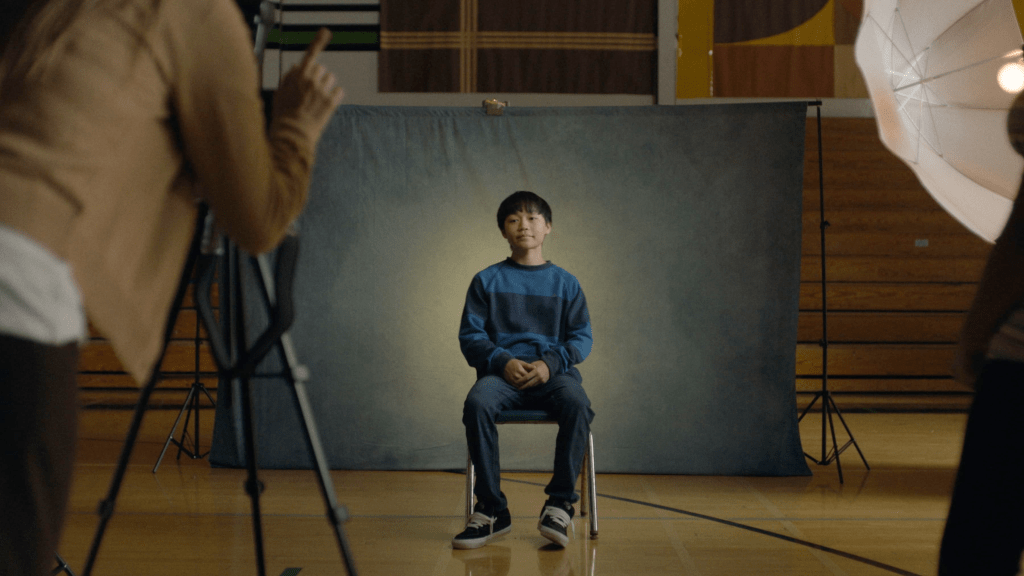
Dìdi (“younger brother” in Mandarin) takes place in the summer of 2008, and tells the story of the 13-year-old Chris Wang (Izaac Wang). He lives together with his mother Chungsing (Joan Chen), her mother in law Nai Nai (Chang Li Hua), and his older sister Vivian (Shirley Chen), whom is soon bound for college at USC San Diego. Most of Chris’s time is spent making silly videos on YouTube with his two best friends. From there alone, it felt like a completely surreal experience for myself, for I was also seeing the exact same era upon which I was also a child, being recreated with such relative ease – to a point of bringing forth all the same discomforts about remembering that period of my life.
That might very well be Sean Wang’s own point. If you were a child, bordering on adolescence in 2008, you probably might also find yourself cringing at the sort of things that you indulged within at that point of your life – and Sean Wang hammers it down. From the casual flinging of racial and homophobic slurs by pre-teens or teenagers who don’t fully get the social ramifications of the usage of such words so frequently, or even the way that such people interact with one another as social media within its early days including how people find means of engaging with silly YouTube videos of the day. I wasn’t exempt from any of this either, and so being reminded of what that period used to be like felt like a shock to my own system too.
Sean Wang keeps a very endearing core to the story being told here. Despite the roughest moments of childhood often taking the center of the screen, going from the bickering between Chris and his older sister Vivian, all the way down to the desire to fit in with other people to a point of feeling embarrassment based on how parents treat them – Wang presents them all in a manner that’s so direct. It’s direct in the sense that it confronts how young people feel within the present, but it’s all done in such a manner where young Chris begins to have a grasp about his own responsibilities as he grows older.
And young Chris’s narrow view of the world around him starts growing slowly, first with the manner of how interacts with others: whether they be a school crush or with family friends. But at thirteen years old, it’s only inevitable that someone of Chris’s age would be more naïve when considering what he wants more out of everyone around himself. This extends to the bickering between himself and his younger sister, which starts out very cruel (he urinates in her lotion, she responds by slapping his face with a used menstrual pad) but they slowly make up before she leaves. But there’s also a point to which it also deconstructs how young people understand what it means to fit in with the “cool kids,” especially when the supposed “cool kids” that Chris looks up to aren’t much different from other kids around themselves despite the image they present.
For writer-director Sean Wang, it’s evident that Dìdi is a semi-autobiographical portrait, even down to having his grandmother, Chang Li Huan playing Chris’s grandmother (Chang Li Huan was the subject of Wang’s Oscar-nominated short documentary Nǎi Nai & Wài Pó). But even looking at this film as a companion piece to said film, it’s also where the film’s highest points come into play. Dìdi finds itself at its strongest when we’re seeing Chris’s relationship with his mother take the center. Joan Chen also brings forth the film’s strongest performance too, especially in moments where she’s trying to make sense of that dissonance between how Chris will grow up versus how she’d seen the world, having grown up in Taiwan – it results in some of the most effectively heartbreaking moments too.
Dìdi feels like it’s tapping into a certain feeling of nostalgia, but perhaps the strongest moments of it come forth when it’s centering specifically around Chris Wang’s own family. In turn, I did wish we’d seen more of his own relationship with Vivian, after how cruel their bickering had started out before they decide to make up – but there’s a very high chance while watching Dìdi that one will find themselves feeling seen. I remember vividly what it’d been like to grow up in the late 2000’s myself, and so I know I’m not immune to nostalgia of that time period. It did sting, though, especially as all these memories had came back to me, and I think Sean Wang did an excellent job at capturing such a period with ease.
Watch the trailer right here.
All images via Focus Features.
Directed by Sean Wang
Screenplay by Sean Wang
Produced by Sean Wang, Josh Peters, Carlos López Estrada, Valerie Bush
Starring Izaac Wang, Joan Chen, Shirley Chen, Chang Li Hua
Premiere Date: January 19, 2024
Running Time: 91 minutes


 Cinema from the Spectrum
Leave a comment