


✯✯✯✯✯
At this year’s edition of the Cannes Film Festival, Payal Kapadia’s All We Imagine as Light has the distinction of becoming the first Indian film to compete for the Palme d’Or in three decades. Being Kapadia’s sophomore feature film, together with her first narrative effort at that, one can’t help but be entranced by the intimacy that can be felt while watching a film of this sort. It’s the sort that just feels incredibly comforting, as we’re moving through life in India’s most populated city, where everything outside can feel so hectic. But for Payal Kapadia, there’s a whole lot more underneath the bustling city, capturing a sense of loneliness and isolation from within. It results in one of the year’s most beautiful films.
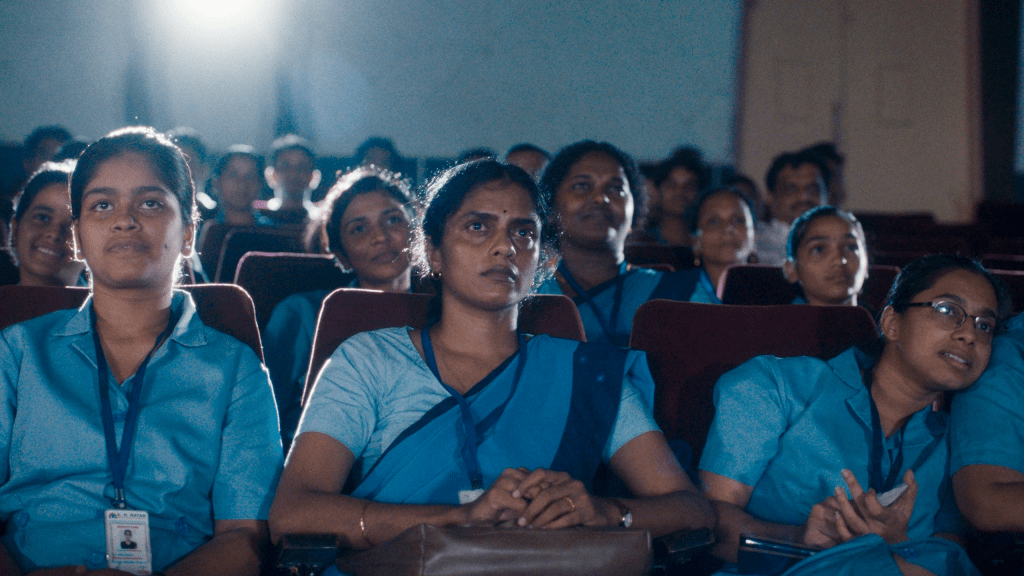
Prabha (Kani Kusruti) and Anu (Divya Prabha) are two nurses in Mumbai who live together as roommates. Prabha is married, but her husband is absent as he went to work in Germany many years ago. Anu on the other hand, being the younger of the two, is much more full of life, and is dating a Muslim boy, which would stir up a scandal within the present-day ruling of the Hindu nationalist Narendra Modi in India. But how these two lives intersect through All We Imagine as Light would only make for a deeply personal portrait at the center, especially in how these two vastly different ideas of intimacy challenge one another.
From the very first frame of All We Imagine as Light, we’re shown a very matter-of-fact picture of the nightlife in Mumbai. But even while there’s almost no personal space to be found on the outside, Payal Kapadia captures a sort of intimacy that almost feels very rare here. It’s rare in the sense that we actually feel that we’re occupying a sense of closeness within a world that’s always so busy, so that it makes this portrait of womanhood so moving. Because she achieves that feeling of wanting to enter a personal space in a city where it won’t ever exist, creating two wholly relatable characters within that process.
With how much of this city is changing so rapidly, it also adds to a melancholy experienced by both Prabha and Anu, as if Mumbai isn’t where the two of them belong. At the same time, it’s all reflective of a wholly conservative background within which they all were brought up. But of course, this is all an aftereffect of life under the ruling of the incumbent Indian Prime Minister Narendra Modi, who had turned the country towards embracing a Hindu nationalist attitude. In turn, much of India’s own population ends up alienated as a result – the only thing left for these people is to continuously look out for each other.
All We Imagine as Light embraces that need to connect with others in trying times, and it’s all the more beautiful as a result. Every minute of this movie feels as if it were made to embrace the bittersweet and melancholic aspects of day-to-day life, but in how the nightlife is captured on the screen, it’s also one of the most visually stunning films of the past few years. There’s not a moment of All We Imagine as Light that didn’t at least appear dreamlike, but perhaps that’s also what makes the whole movie feel all the more melancholic in its depiction of womanhood. It’s a movie all about a reality that perhaps might seem a bit out of reach for such people, only adding to the delicate nature of the work – creating a greater heartbreak underneath.
At the same time, though, it’s not always sad: it’s a movie about the search for happiness where circumstances would seem to work against them. For Prabha, memories of her absent husband are constantly sought after, especially upon receiving a state-of-the-art pressure cooker. Because her husband is staying in Germany for work, the two of them have almost no proper time to talk with one another – and thus it’s the closest thing she can feel to her husband being present in the room again. Meanwhile Anu’s own romantic life is the exact opposite, but would cause a scandal due to social attitudes about a Hindu and a Muslim getting together.
Yet the two of them have so much in common with each other despite this. The two of them speak Malayam and came to Mumbai in order to seek better lives for themselves, but it seems like there’s almost no real space for the two of them to share with each other. But the beauty of Payal Kapadia’s movie comes forth in knowing that this is a movie all about the spaces that feel like they don’t exist, especially as the film moves from the busy city life to a peaceful life in the country.
Films like All We Imagine as Light feel almost like a very delicate bunch within today’s age, but that’s also why the time spent with them is to be treasured greatly. With how easily the film pulls you in with the world that Prabha and Anu occupy through the gorgeous nightlife cinematography by Ranabir Das and the jazzy score, it also places you within a perspective that feels ignored by most. In turn, you’re left with what’s without doubt one among the most beautiful films to come out in recent memory, and one that won’t easily be forgotten.
Watch the trailer right here.
All images via Janus Films.
Directed by Payal Kapadia
Screenplay by Payal Kapadia
Produced by Thomas Hakim, Julien Graff
Starring Kani Kusruti, Divya Prabha, Chhaya Kadam, Hridhu Haroon
Premiere Date: May 23, 2024 (Cannes)
Running Time: 115 minutes




 Cinema from the Spectrum
Leave a comment