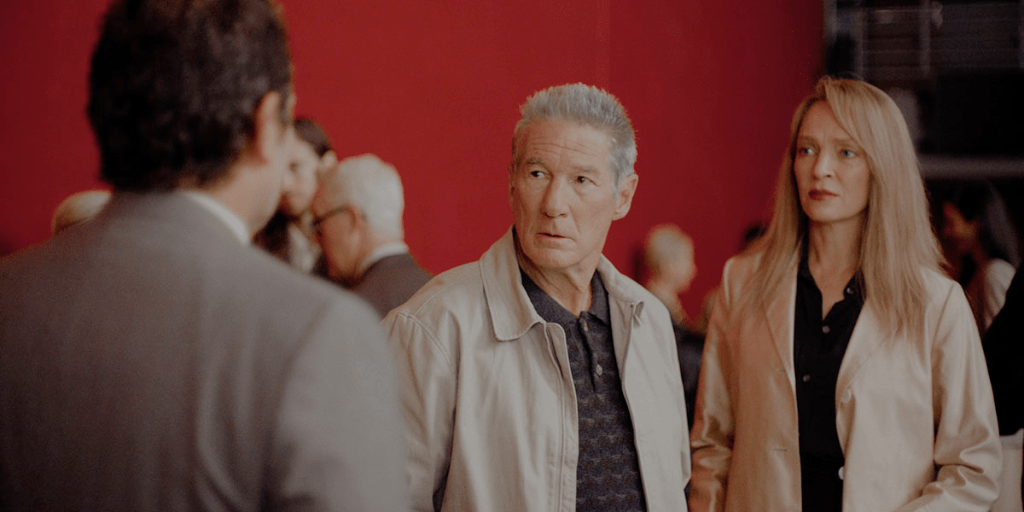

From the start of his career, Paul Schrader has always been a very radical figure within American cinema, through writing some of Martin Scorsese’s best-loved masterpieces including Taxi Driver or Raging Bull, or directing films like Mishima: A Life in Four Chapters or more recently First Reformed. In Oh, Canada, it seems as if Paul Schrader’s own interests lie in how we valorize people who stand for revolutionary beliefs within our world. Frankly, they’re just ordinary people who live ordinary lives after all – but in a country like the United States, the center has only moved so far enough to the right that any actual left-wing attitudes could easily be seen as communist.
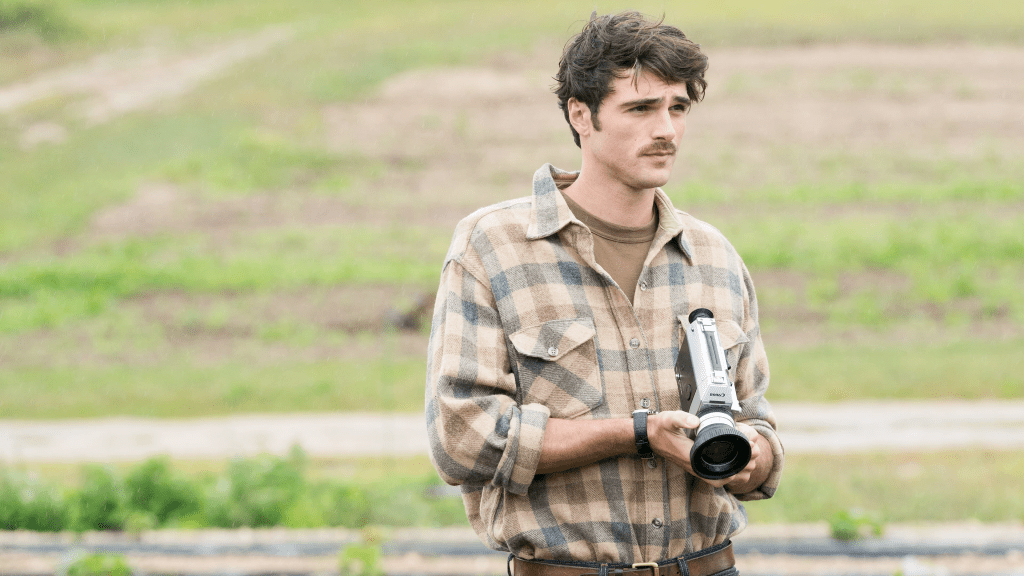
Leonard Fife (Richard Gere) is a left-wing documentary filmmaker who fled to Canada in order to avoid being drafted into the Vietnam War during his youth (Jacob Elordi). Now terminally ill and nearing the end of his life, he agreed to provide a final testimony for a CBC documentary crew seeking to create an honest portrait of his own life. Yet for the ailing and elderly Fife, these recollections of his life ultimately prove themselves to be heavily unreliable due to their apparent distortion of reality. Weaving back and forth between past and present, Oh, Canada seeks to create a demythologized portrait of someone who might be seen as some sort of revolutionary legend – but perhaps it’s the blurring of that line between fact and fiction which only leaves us wondering where such valorization starts.
Oh, Canada isn’t so much a movie about a left-wing legend as much as it is about how far to the right the center of the political spectrum has moved. So for someone like Leonard Fife, who sees himself a very ordinary man with left-wing values, but in the years when American support for the Vietnam War has been pushed forth by both the Democratic and Republican parties, his own disillusionment with a country he lived within became more apparent. It only shows here, that the story of a supposedly “great man” is one that might not just be all that it was cracked up to be, as Fife’s memories slowly come back to him while they also fade away.
This might also be where Paul Schrader might find a means of adding a personal touch to telling this story. It feels like the sort of film that only a filmmaker like him at his age could make, as a means of accepting his own fate, making Oh, Canada feel like a confessional. Through Leonard Fife, Schrader expresses how he never really took the opportunities for further revolutionary activity while people continually view himself as such. Yet his memories of such periods in his life are nothing but blurs.
That alone makes Richard Gere’s role in here particularly melancholic, but Jacob Elordi’s own counterpart to the legendary American actor to play Fife in his youth is also rather extraordinary. With how much of the film is told in flashbacks, Fife inserts his older self into these fragments of his own life in order to show how he did not lead such an honest life – but wonders if that it might be too late to change his ways. In his youth, he was a womanizer who fancied himself an intellectual, but as he got older, he wanted the opportunity to grow wiser.
We won’t ever fully know Leonard Fife the way that he’s presented. Even through the flashbacks where we’re seeing the sort of life he chose to live, it’s easy to see why he’d be propelled to legendary status, especially if the sorts of films he had made reflected how he saw the world. The same can be said for Paul Schrader himself, especially over his long career, as he’s also well-known to many cinephiles as being the writer of some of Martin Scorsese’s most beloved films. But we don’t ever really know what such people are like outside of the work they present, let alone how it spoke to so many people all these years later.
It all makes Oh, Canada feel very poignant – though one can’t help but feel with the disorienting manner in which this story is told, how much of what we’re seeing is built from truth. Leonard Fife isn’t a reliable narrator, but for Paul Schrader, he also doesn’t need to be. There are many ideas in Oh, Canada that are touched upon, especially with the means of which a revolutionary figure can be formed not through a man’s actions but how the political center moves further to the right over the years, but are not explored fully enough. But even that might be where Oh, Canada becomes a victim of its own structuring, even if it’s the only way it can be told. Still, as a portrait of one’s own disillusionment with their own country’s political strides, it is very powerful.
Watch the trailer right here.
All images via Kino Lorber.
Directed by Paul Schrader
Screenplay by Paul Schrader, from the novel Foregone by Russell Banks
Produced by Tiffany Boyle, David Gonzales, Meghan Hanlon, Scott LaStaiti, Luisa Law
Starring Richard Gere, Jacob Elordi, Uma Thurman, Victoria Hill, Michael Imperioli, Penelope Mitchell, Kristine Froseth
Premiere Date: May 17, 2024 (Cannes)
Running Time: 91 minutes


 Cinema from the Spectrum
Leave a comment