
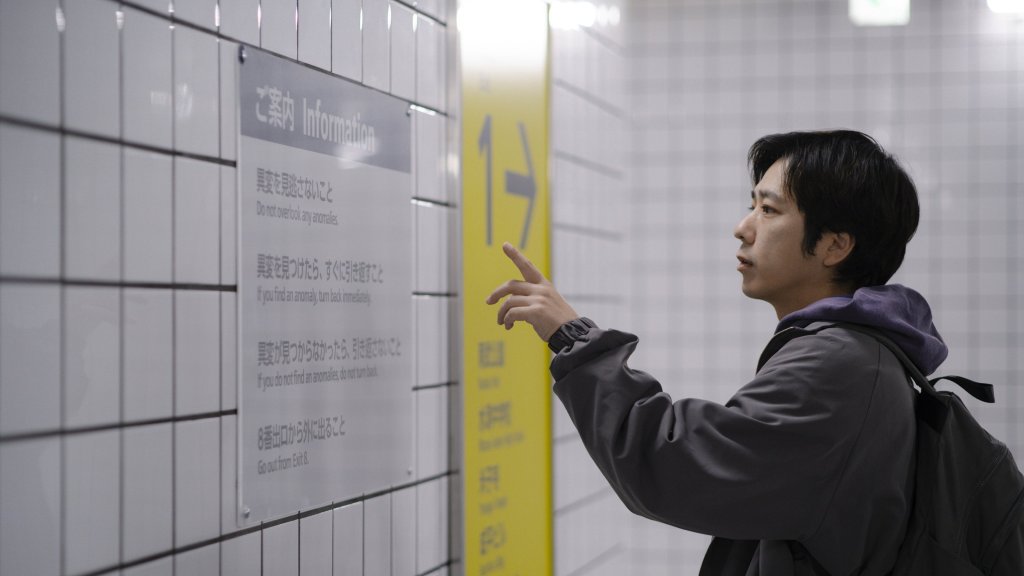

When I sat down with fellow critics at the press screening of Exit 8, we quickly noticed some anomalies; quite fitting, in hindsight. First, the film began with no sound. That was soon corrected. The second attempt played without subtitles; assuming this was an artistic choice by director Genki Kawamura, I watched on, until we were informed a subtitled version did in fact exist. Finally, on the third go, everything ran smoothly. Why mention this? Because Exit 8 itself is built on anomalies, things that feel slightly off, different from what you expect.
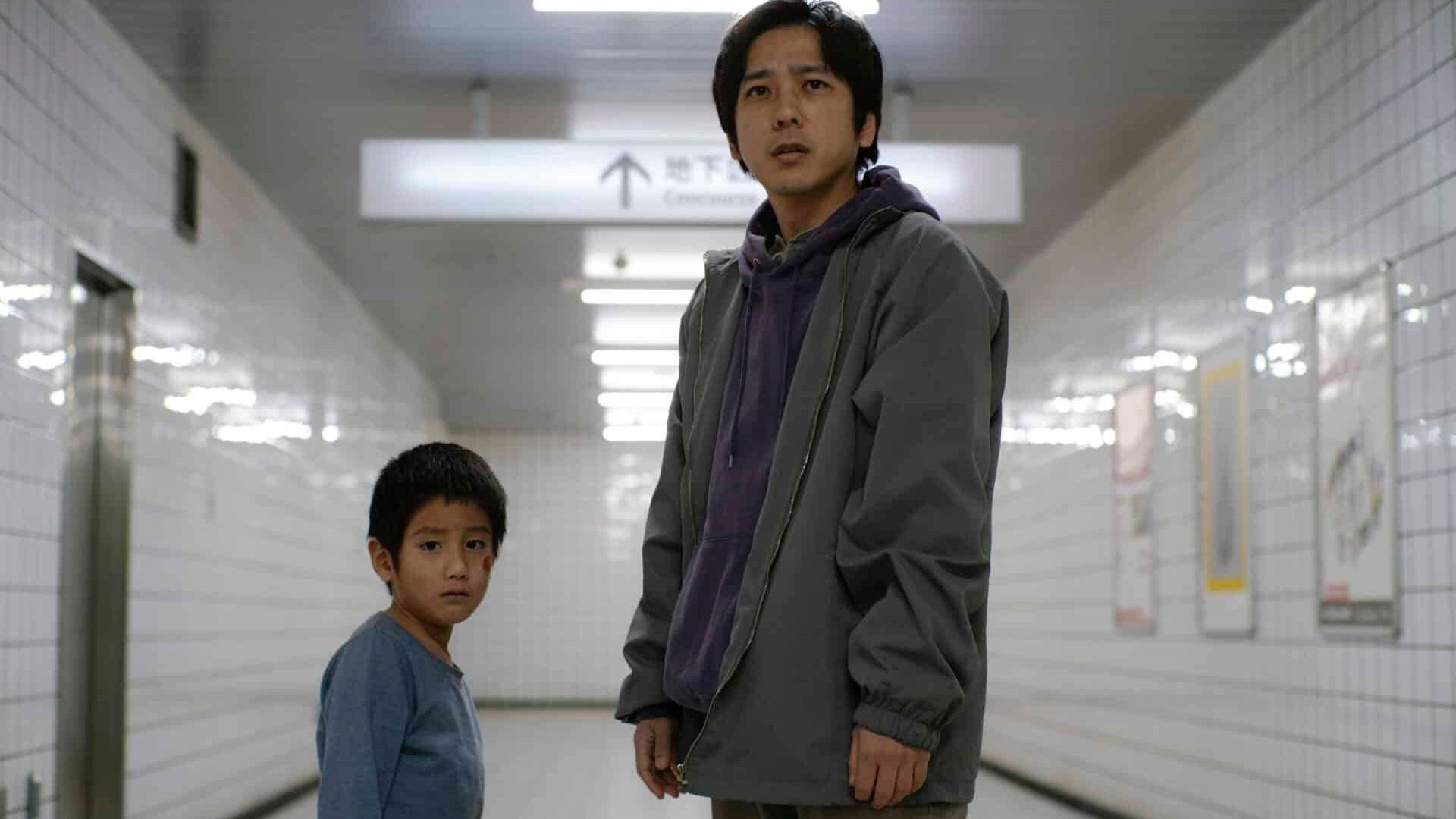
The film is based on the 2023 video game The Exit 8 by KOTAKE CREATE. The game’s premise was deceptively simple: players walk down a seemingly endless passageway, tasked with spotting anomalies before moving into the next corridor. Miss one, and you’re sent back to Exit 0. Eventually, persistence leads you to Exit 8 and the end of the game. One of the most memorable mechanics was a lone “Walking Man,” an NPC who marched forward endlessly, only stopping if the player physically blocked his path. A straightforward 20-minute game, so how could this possibly translate into a feature-length film?
Kawamura’s adaptation begins with Maurice Ravel’s Boléro. The piece is famous for its unchanging rhythm, with only the instruments above it shifting, an apt metaphor for a story about loops and subtle variations. We’re soon in the Tokyo subway, where we meet the protagonist known only as “The Lost Man” (Kazunari Ninomiya, familiar to Western audiences from Letters from Iwo Jima). Before long, he too is trapped in the endless corridor. The “Walking Man” (Yamato Kochi) also returns from the game, though here Kawamura expands on his backstory, giving a human dimension to what was once just a passing figure.
The anomalies themselves are borrowed directly from the game, with some variations. Yet the film is not simply an exercise in replication; it uses the game’s framework to probe larger themes. Kawamura, making only his second feature after 2022’s A Hundred Flowers brings with him a remarkable pedigree as a producer for anime auteurs like Mamoru Hosoda (Wolf Children through Belle), Makoto Shinkai (Your Name., Weathering With You, Suzume), and Naoko Yamada (The Colors Within), as well as Hirokazu Kore-eda’s Monster. Here, he explores the human condition through repetition: our tendency to remain stuck in cycles, unable or unwilling to break free. The title itself hints at this: turn the number 8 on its side, and it becomes the infinity symbol, a visual metaphor for the film’s looping structure.
Later, we meet another key figure, “The Schoolgirl,” (Kotone Hanase) who muses on how life might feel like “hell” if it were nothing more than endless repetition. Kawamura even hints at Dantean imagery like spirals, staircases, and a symbolic shell that becomes central to the film’s meaning.
It’s rare to see a video game adaptation programmed at TIFF, but Exit 8 is no ordinary adaptation. Its source material, minimalist yet strange, gives Kawamura room to explore philosophical ideas while still engaging audiences with eerie tension. Keisuke Imamura’s cinematography enhances this by favouring long, continuous takes that simulate real time, interrupted only sparingly by cuts. Dialogue is sparse, but it feels deliberate and fitting for this hypnotic setting. Personally, I was left wondering how the production team designed the set, how many physical loops were actually built, and how much was cinematic trickery.
At 95 minutes, Exit 8 is brisk, efficient, and effective. It neither overstays its welcome nor cuts corners, culminating in an ending that challenges viewers to reflect on their own cycles and whether they’re ready to break them.
Watch the trailer right here.
All images via NEON.
Directed by Genki Kawamura
Screenplay by Genki Kawamura, Kentaro Hirase, from the video game The Exit 8 by KOTAKE CREATE
Produced by Yoshihiro Furusawa, Minami Ichikawa, Taichi Ito, Genki Kawamura, Yuto Sakata, Taichi Ueda, Kenji Yamada and Akito Yamamoto
Starring Kazunari Ninomiya, Yamato Kochi, Naru Asanuma, Kotone Hanase, Nana Komatsu
Premiere Date: May 19, 2025 (Cannes)
Running Time: 95 minutes






 Cinema from the Spectrum
Leave a comment