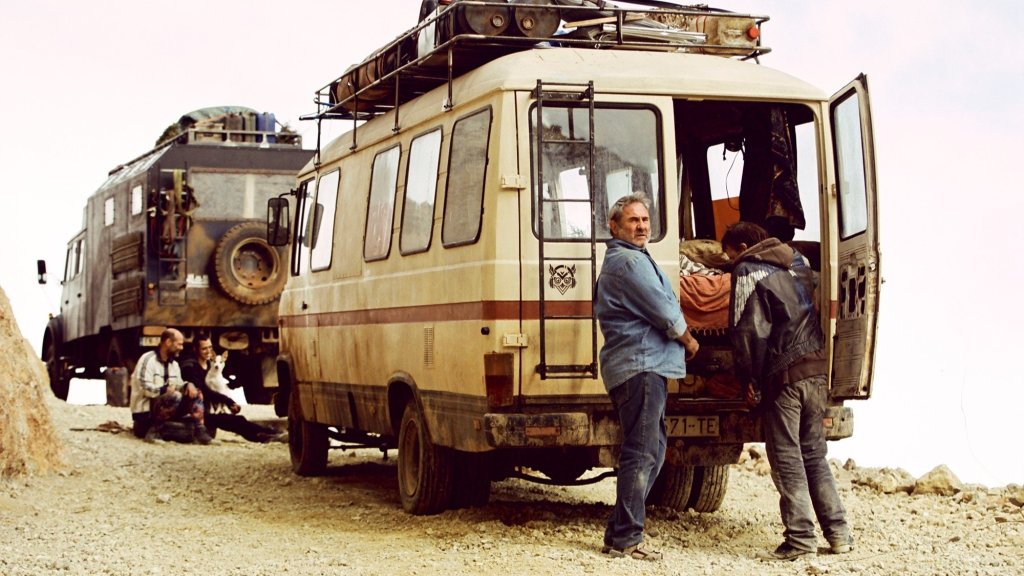

With recent world events, the question of how to survive when the world around us feels like it is crumbling has become more pressing than ever. Sirāt, the fourth film by French-born Spanish filmmaker Óliver Laxe, carries a title with layered significance. In one sense, Sirāt refers to the bridge in Islamic tradition that every soul must cross on the Day of Resurrection, suspended over Hell with Paradise waiting at the other end. In another sense, Sirāt can mean “to travel” or “to be on a journey,” reflecting the film’s focus on the physical and existential passages of its characters. Both meanings are present in the film’s narrative: the desert crossings, the uncertain survival of its travelers, and the transformative experiences they endure mirror a journey across a perilous, metaphorical bridge between destruction and renewal.
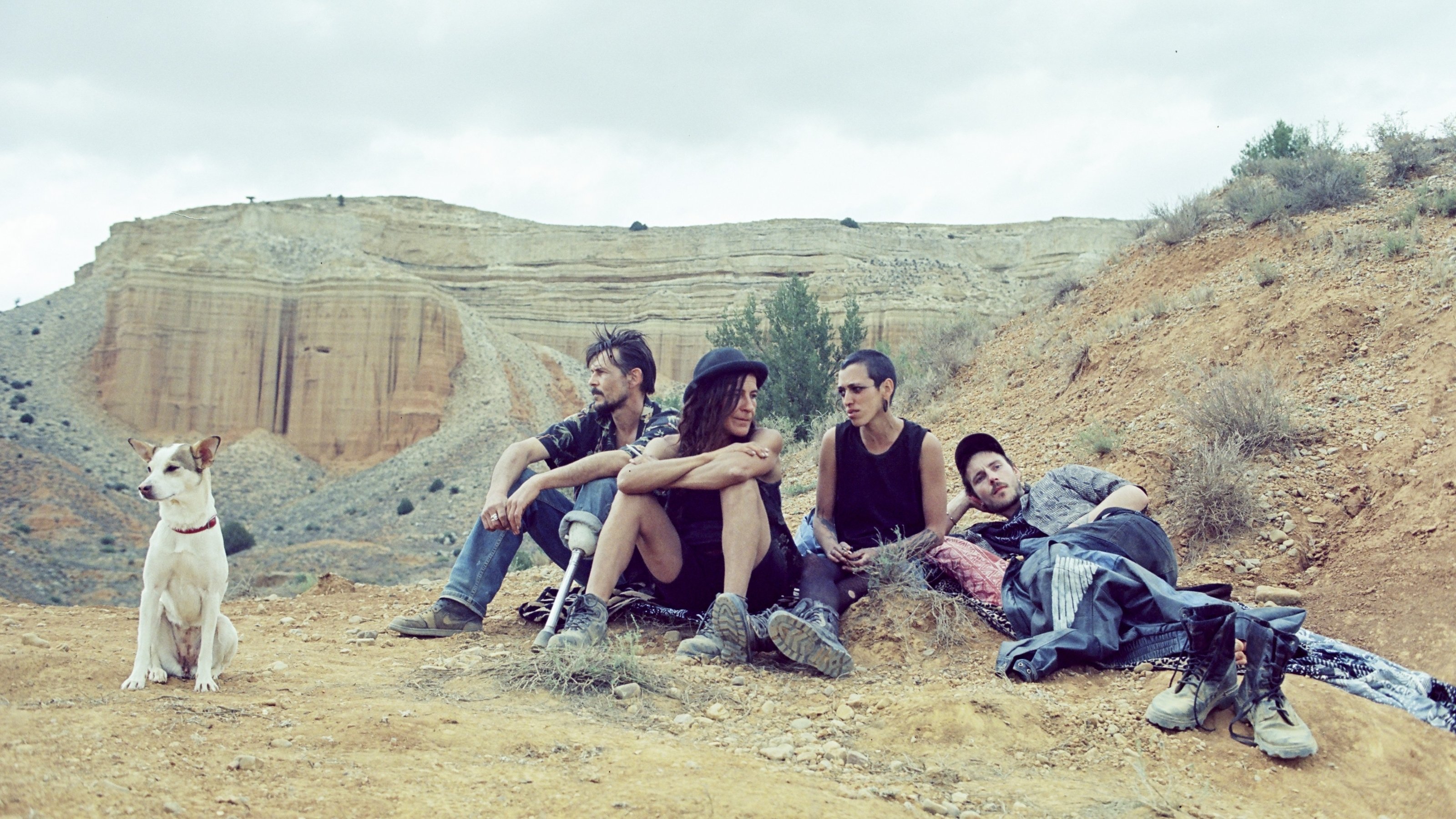
The story begins with a rave in the Moroccan desert, where a crowd of strangers is drawn together by pounding music and neon light. It feels both ecstatic and ominous, recalling the sensory intensity of Gaspar Noé, not in content but in its merging of music, movement, and camerawork. Among the partygoers are five central characters playing versions of themselves: Stefania Gadda, Joshua Liam Henderson, Tonin Janvier, Jade Oukid, and Richard Bellamy, who goes by “Bigui.” They soon cross paths with Luis, played by Sergi López, traveling with his young son Esteban (Bruno Núñez Arjona) and their dog Pipa, on a search for Mar, Luis’s missing daughter.
The euphoria abruptly collapses when soldiers storm the rave, announcing that all EU citizens must be evacuated. The group flees together, and soon their journey across the desert takes on a desperate, survivalist quality. As news of global war filters in through radio static, the film begins to echo Henri-Georges Clouzot’s The Wages of Fear and William Friedkin’s Sorcerer, while its gradual abandonment of the central search recalls Michelangelo Antonioni’s L’Avventura.
Laxe fills this world with striking symbolic details: a CRT screen showing pilgrims on the Hajj, Esteban quietly having his hair cut in the desert, and Jade’s insistence that “the music is not for hearing, it is for dancing” as she collects a battered speaker she refuses to discard. These fragments of imperfection, echoed by Tonin’s missing leg and Bigui’s deformed hand, underscore a recurring theme of finding beauty in what is flawed or damaged.
Visually, Sirāt is breathtaking. Mauro Herce’s cinematography captures the Moroccan desert with both stark grandeur and fragile intimacy. The night sequences are especially unforgettable, bathed in headlights and shadows that recall The Wages of Fear. Kangding Ray’s electronic score, his debut for cinema, pulses with a harsh, hypnotic energy that mirrors both the rave and the desolation of the desert. It is no surprise the soundtrack won honors at Cannes.
The ensemble cast delivers raw, compelling performances. Most of the non-professional actors bring an unfiltered presence, while López and Núñez Arjona provide emotional depth as father and son. Yet identity itself remains unstable. The film hints at transformations that blur the lines between loss, recognition, and becoming. Characters you come to care for may not survive, and the narrative resists easy closure.
By the end, what remains is not resolution but imagery that lingers: a sunset between broken speakers, the sensation of crossing fragile terrain, and a final movement that feels at once haunted and transcendent.
Sirāt is both a survival story and spiritual parable. It is about war at the edges of perception, about identity in flux, and about the fragile passage across a bridge between destruction and renewal. Laxe, Herce, and Kangding Ray have crafted a film that is as harrowing as it is beautiful, a work that lingers like a vision of judgment and transcendence.
Watch the trailer here.
All images via NEON.
Directed by Óliver Laxe
Screenplay by Óliver Laxe, Santiago Fillol
Produced by Agustín Almodóvar, Pedro Almodóvar, Domingo Corral, Xavi Font, Esther García, Óliver Laxe, Oriol Maymó, Mani Mortazavi, César Pardiñas, Andrea Queralt
Starring Sergi López, Bruno Núñez Arjona, Stefania Gadda, Joshua Liam Henderson, Richard Bellamy, Tonin Janvier, Jade Oukid
Premiere Date: May 15, 2025
Running Time: 115 minutes

 Cinema from the Spectrum
Leave a comment