
During this year’s Toronto International Film Festival, I noticed some discussion around the fact that the festival has truly become a hot spot for actors-turned-filmmakers. Some went as far as to call it a dumping ground for their “vanity projects.” Whatever you want to say about Scarlett Johansson’s Eleanor the Great, which had already premiered in the Un Certain Regard section at Cannes before heading to TIFF, I think it would be a grand mistake to give it such a term. It’s a lot stranger than that.

In fact, there’s a part of me that regrets not making the time to see it at TIFF this year, and that’s really only because I didn’t get to look around and see the collective shock on everyone’s faces the moment this seemingly cute film reveals what it’s actually about. It’s built around a lie so heavy that I almost respect it for its ambition. If only the film didn’t fumble it from there.
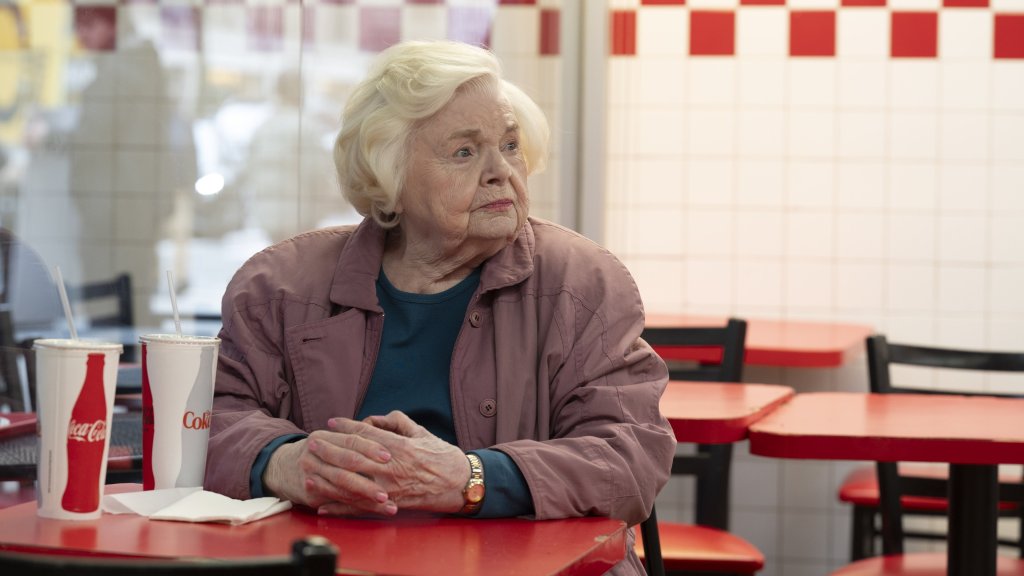
The premise goes like this: We meet our 90-year-old woman, title protagonist (June Squibb) in Florida, where she’s lived for decades alongside her best friend Bessie (Rita Zohar) in a shared home after their respective husbands passed. As composer Dustin O’Halloran’s intimate piano solo (one of his signatures) kicks in, we get a glimpse of their history together through framed photographs, as well as their daily activities, which include watching their favourite news anchor Roger (Chiwetel Ejiofor) on the evening news. It’s actually quite charming.
But when Bessie suddenly dies, Eleanor is keft adrift in her life at such a late stage. So, she moves back to New York City, living with her daughter Lisa (Jessica Hecht) and teenage grandson Max (Will Price) – both of whom are far too busy with their own lives to take care of her. So, at Lisa’s behest, Eleanor attends the JCC and accidentally walks into a support group for Holocaust survivors. When she’s immediately mistaken as a new member. Eleanor shares Bessie’s harrowing story to the group as if it were her own, reaching back into her memory (in an effective moment of editing by Harry Jierjian, we see Bessie tell the story) to do so.
The story catches the attention of college journalism student Nina (Erin Kellyman), who’s dealing with the loss of her mother. From there, she asks Eleanor if she could write a paper on her, and the two become friends. But as the lie gets bigger for Eleanor, especially when Roger (who is Nina’s father) gets tangentially involved, it’s only a matter of time before the truth comes out.
From the jump, you know that Eleanor’s lie will catch up to her, especially because it’s so offensively wrong. And if this didn’t attempt to be less easygoing, it might’ve tried to actually deepen its themes of the ways some deal with grief and how it intersects with confused Jewish identity. But that’s obviously not what the movie is. If there’s any real tension, it’s less from wondering how the truth will come out and more from wondering how Johansson and first-time screenwriter Tory Kamen will successfully marry that premise with that kind of tone without causing even some whiplash. They don’t. Not really.
It’s especially a problem when we get to the third act, where it drops whatever comedy it initially presented and becomes the most treacle version of itself – with big, tearjerking speeches and everything. At that point, it’s truly hard to ignore all the problems Kamen’s script has presented early on, especially when they could’ve easily been solved or rectified sooner if one of the characters bothered to make even one logical decision.
The shame is, even with that bizarre cloud hanging over it, you do get a little lost in its charms. And some of that credit goes to Johansson as a director. While she definitely has room to grow technically (her utilization of the great French cinematographer Hélène Louvart is unfortunately plain), she does know how to let her actors shine. At 95, Squibb – in only her second leading role following Thelma last year – brings a lot of delightful prickliness to the part, as well as some depth that isn’t really on the page. It’s enough to make you feel even some empathy for Eleanor as a protagonist, despite her offensively big mistake.
The same can be said for Erin Kellyman. Even though the script renders her character a fool (she’s a journalism student who doesn’t do any research on her subject), Kellyman still manages to bring some likability to the part. She and Squibb have fairly nice chemistry with each other as well. Supporting turns from Ejiofor and Hecht do a fine job deepening (as much as they can) the relationships they have with the respective protagonists, and how they’ve changed over time.
There certainly isn’t a lack of good (or even decent) stuff sprinkled throughout Eleanor the Great, and it’s obvious that those involved had the best intentions upon making it. But sometimes, the road to hell is paved with good intentions. It’s not that bad a movie, to be very clear. It’s just fascinatingly and strangely misguided. For a directorial debut from one of the most famous actors working today, I suppose that’s not nothing of a start.
Watch the trailer right here.
All images via Sony.
Directed by Scarlett Johansson
Screenplay by Tory Kamen
Produced by Scarlett Johansson, Jonathan Lia, Keenan Flynn, Trudie Styler, Celine Rattray, Jessamine Burgum, Kara Durrett
Starring June Squibb, Erin Kellyman, Jessica Hecht, Chiwetel Ejiofor
Premiere Date: May 20, 2025 (Cannes)
Running Time: 98 minutes


 Cinema from the Spectrum
Leave a comment