
In 2012, Andrew Stanton branched out from his work at Pixar into live-action filmmaking with John Carter. Although said film was a notorious box office bomb upon release, losing Disney over $200 million adjusted for inflation, it still presented a sense of ambition that seemed rare in the blockbuster landscape. Said ambition was present in his work at Pixar, for it brought him to new heights when he directed WALL-E, which may very well be the best film the studio has produced since the first Toy Story. That’s more than enough to get you a sense of what he’s trying to channel with In the Blink of an Eye, but it feels like a very bizarre step backwards.
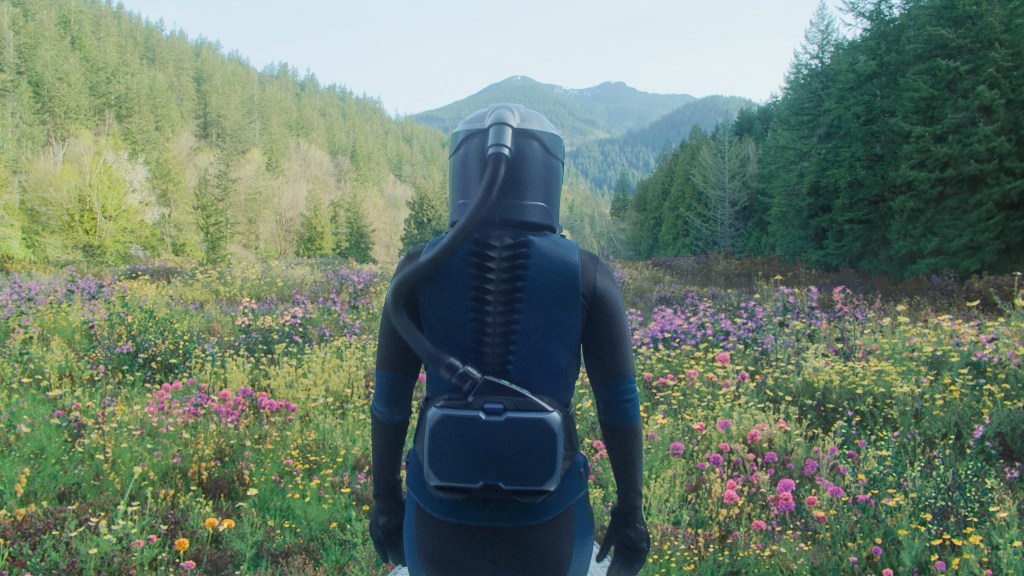
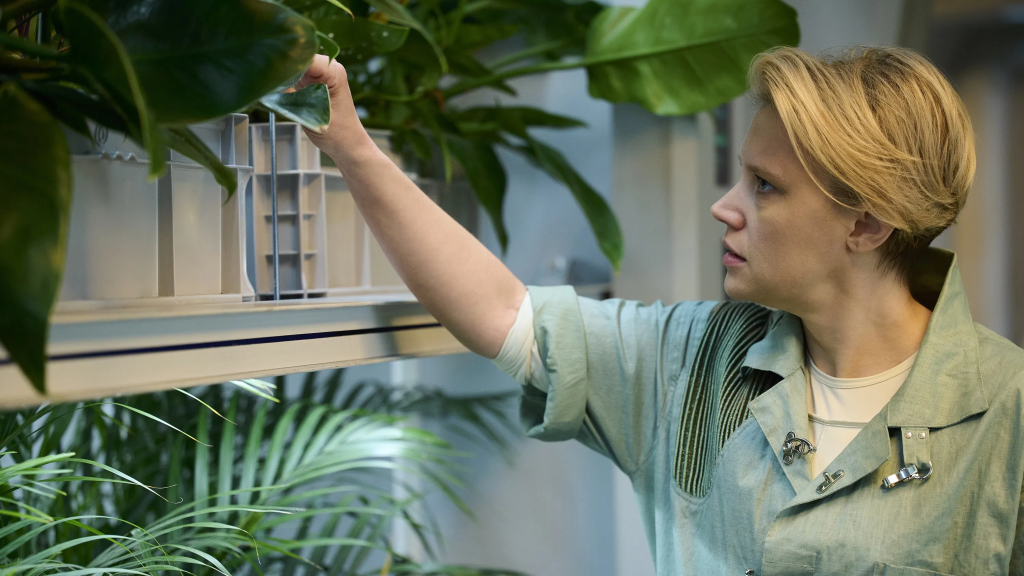
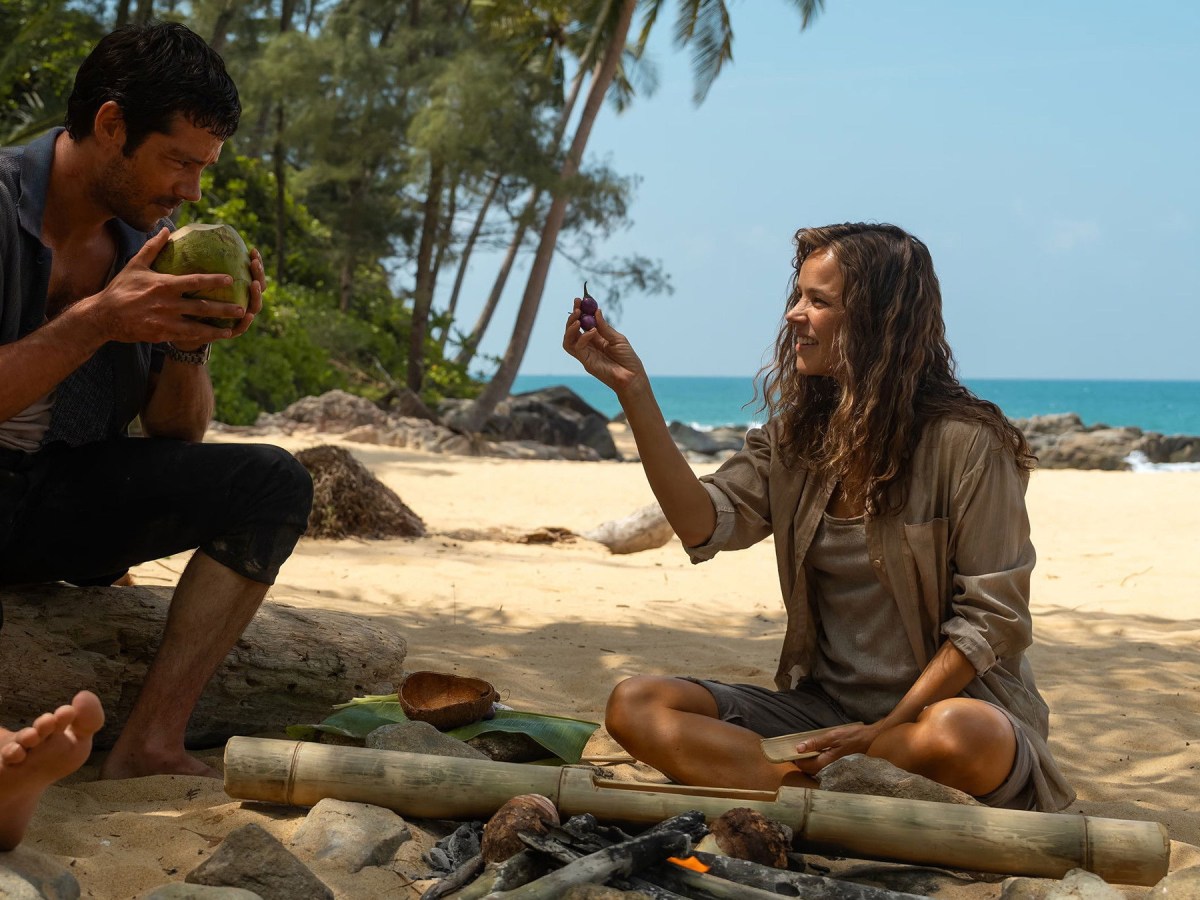
Three parallel stories comprise In the Blink of an Eye: one is set in 450,000 B.C., another is set in what appears to be the present day, and the last is set in the far off future. To what end are these stories connected, you may ask? It all seems like you’ll get an answer sometime, in a manner akin to Cloud Atlas. As the film goes on, it’s something that remains on your mind as we see that these narrative threads are running parallel to one another. In the story set many years in the past, we have a family of Neanderthals, trying to survive. The present day story focuses on Claire (Rashida Jones), who is studying the bones of an ancient man, supposedly the Neanderthals. And lastly, the story far off in the future centers Coakley (Kate McKinnon), the only human passenger on a space station heading to some distant planet. It doesn’t take long to see where the narrative throughline is present, as mortality is on the line. However, it’s also where it all seems to come undone, considering what it all circles back to.
One can’t fault Andrew Stanton for being an overtly ambitious storyteller, especially when it’s been vital to his success at Pixar Animation Studios. Yet, it seems like he has trouble adapting many of those same sensibilities between the mediums of animation and live action, especially with how In the Blink of an Eye’s parallel storylines never coalesce with much meaning. And it’s easy to see why someone would believe in this idea of interconnectedness through the eras, especially when the Wachowskis and Tom Tykwer took on the task of adapting David Mitchell’s Cloud Atlas. Unfortunately, it seems like the blame lies solely on Colby Day’s script, which never seems to have much interest in exploring the science behind the mortality that brings these three narrative threads together.
It’s hard to resist making the connections to Cloud Atlas, especially with the notion of connected storylines that make up the triptych we’re seeing. Alas, with a very short runtime of 94 minutes including the credits, it seems like it’s rushing through the facts without really letting much sink in. At the very least, it seems like Stanton’s accomplished something more thoughtful with the Neanderthal story. This is first felt in its little dialogue, but it pulls you in with relative ease as you’re also being made to watch the development of human ability to persevere through tough times. It’s a very simple connective tissue for both the present-day and future story threads, given that in Claire’s story, we’re seeing her choose between her work and the people she loves after her mother develops cancer. That same intrigue can’t be said about the future storyline, especially when its naive optimism about humankind’s ability to coexist with technology just paints a bleaker picture altogether.
Still, one has to admire that Andrew Stanton is trying to accomplish something with such massive stakes on a considerably smaller budget than John Carter. He knows how to hit the same emotional registers in the viewers, especially given the heavier moments in both WALL-E and Finding Nemo. With Thomas Newman scoring, you know that it’s set to hit at some point or another, especially while his music is always relaxing to the ear. Yet, that’s also where Stanton ends up playing the hits all over again. Everything here just feels heavy-handed, given how many of these registers are delivered via monologues. It all feels so stiff, almost as if you’re coming out of a lecture. Yet, with only 94 minutes to spare, we don’t have enough time to let anything coalesce into anything meaningful. It just comes and goes, without ever leaving much of a mark.
All one can really ask themselves is, how can the same genius behind WALL-E, which offered a very hopeful outlook for humanity’s future in a world driven by capitalism, make something as trite as this? You can’t solely put Andrew Stanton at fault, especially if he doesn’t take this material lightly. That’s not to say that there’s no value to In the Blink of an Eye, because it seems like Stanton is the kind of filmmaker who saw potential to these musings about mortality. Worst of all, this naive optimism upon which In the Blink of an Eye is built on seems to point back towards something more insidious. And it certainly doesn’t help that Andrew Stanton is as well-meaning as he is, either. Instead, it just hurts that this was the result.
Watch the trailer right here.
All images via Searchlight Pictures.
Directed by Andrew Stanton
Screenplay by Colby Day
Produced by Jared Ian Goldman
Starring Kate McKinnon, Rashida Jones, Daveed Diggs
Premiere Date: January 26, 2026 (Sundance Film Festival)
Running Time: 94 minutes
 Cinema from the Spectrum
Leave a comment