
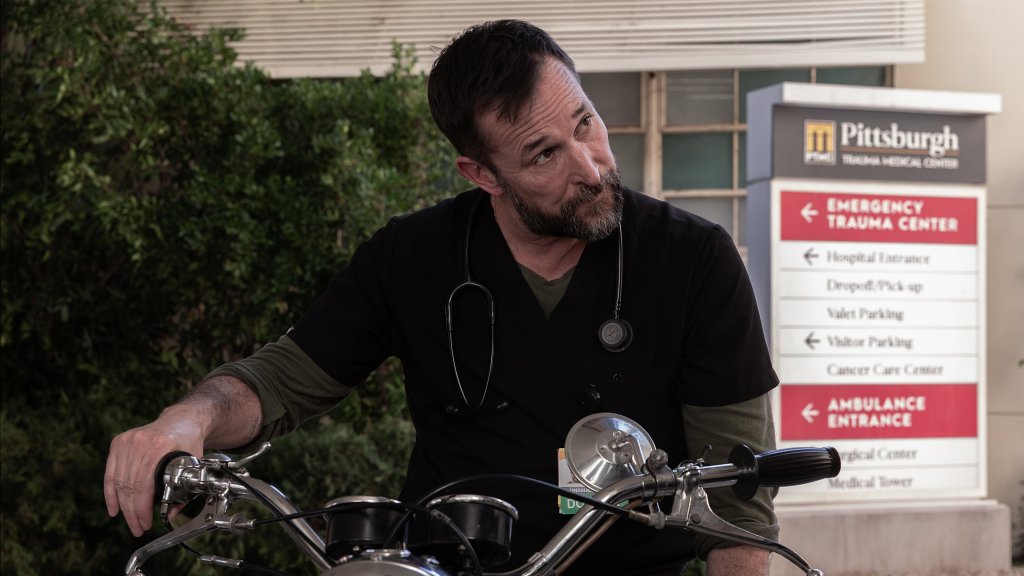

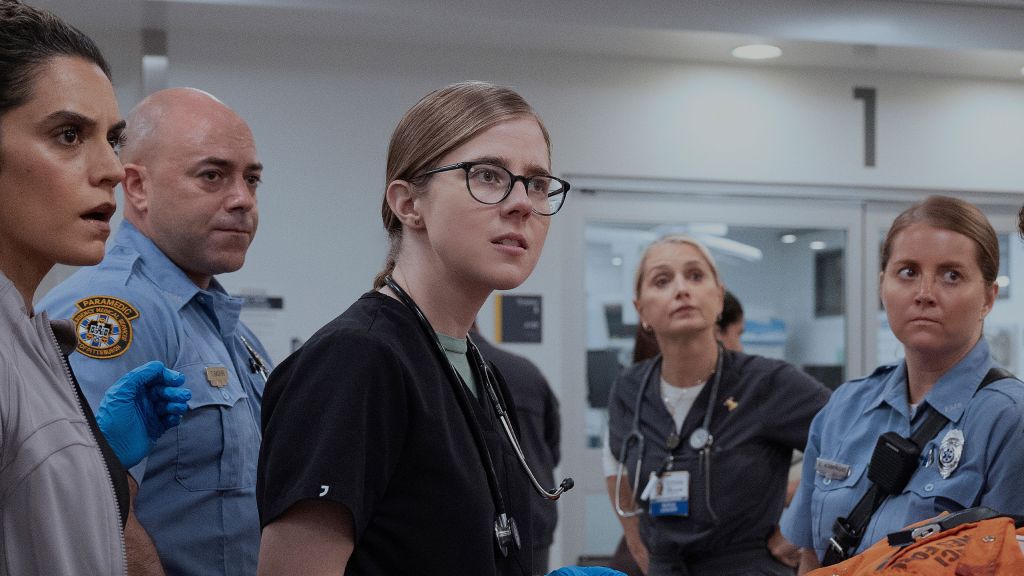
After a critically acclaimed first season, Season 2 of The Pitt settles into a different rhythm and focus. The medical cases remain as graphic as ever, but the tension shifts toward the staff in the Pittsburgh Trauma Medical Center ER rather than the patients. That shift becomes palpable when a cyberattack sends the hospital into a system-wide shutdown. With the monitors no longer working, the staff is forced to rely on a whiteboard, and without access to patient records, the illusion of control disappears instantly.
The planned sabbatical of Dr. Michael “Robby” Robinavitch (Noah Wyle) looms over the show; a major question lingers: “Is he actually going to leave?” A lot of the staff think he’s bluffing and that Robby intends to stay. Resident surgeon Dr. Yolanda Garcia (Alexandra Metz) says, “I’ll see you next week.” Towards the latter half of the season, the thus far unflappable Robby begins to crack, snapping at his colleagues. His patience dwindles, and his tone becomes harsher with a need for control of his environment, including his issues trying to get his motorcycle buddy Duke (Jeff Kober) through the ER bureaucracy.
Among the most revealing dynamics this season is Robby’s increasingly combative relationship with no-nonsense charge nurse Dana Evans (Katherine LaNasa, who won an Emmy for this role last season). Their interactions underscore Robby’s need for control, the mounting strain he’s under, and a growing doubt about where he wants to stay beyond his sabbatical. Dana is the glue holding that system together, but even she is forced to step away from the desk as one of the only Sexual Assault Nurse Examiners (SANE) on duty. Eventually, the strain begins to shape their decision-making. When she steps in to protect a nurse during a violent situation, it leads to another confrontation with Robby, one that reveals a fundamental divide in how they understand the risks and responsibilities of the ER. It also makes clear that the real conflict is no longer the cases but the people treating them.
This season introduces a second attending physician to the ER, Dr. Baran Al-Hashimi (Sepideh Moafi). She is initially characterized as rigid and demanding, defined by her strict commitment to protocol and control, particularly in her advocacy of AI in the workplace. Over time, we see her reasoning behind her willingness to accept a 2% margin of error. Her experience with Doctors Without Borders has taught her that medicine is managing risk at scale. While the system is imperfect, she believes it can save more lives than hesitation ever could. Robby operates as a reactive physician, responding to crises as they unfold, while Al-Hashimi takes a preventative approach, focused on anticipating problems before they escalate, making the contrast between them compelling. That contrast becomes more complicated when her seizure disorder is revealed, raising ethical questions and concerns about her ability to continue in such a high-pressure role.
Another key theme of the season is the breaking point of American healthcare. What we ultimately see is that Dr. Samira Mohan (Supriya Ganesh) reaches that breaking point, and it is through her that the growing divide within the ER comes into focus. Robby’s insistence on pushing forward, even as the strain becomes unbearable, places him increasingly at odds with colleagues who recognize the need to step back, exposing a fundamental conflict between endurance and self-preservation.
The cyberattack story line connects much of the season. With the hospital’s electronic systems down, the ER must revert to a more analog approach. Having been flipping back between ER and The Pitt, I could see the old whiteboard approach that used to be common in hospitals rather than the digital boards. The loss of access to medical records means that errors become easier to make and harder to catch. We find out later in a future episode that being unable to access medical health records is an issue that costs them a patient. While the hospital does adjust to this change, albeit not easily, it’s clear how reliant it has become on technology.
We start to see the doctors’ personal lives bleed into their work. Dr. Mel King (Taylor Dearden) spends much of the shift balancing her work with two major issues. One is the fact that she’s been named in a malpractice suit related to a measles case from the previous season and faces a deposition during the day. She also has to worry about her sister Becca (Tal Anderson), who is autistic and requires support. As a publication with autistic writers, I think this moment is important to highlight because I found myself siding with Becca, as she asserts her independence even when Mel thinks she’s helping. While it may seem small, all these little moments once again show a similar theme of control and autonomy that threads the season.
Victoria Javadi (Shabana Azeez) faces a case in the ER involving her mother, Dr. Shamsi (Deepti Gupta), one of the attending surgeons. Robby pushes her to establish herself on her terms. Victoria’s moments add up, and this season reinforces that authority must be earned and not given. This particular moment becomes evident in Robby, whose need for control both defines and undermines his authority, once again reflecting the season’s contrast between authority and autonomy.
Dr. Trinity Santos (Isa Briones) begins to show signs that the pressure is affecting her more deeply as tensions reach their boiling point with fellow resident Dr. Frank Langdon (Patrick Ball), who is trying to regain trust after battling addiction to lorazepam and librium, drugs that he was stealing from the hospital pharmacy. It’s made abundantly clear that time has not healed all wounds, and Santos is less than thrilled. Langdon insists he is trying to improve and reestablish himself within the team, though Santos is less willing to overlook his history under mounting stress.
What makes Langdon’s arc compelling is he represents a mirror version of Robby. He has confronted his issues and has sought help, which features in a conversation in the last episode that illuminates how he is emotionally ahead of Robby, who is literally running or, in this case, driving away from his problems. Dr. Cassie McKay (Fiona Dourif), feels like one of the few steady presences, often slowing things down and advocating for patients when others rush. Despite hints of a more complicated past in earlier seasons, Dourif is given less to do this season, aside from storylines involving a cancer patient and her practice of street medicine.
Dennis “Huckleberry” Whitaker (Gerran Howell) is now a doctor and has two medical students of his own, James Ogilvie (Lucas Iverson) and Joy Kwan (Irene Choi). After serving as the butt of many jokes last year, where it seemed nary an episode would go by without some kind of fluid getting on him. Dr. Whitaker emerges as a surprisingly stabilizing force in the ER, and Robby views him as a potential successor.
As the shift continues, the pressure manifests in the environment itself. Hallways grow crowded and the waiting room fills, and by the final episode it becomes clear that the waiting room, itself, is a serious problem, contributing to the death of a patient who never receives treatment. External factors add to this instability, introducing complications that the staff struggles to manage in the same way they handle patients.
The recurring presence of a Baby Jane Doe case and an emergency C-section in the final episode take on meaning. For Robby, it becomes more than just another patient. In a season where he openly questions what he has outside of the ER, the child represents another issue left unresolved: the life he never built. Again, the themes of being in control despite being a reactive doctor come into play with issues that only he can respond to. It’s a subtle but important shift, suggesting that even as he continues to function within the system, something in him is beginning to change.
Even as the hospital starts to regain some order, the day has clearly affected the staff. By the final episode, the strain surfaces in every major character. Javadi observes that nearly every member of the staff is visibly affected, with Whitaker the lone exception. At the same time, we see moments of connection form between Dr. King and Dr. Santos in a scene where they are belting out Alanis Morissette’s “You Oughta Know.” The sequence also marks the first time the camera moves beyond the hospital in the series.
The Pitt makes its central idea clear over the course of the season: working in the ER is a constant test of endurance. One that ultimately reveals who is capable of staying, who needs to step away, and who is already past that point, even if they cannot admit it to themselves. By the finale, the chaos of the day gives way to something more introspective, leaving key questions unresolved as the series looks ahead. That direction is made explicit by Noah Wyle, who described the guiding idea for Season 3 as “doctors benefit from being patients.” This suggests that the next chapter will turn inward, forcing its characters to confront their limits in the same way they have confronted those of others.
Watch the trailer right here.
All images via Warner Bros. Television.
Episodes directed by John Wells, Damian Marcano, Uta Briesewitz, John Cameron, Noah Wyle, Shawn Hatosy, Amanda Marsalis
Teleplays by R. Scott Gemmill, Joe Sachs, Noah Wyle, Cynthia Adarkwa, Simran Baidwan, Valerie Chu, Kirsten Pierre-Geyfman, Danny Hogan
Created by R. Scott Gemmill
Starring Noah Wyle, Patrick Ball, Katherine LaNasa, Supriya Ganesh, Fiona Dourif, Taylor Dearden, Isa Briones, Gerran Howell, Shabana Azeez, Sepideh Moafi
First episode release date: January 8, 2026
Last episode release date: April 16, 2026
Episodes: 15






Leave a Reply