
✯✯✯✯
This piece was written during the 2023 WGA and SAG-AFTRA strikes. Without the labor of the writers and actors currently on strike, the film being covered here wouldn’t exist.
For her third film as a director, Greta Gerwig leaves behind the world of coming-of-age as she’d explored in Lady Bird and Little Women, now to make a film about a children’s toy beloved by girls across the globe. Something like this seemed like an inevitability as most studios are turning towards making films based on beloved properties whether they be Disney or Paramount among many of Hollywood’s biggest players, though there’s an infectious energy to Greta Gerwig’s take on the toy line that felt missing from most big studio productions coming out around now. If anything, it’s the sort of energy that I think needs to be embraced more by films that are based on beloved properties especially while they’re commonplace now.
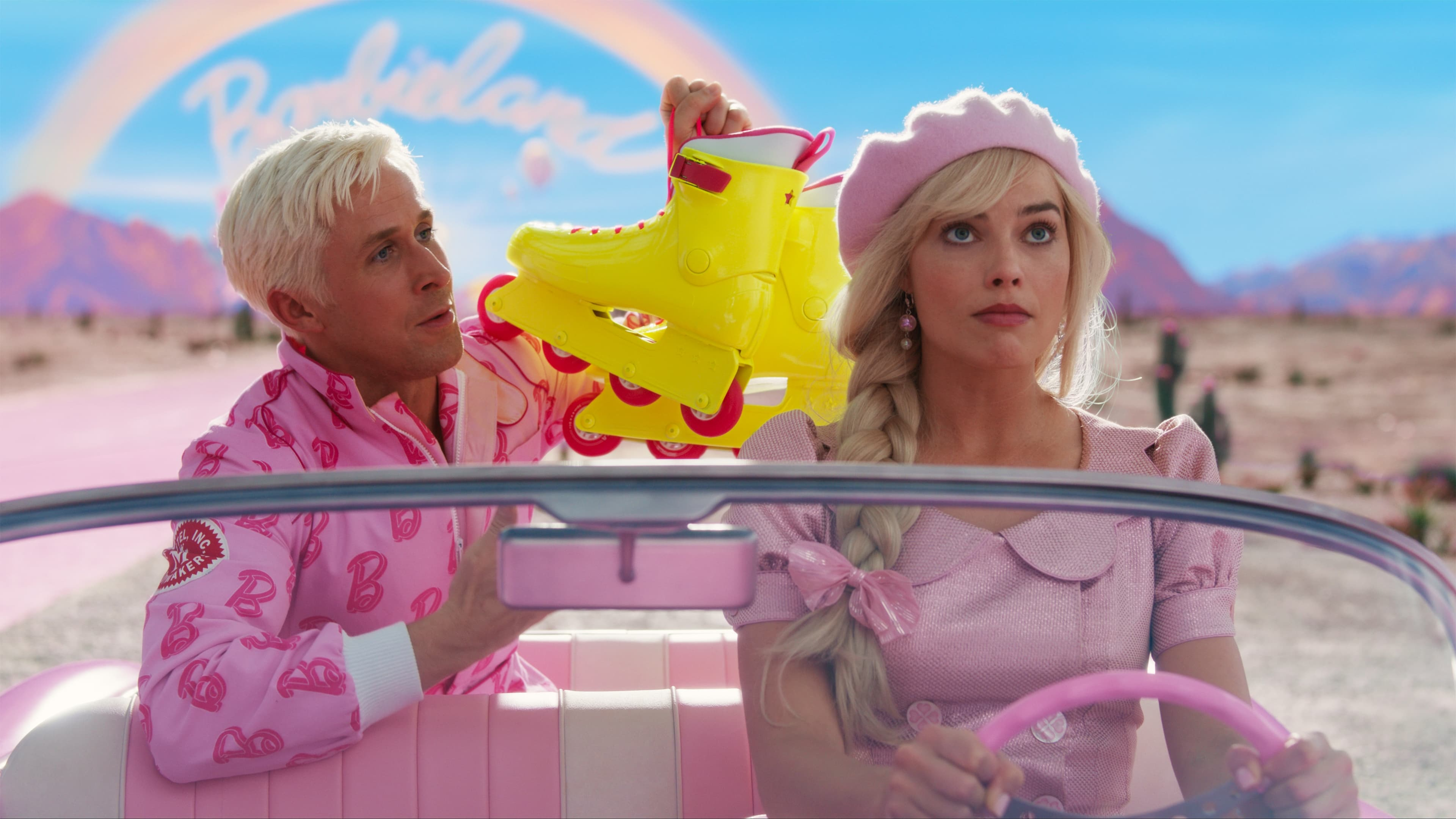
As the film starts, we’re introduced to a 2001: A Space Odyssey parody built around the Barbie doll. It’s maybe the best way for Barbie can start out, as it sets us up perfectly for the satire we’ll be seeing upon our entrance to Barbieland. Every Barbie lives their best life, but in particular, this film focuses itself on the “stereotypical” Barbie, as played by Margot Robbie. She’s the one Barbie who sets the example for every Barbie around, and is the object of every Ken’s desire – but especially the Beach Ken (Ryan Gosling). While every Barbie works important jobs in Barbieland, every Ken is all about having fun, hoping that a Barbie will come by to complete their lives.
Looking at Barbie from a vague enough description as I’d included above might set you up for a very fun ride that takes a jab at the stereotypical gender roles in society. Women rule Barbieland, the men are all submitting themselves – everything seems like it’s in perfect order up until the stereotypical Barbie faces an existential crisis. Greta Gerwig boasts some incredibly imaginative world building just from the first minute of the film alone, but it’s the way that Barbieland contrasts perfectly with the real world that gives us the sense that Gerwig’s appropriation of the beloved girls’ dolls can reach for something greater with regards to the gender roles that they’ve represented for the generations ever since her creation.
All the sets of Barbieland are perhaps among the most imaginative that you’ll ever see in a recent major studio film. But the imaginative nature of Barbie doesn’t limit itself only to the looks of Barbie’s dream house, but it even makes for some of the film’s funniest gags. Barbie’s Dream House for one looks exactly like you would expect a dollhouse to look – where every room is exposed from one angle and opened up, the water doesn’t actually run, and even Barbie herself slowly descends from the top floor to the ground as if she were a doll being played with by a human in a similar manner. It’d be easy enough to imagine that Greta Gerwig could have played this all akin to Toy Story where we see the toys’ perspectives of what it feels like to be played by a human being (specifically, the intro of Toy Story 3 comes to mind) – but the approach Gerwig uses here is far more clever.
This isn’t limited only to the fantastical world of Barbieland, but there’s a sharp enough contrast between what’s real and what isn’t in here to give you a sense of how Greta Gerwig is playing into with what an idealized fantasy for girls but the reality at hand makes that impossible. Barbie’s blissful ignorance fades away immediately, and Ken realizes that there’s a lot more to his own life than being subservient to the other Barbies, which results in a radically altered Barbieland the moment she comes back – but also a sense of Barbie discovering that not everything can be the perfect dream she sought everything to be. She knows that she’s something of a role model to many young girls who’ve played with her all throughout the years, and being the source of happiness for many, it only means that’s what she represents at her own expense.
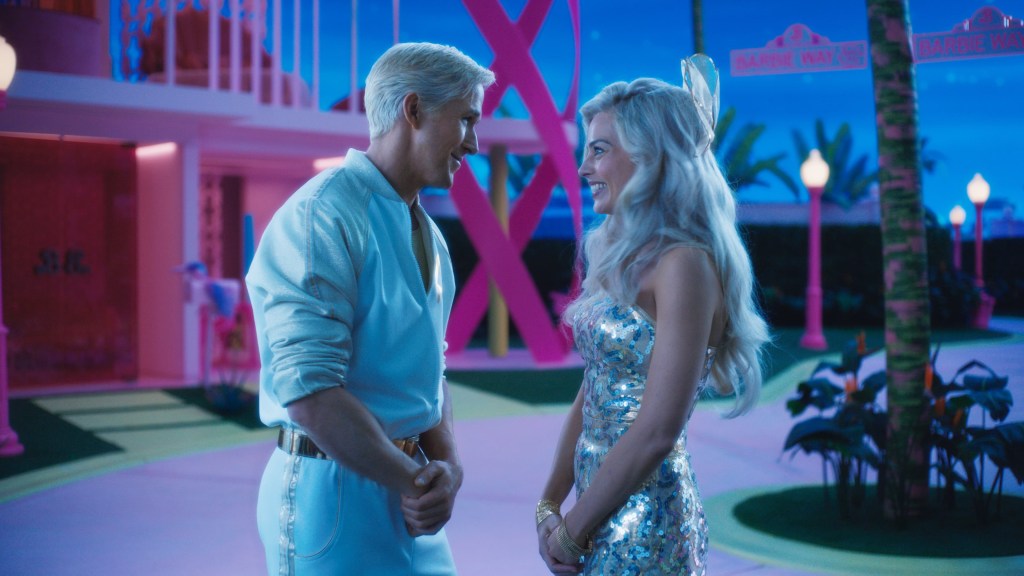
Of course, no one could be better fit to play Barbie than Margot Robbie. It’d be one thing for her to simply “look” the part of Barbie, but her casting is genius because of Robbie’s own comedic timing, something that she’d been able to express perfectly from her own roles in The Wolf of Wall Street and I, Tonya among others. Robbie is very funny in the part, but if we’re also talking people who carried the very look of their roles down to the bone – there’s also no one else one can envision as Ken quite like Ryan Gosling. And both Margot Robbie and Ryan Gosling play off one another very well, each as a representation of the opposite ends of the binary gender constructs that they stand for. The all-star cast helps a great deal; with many conventionally attractive-looking men playing Kens and Michael Cera as the only non-Ken doll in the world, but also the many different forms of Barbie all played by players of all sorts.
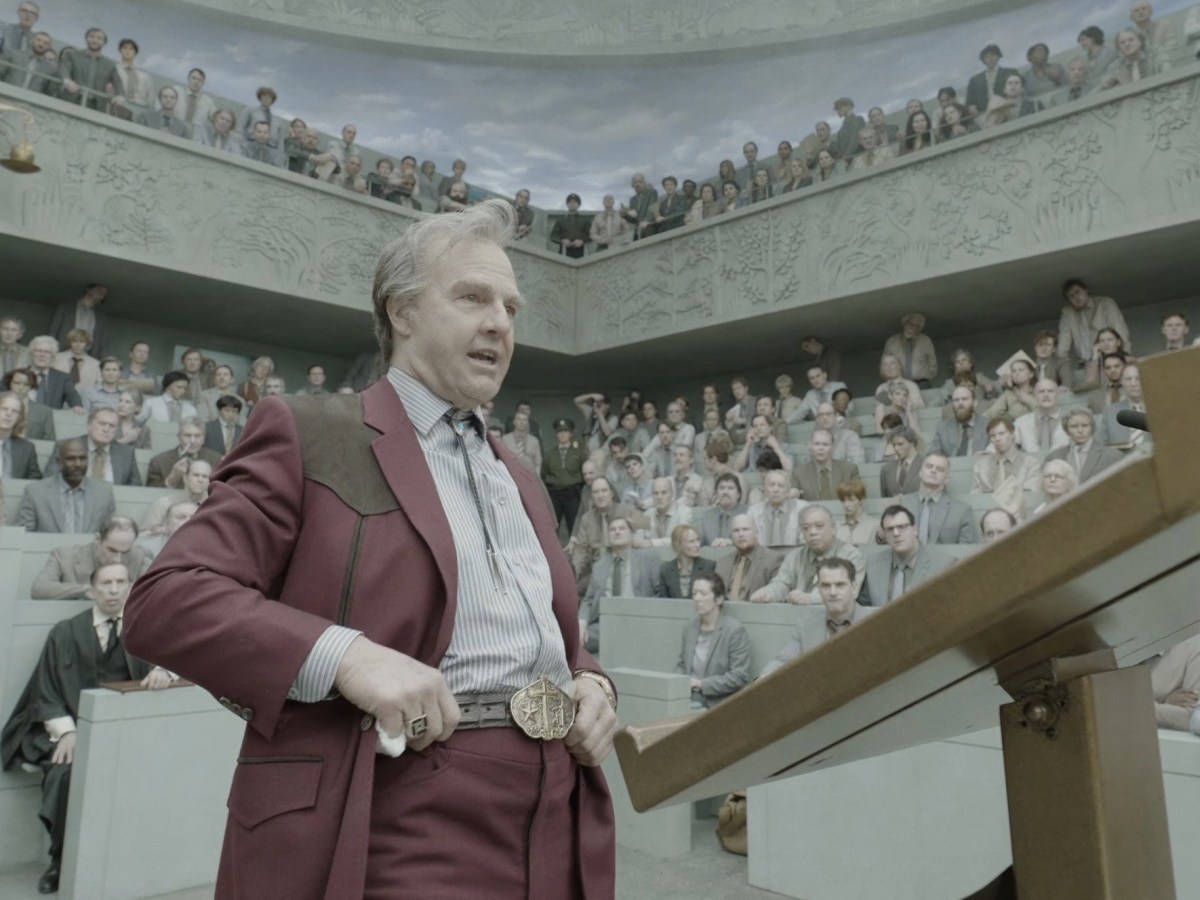
While I think it’s admirable that Greta Gerwig was aiming to use the figure of the Barbie doll in order to create something to reach girls of all sorts, I think that Barbie finds its own shortcomings fall flat in the extent to which its message’s reach is realized. This perhaps is best reflected in the moment where the Mattel Corporation are introduced in the film, where Greta Gerwig sets them up to appear with a villainous role, and as expected, with the CEOs all being men. But I think it’s clear from here on where Mattel had to put the foot down, and ultimately it’s what keeps the film at bay from where I imagine Greta Gerwig would have wanted to take it. There was potential here for what could have become a clever commentary on how capitalism and the interests of girls are all decided by men, but it seems like almost nothing is done with this – and it seems to render Will Ferrell’s role into a waste of potential.
You can probably call me a bit of a crank when commenting on the film’s feminism – but a huge chunk of what doesn’t work for me about this particular aspect is that it just simply rings very surface level. Most of it is pretty boldly stated out loud, which I suppose is enough to attract the ire of many conservative viewers today who get upset over the slightest left-leaning implication, but it never comes out feeling expansive (spoiler alert, the film is not anti-men). It’s this aspect that I find does the film more harm than good, because it’s coming out like it boldly wants to be a part of the popular feminist canon which had long been built on films like Thelma & Louise, Legally Blonde, or Clueless. Which, I think that Barbie being a film from a product line made it inevitable that these limits were in place – but it also feels at odds with Gerwig’s own intentions too.
Still, I think there’s something great done here with how the film addresses the effects of the extreme ends of the gender binary. In reality, it’s men who dominate everything – but in Barbieland, it’s the opposite. But everything being led by a dominant force is something that hurts everyone in the end, which is not a particularly radical statement. Yet I think that with Greta Gerwig reaching out for girls of all ages, who’d been living under the influence of men, it’s doing well enough to achieve what it’s set out for. I think it’s great to see that this is how many young girls especially will see a sense of what’s going on in the world around them, even if it means that baby steps will be taken through reaching them with a popular toy that’s stuck around for so many generations.
Barbie at least gets points for being a film that’ll inevitably expose many young girls to the radical aspects of the real world. Though I have to admit, I have trouble with calling a film that functions as part of a toy line a greater political statement that both Greta Gerwig and Noah Baumbach are trying to reach for – and I don’t think the film does enough to reckon with that. This is not to say that either filmmaker is incapable of reaching that, but if you watch Barbie expecting it to be that film, you will not be getting that. You’ll at the very least be getting a very fun movie that boasts more imagination than you probably might ever see in most major Hollywood productions coming out now that cost over $100 million. Here’s to hoping that Greta Gerwig will be allowed even more creative liberty with what she’s got coming up next.
Watch the trailer right here.
All images via Warner Bros. Discovery.
Directed by Greta Gerwig
Screenplay by Greta Gerwig, Noah Baumbach, based on Barbie by Mattel
Produced by David Heyman, Margot Robbie, Tom Ackerley, Robbie Brenner
Starring Margot Robbie, Ryan Gosling, America Ferrera, Kate McKinnon, Michael Cera, Issa Rae, Rhea Perlman, Will Ferrell, Simu Liu, Hari Nef, Dua Lipa, John Cena
Release Date: July 21, 2023
Running Time: 114 minutes


Leave a Reply