
✯✯✯✯✯
One of the biggest hits from this year’s Cannes Film Festival was none other than Justine Triet’s Anatomy of a Fall, which won the coveted Palme d’Or. Being the third film directed by a woman to win the Cannes Film Festival’s highest honour, this courtroom drama presents itself as directly as it can to your face. And yet I think there’s so much to be admired about how meticulously it all unfolds, telling a story that changes one’s own perspective on a seemingly simple matter at hand, whether it’s within the courtroom or outside. The end result is maybe one of the year’s most haunting films, but it involves you as the viewer in more ways than expected – as you’re made to play the investigative role in this story.

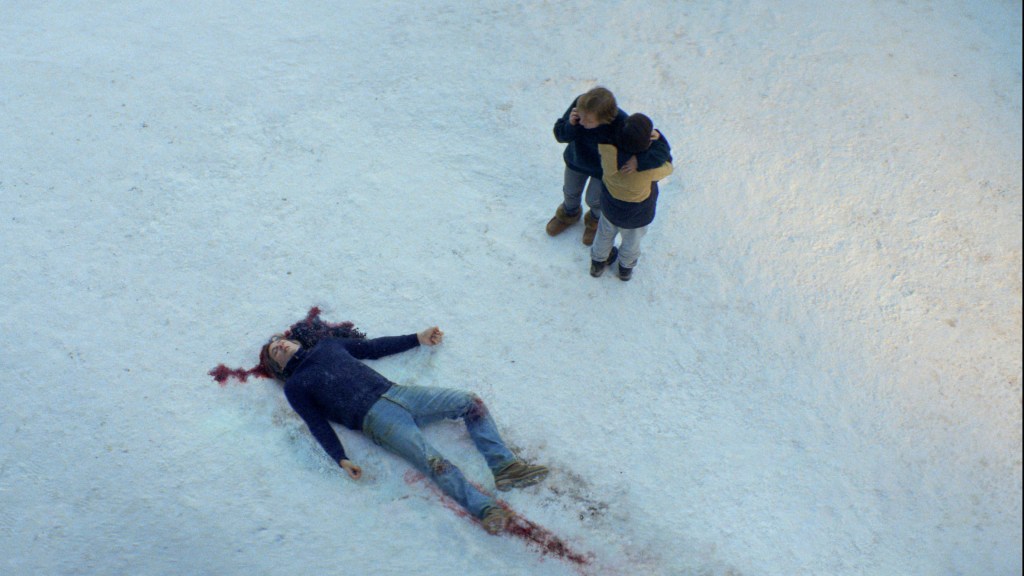
Sandra (Sandra Hüller) is a German author living in the French alps together with her husband Samuel (Samuel Theis) and blind son Daniel (Milo Machado-Graner). After Samuel is discovered lying dead outside of their isolated home, authorities point to Sandra as being a prime suspect in his strange death. What follows afterward is a very tense courtroom drama, where what seems to have been a strange death ends up involving more of Sandra’s past life, as well as the troubled circumstances that led to Daniel’s blindness – and even puts into question whether or not Sandra truly loved her husband.
With so much of Anatomy of a Fall taking place within a courtroom, it breezes by so quickly – and yet the feeling of yourself being there to watch the chaos unfold makes it exhausting. Justine Triet makes you feel the frustration that Sandra is experiencing, especially as judges can turn this trial into a seemingly unfair one, as character assassinations are lobbied left and right, with her son being made to hear so much of it happen on the spot. Even as Triet invites the viewers to play on an investigative role in examining the circumstances behind a strange death, there’s also a clever commentary at play with how Anatomy of a Fall lets everything unfold, as this scenario is one set to become a media circus if too many people decided to play the investigator.
Nonetheless, I think it’s an approach that works in Anatomy of a Fall’s favour. It works because the investigative nature of the film gives you the feeling of invading another person’s privacy, perhaps because Justine Triet continually tempts you as the viewer to speculate about the life of someone you can only see on the screen, because of the impulse to want to believe them to either be innocent or guilty. When considering how Triet lets the whole thing involve you to make your own judgments, you can only be so stunned enough witnessing the actual feeling of being in the position of the one caught in the frenzy. It’s uneasy, often distressing, and makes you question the justice system as we know it – by showing how little we understand the intricate details.
Hüller delivers when expressing the exhaustion in hearing her character being slandered by the people around her in a professional setting. It’s a very devastating performance that might just as well have the makings of a career best, but I think that the strength of her role here is best stated by how the courtroom has ultimately rendered her senses completely dulled. It’s the perfect portrait of the disillusionment one can experience when a trial goes completely out of hand, and ends up destroying any sense of privacy that one would want to maintain. This performance could very well be among the year’s best, but there’s another star in the making out of Milo Machado-Graner – the young child caught in the middle of trying to make sense out of everything.
But really, in a case like this, how can you truly make sense out of everything happening? People can always feel like they are able to rush to judge, slinging out assassinations of character because they want to be right. And yet, for the people who are actually at the center of the case, something more devastating can be found underneath. It’s why Anatomy of a Fall is as impressive as it is, because there’s only so much we can truly know about a circumstance like this before we realize it’s just how puzzling human nature can be. Nothing is black and white, and once everything is laid out, we see more than what meets the eye.
Watch the trailer right here.
All images via Neon.
Directed by Justine Triet
Screenplay by Justine Triet, Arthur Harari
Produced by Marie-Ange Luciani, David Thion
Starring Sandra Hüller, Swann Arlaud, Milo Machado-Graner, Antoine Reinartz, Samuel Theis, Jehnny Beth, Saadia Bentaieb, Camille Rutherford, Anne Rotger, Sophie Fillières
Release Date: October 13, 2023
Running Time: 150 minutes

 Cinema from the Spectrum
Leave a comment