

✯✯✯✯✯
Odds are you will probably be thinking of the similarly titled Lou Reed song before watching Wim Wenders’s Perfect Days. It may very well be the best way to describe what Perfect Days happens to be about, as it is a film that is built around the ordinances that make up everyday life. But even then, a film that reveals so little on the surface ends up working its way under your skin to become one of the most quietly devastating films of the year – something which Wim Wenders has taken clearly from the films of Yasujiro Ozu. It would be one thing to describe this film as something of a narrative ode to the great Japanese auteur, but as I see it, it happens to be Wim Wenders’s best since Until the End of the World.

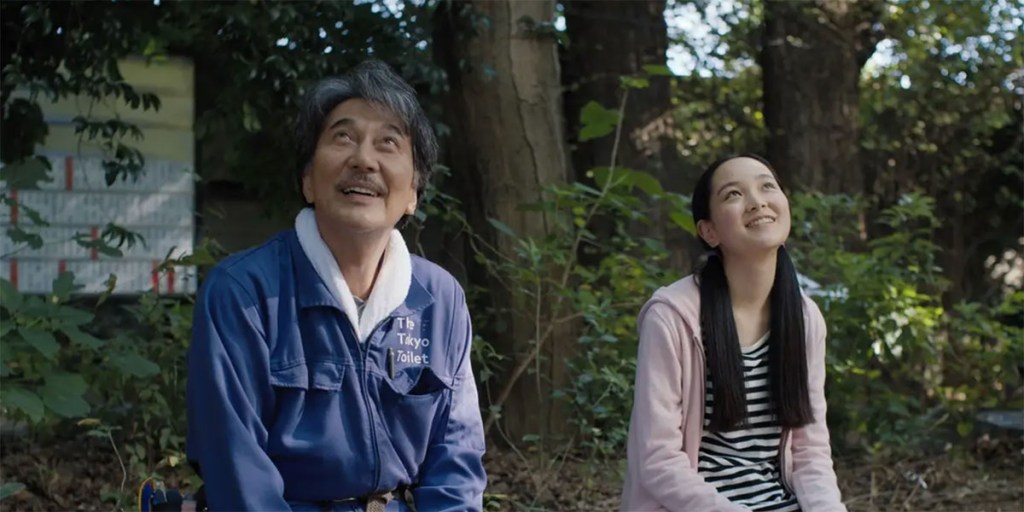
Hirayama (Koji Yakusho) is a middle-aged man who spends his days cleaning public toilets for a living. He doesn’t really talk very much, lives a life of solitude that consists of reading and vintage cassette tapes going from Patti Smith, Van Morrison, and (as expected from the title) Lou Reed. There’s nothing about his job that strikes us as being especially out of the ordinary, as the toilets all across the city look very clean – and sometimes there’s a bit of joy to be found in the trinkets he finds on his job. One such being a game of tic-tac-toe in one public toilet, another being his love of a particular tree, things that seem mundane to the human eye but end up revealing something more about the human soul underneath.
Perfect Days keeps you within the repetitive nature of Hirayama’s lifestyle without cutting away – but I think that it’s the slight changes in the routines as we see that end up telling stories of their own. There’s one to be found out of his younger and more energetic co-worker and the people whom he meets, another to be found in a bar he frequents, but one more that involves his life outside of his daily routine. Even then, it’s the way that these changes come into a series of “perfect days” that show us more about human nature, which just happens to be all that Wim Wenders really needed in order to bring us a great film.
But these vignettes are also what make Perfect Days devastating. In part because we’re made to have great respect for the dedication that Hirayama shows to his meticulous cleaning of public toilets, and also the manner by which he interacts with the people around himself. He’s a very reserved man, especially compared to his more outgoing co-worker, but he senses himself being part of another story waiting to be told, and the amount that Wenders can pull out of these moments of seeming mundanity would only show how he’s learned from the best in this regard: there’s a great deal of care present in how he celebrates the ordinary to the point that we start to embrace the little things that shake up the monotony.
It really is just devastating underneath too, especially because of Koji Yakusho in a career best role. Having made himself out to be one of Japan’s greatest actors working today, his role in Perfect Days is a very subdued part – but its brilliance is best stated by how much he makes you feel the beauty of ordinary life. He plays this role not with spontaneity, but simply with the means of showing you that there’s so much beauty in what’s ordinary and already set in stone. But even then, a welcome disruption allows oneself to embrace life like such.
I also couldn’t help but think to listen again to Lou Reed’s similarly titled song right after watching Perfect Days, in part because it’s a soothing vibe all throughout. But also, I think that while Wim Wenders aims for pure simplicity within Perfect Days, it might be more than enough in order to make something worth remembering. For my money, it’s the best film that Wim Wenders has made in quite some time – perhaps since Until the End of the World at that. It’s just simply a very lovely film all throughout.
Watch the trailer right here.
All images via Neon.
Directed by Wim Wenders
Screenplay by Wim Wenders, Takuma Takasaki
Produced by Wim Wenders, Takuma Takasaki, Koji Yanai
Starring Koji Yakusho, Tokio Emoto, Arisa Nakano, Aoi Yamada
Running Time: 123 minutes
Release Date: December 21, 2023



 Cinema from the Spectrum
Leave a comment