
✯✯✯½
This piece was written during the 2023 WGA and SAG-AFTRA strikes. Without the labour of the writers and actors currently on strike, the film being covered here wouldn’t exist.
Television writer Cord Jefferson, whose television credits include Succession, The Good Place, Watchmen, and Station Eleven makes his feature directorial debut with American Fiction. This new satire, based on the novel Erasure by Percival Everett, takes aim at the world of literature, but also the need to preach diversity by most institutions run by white editors. Built on comedy and tragedy, it’s a film that aims to reflect the reality that black creatives face especially when they’re telling stories much like that of our own – and white people carry that conscious bias to a degree of uncomfortable overcompensation.

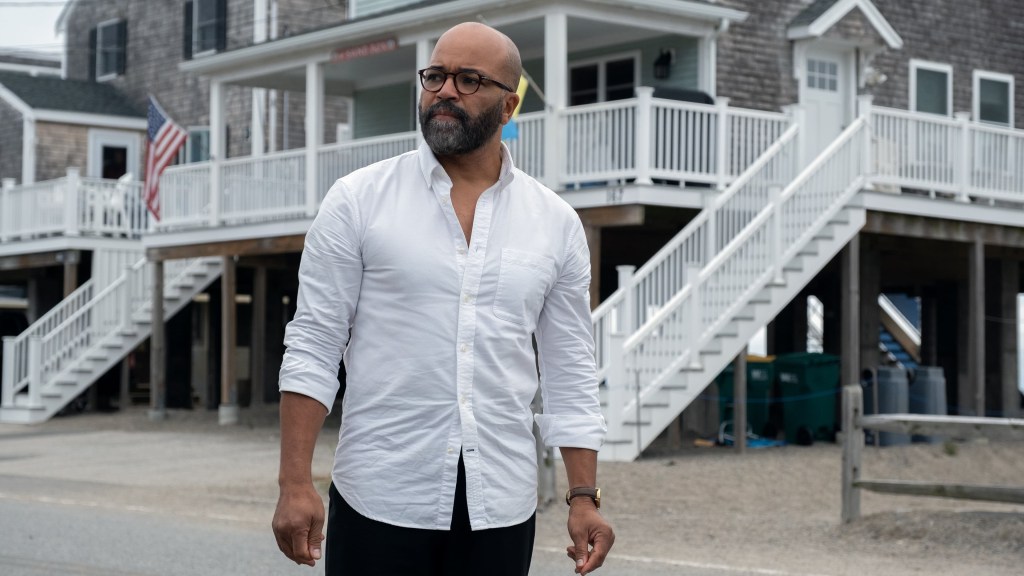
Jeffrey Wright stars as Thelonious “Monk” Ellison, an African-American author and professor of English literature. Though respected by his students, he also has very little patience for the standards set upon fellow black authors after his writing was deemed “not black enough.” Seeing the popularity of a new book called We’s Lives in the Ghetto by first-time writer Sintara Golden (Issa Rae), Monk takes it upon himself to challenge the publishing standards. Adopting a pseudonym, he spitefully writes a novel filled with every offensive stereotype known to many stories about black people which he calls My Pafology, hoping for it to be unpublishable. The plan backfires when it turns out to be an immediate hit, and he must reckon with the monster he created.
In today’s world of entertainment, a film like American Fiction seeks to challenge how true people are to their word when it comes to the celebration of diverse storytelling. A lot of the funniest bits in American Fiction come about because they’re built upon how many familiar famous black stories feel as if they’ve been built upon by familiar tropes, or even the experience of misery. Knowing this can add a layer of discomfort to the film’s sense of humour, but at the same time, Cord Jefferson establishes that Monk isn’t interested in representing the entire black consciousness, but only an individual. At its best, American Fiction is very funny, especially when it comes to challenging the over-compensation presented upon black creatives by white moguls who are often in charge of everything.
There’s a resonance to be found here, especially because of the fact that we’ve seen stories of African-American trauma get highlighted by white audiences more often than not, but also stories about “the good white people” during an era of racism. Of course, one such story can be found in recent memory through Peter Farrelly’s Best Picture-winning Green Book, which established itself as an audience favourite but was also founded solely on white people parading around themselves for preaching diversity. It’s a film that excoriates how the world of entertainment continually leeches off of itself in order to let stories that they deem “acceptable” can get their time in the spotlight, especially when the mainstream standard is often set by white audiences rather than a true celebration of diversity.
What’s also important to letting American Fiction’s success ring true is the way that we’re made to see things from Monk’s point of view – not as a writer, but as an ordinary family man. Unfortunately, I can’t always say that these moments worked nearly as much for me as much as they did create a disconnect between the film’s own intentions. A lot of this comes down to the fact that Monk’s own family life seems like such a drastic shift in tone in comparison to the harshness of another story that challenges the way people wish to celebrate diversity in creative fields – and they don’t really weave together until the film’s later half. Up until then, it gives the film the feeling of being two stories told at the same time, and it doesn’t always work.
Nonetheless, Cord Jefferson makes himself out to be a strong voice behind the camera – in part because his television sensibilities translate brilliantly to the bigger screen. The writing keeps everything entertaining, in part because Cord Jefferson allows the world of literature to remain as accessible as it can be for most viewers. But I think that where Jefferson really shines as a writer comes from the approach to American Fiction as an entirely self-aware narrative taking the people who approved its own making to task. What one can hope is that the years following the release of American Fiction will see the preaching of the values of diversity being honoured, rather than as a performative gesture – especially when one considers the novel’s publication came in response to the popularity of novels like Push by Sapphire (which, fittingly enough, was adapted into an Academy Award-winning film). Jefferson interrogates the mainstream’s continued ignorance of engaging with black creatives on an intellectual level, especially as stories about their misery remain as prominent as ever.
With an ensemble led by Jeffrey Wright, you can’t really go wrong, especially when Wright carries so much charisma from beginning to end. Also backing him up are a wonderful turn from Tracee Ellis Ross and Sterling K. Brown, keeping afloat the segments that focus on Monk’s own dysfunctional family. It’s easy enough to say that Jeffrey Wright shows himself to be a great leading man (he’s been delivering great work for a while already), but Brown is the standout in here – as a man undergoing many hilarious mid-life changes.
American Fiction will certainly find itself becoming an audience favourite, although one can only be so hopeful that performative gesturing for diversity will be put to task sooner rather than later. While its satire has already been handled in more blunt ways on the screen through films like Hollywood Shuffle or Bamboozled, I also find that with how American Fiction asserts itself, we can only see it resonating greatly within the coming days. It’s hard enough trying to blend the two, especially given the more experimental structuring of Everett’s novel, which infuses the manuscript of My Pafology into Monk’s own story – but I think that it’ll have us asking ourselves about how true we are to our word about seeing diverse stories on the screen.
Watch the trailer right here.
All images via MGM.
Directed by Cord Jefferson
Screenplay by Cord Jefferson, based on the novel Erasure by Percival Everett
Produced by Cord Jefferson, Jermaine Johnson, Nikos Karamigios, Ben LeClair
Starring Jeffrey Wright, Tracee Ellis Ross, John Ortiz, Erika Alexander, Leslie Uggams, Adam Brody, Keith David, Issa Rae, Sterling K. Brown
Release Date: December 15, 2023
Running Time: 117 minutes



 Cinema from the Spectrum
Leave a comment