
✯✯✯
It’s the near future, America is at war with itself – perhaps this all feels a bit too close to home. For someone like Alex Garland, who’s a British-born filmmaker, he’s looking at such events from a distance, and that’s about all he can really make a film like this from. It ends up becoming both one of the most interesting things about Civil War, while also being its greatest curse at that. With how the film unfolds, especially in regards to how journalists cover a nation at war, it opens up another realm entirely when talking about how the events become sensationalized to pander either to left-wing or right-wing readers. That, in turn, ends up becoming the biggest problem which Civil War poises.
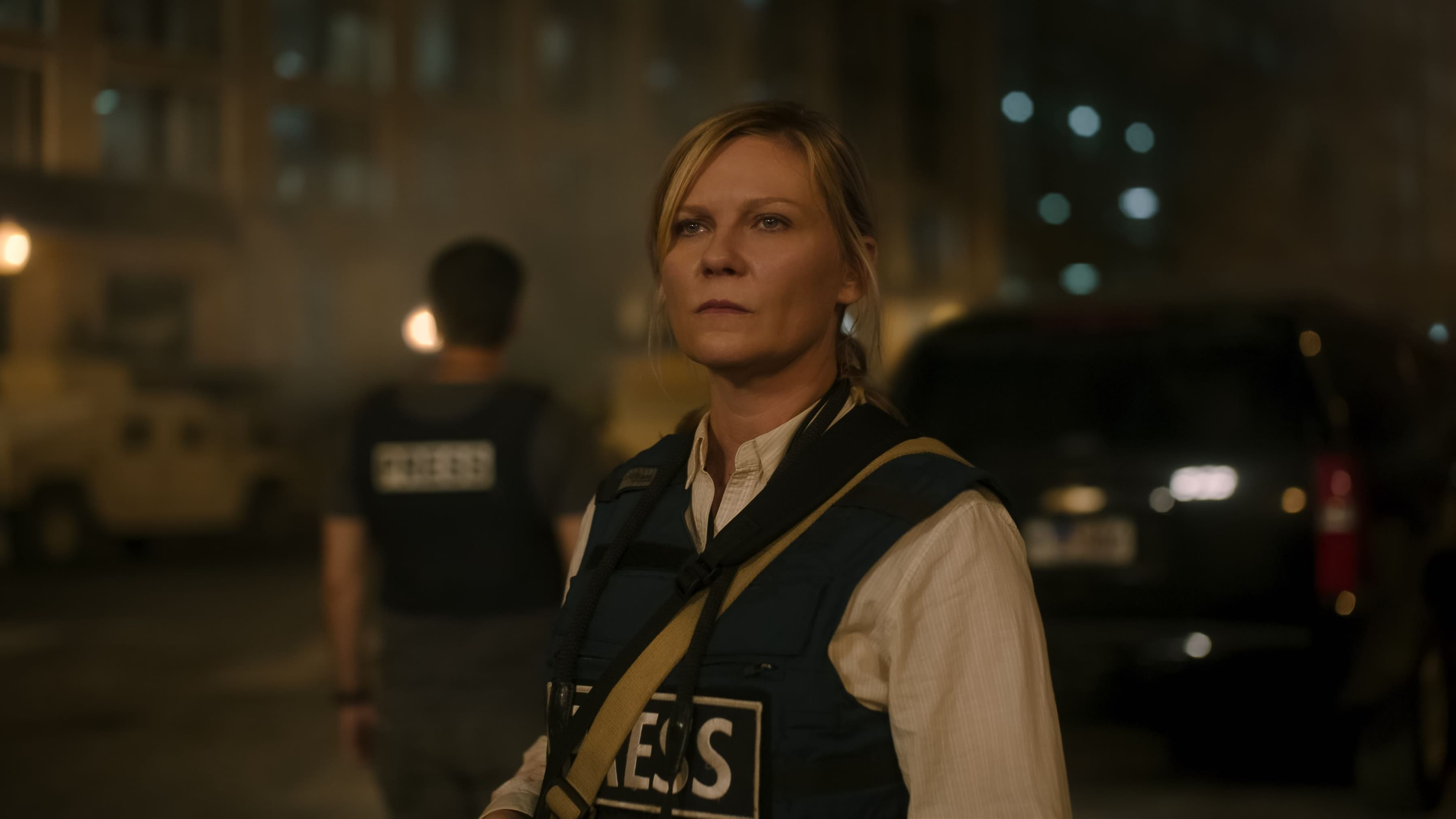
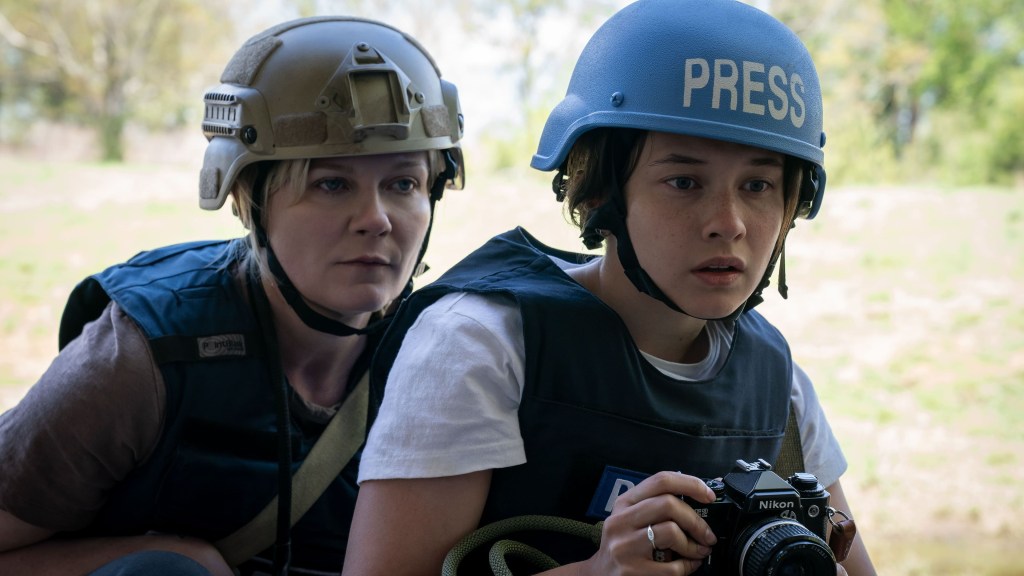
When the film starts, an opening speech made by the President of the United States (Nick Offerman) plays over real riot footage. This only shows itself to be a means to segue into who our film is really about, a group of journalists who walk through the war-torn nations in order to show their readers what’s really going on. That’s how our lead, the hardened photojournalist Lee Smith (Kirsten Dunst) comes into the picture. She rescues a younger, aspiring war photographer named Jessie (Cailee Spaeny) from a riot that escalates into a suicide bombing in New York City, and eventually agrees to take her to Washington, D.C. with her colleagues Joel (Wagner Moura) and Sammy (Stephen McKinley Henderson) to interview the President – a journey that eventually puts their own lives on the line.
Although explicitly set within the United States in a theoretical future, perhaps the fact that its titular “civil war” is seen through the perspective of an outsider opens up room for exploring how people whose job is to ensure that these stories are put in the public eye ultimately must carry a nonpartisan approach to their material. Except I find that this is a very naïve approach at that. In part because I think that Alex Garland seems to present the work of people who photograph these images of war being devoid of content – which only the readers themselves can impose, and ironically, that ends up becoming how people perceived the film itself.
For this alone, I think it makes Civil War a film that’s at least worth talking about. It’s worth talking about, because we know that there are photojournalists out there whose intentions are to capture a neutral perspective in a war by means of capturing everything on the scene. That Alex Garland is choosing not to explain the cause of this war ends up becoming a grander statement about how this is not something that’s exclusive to the United States, but everything will inevitably be filtered through a lens that caters to one exclusive viewpoint – only informing Kirsten Dunst’s performance of a journalist who’d seen so many horrible things happening all around her inevitably reduced to shallow sensationalism.
To that end, how do we think of ourselves in that moment? People on social media will inevitably get mad at Alex Garland for not taking a political stance by choosing to have his movie present itself as “apolitical.” Except for the fact that this is not an apolitical film, rather instead the fact we don’t know the allegiances of its lead characters, let alone the nature of the conflict we’re seeing, is very interesting. It’s an interesting thesis, and I think it might very well be one of the boldest statements that a filmmaker like Alex Garland could possibly make, especially around now, while liberal viewers are unequivocally expressing support for Ukraine in a war against Russia, but conflicted about the circumstances pertaining to a presently ongoing genocide of Gaza.
Garland’s film is bleak, but his greatest failing with Civil War is not the fact that he’s refusing to take a side in a pointless war. Instead, it is in how it seems to trade that insight for action sequences. The few moments in Civil War where violence come about ultimately do leave their mark, but as they become more frequent, they only feel more numbing. They’re only more numbing in the sense that they obscure any real insight beyond the fact that we’re seeing a movie being made about journalistic practices during an armed conflict, especially as we’re left wondering what’ll happen next for our leads.
And eventually, you reach a point where Civil War reaches that climax you expect: and there’s no real gain to be had. It’s a bleak moment, but perhaps the nihilism is what lets it stand out. Who else will be there to hear such a story? What will be in it for the journalists who were there in the end? Are they sure that their experiences will be shared to the public in good faith? The lack of certainty is very much deliberate, but perhaps the most telling aspect about Civil War is that it’s not trying to poise a solution. Alex Garland does not wish to observe it all so passively, but it never goes beyond the surface.
Watch the trailer right here.
All images via A24.
Directed by Alex Garland
Screenplay by Alex Garland
Produced by Andrew Macdonald, Allon Reich, Gregory Goodman
Starring Kirsten Dunst, Cailee Spaeny, Wagner Moura, Stephen McKinley Henderson, Nick Offerman
Release Date: April 12, 2024
Running Time: 109 minutes
 Cinema from the Spectrum
Leave a comment