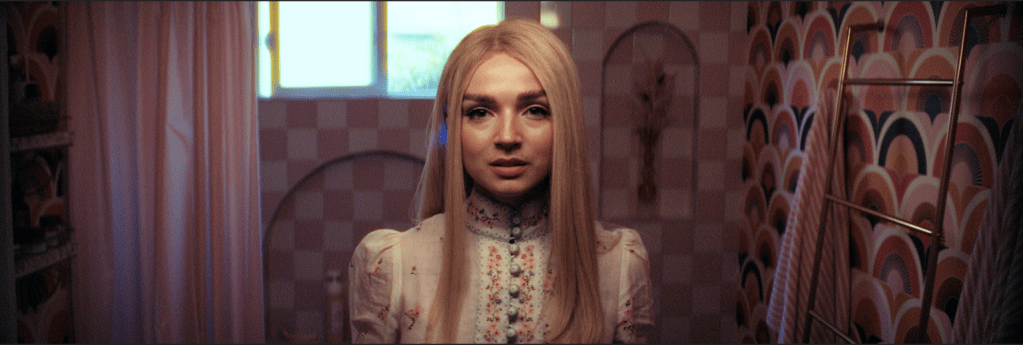

This film is more than a creative statement, it’s a vital contribution to the ongoing reclamation of Poppy’s character, identity, and authorship. But for me, as an autistic viewer, it’s also something much deeper: a cinematic mirror reflecting the struggle to navigate a world that demands perfection, masks authenticity, and punishes the “wrong kind” of difference.
The story opens in darkness, an endless black abyss. Poppy appears, dressed in black, her face streaked with running makeup. The only break in the void is a glowing portal right above her head. A slow, eerie fusion of buzzing and melody transitions into the Moshi Moshi music video, originally released on YouTube in 2017 to promote her debut album Poppy.Computer. The bright, candy-colored electropop aesthetic is disrupted by the insistent buzzing of notifications chiming from her phone. Her cat, Pi, nudges her phone, encouraging her to re-engage. She scrolls. She reads. Her expression barely changes. Despite the praise, she looks utterly lost. She is trying to keep up with the continuous demand. From the outset, I recognized this feeling intimately. The cycle of external praise but internal detachment. The disorienting demand to constantly perform, respond, and be on. Especially online, where presence becomes a form of currency and requires masking.
Whether audiences are familiar with Poppy or not, this film, directed by multimedia filmmaker Paul Trillo invites us to consider the cost of maintaining an identity that’s been flattened and packaged for mass consumption. For those of us who’ve experienced neurodivergence, particularly autistic individuals, the themes ring hauntingly close to home. The film makes a powerful introduction to Poppy as both a character and an evolving persona. However, this work isn’t just another performance. Poppy is credited as writer and executive producer, and her fingerprints are all over this surreal, layered narrative. It’s a deeply personal continuation of her public reclamation. One that confronts previous misconceptions and celebrates her creative authorship.
A jarring shift breaks her scroll. Poppy receives a call. “So, Poppy, how are you feeling?” a man asks in a rehearsed corporate tone. We cut to a slow pull-out shot, revealing she is seated between two suited executives in a dimly lit conference room. Her response is hesitant. She is burnt out, but reluctant to say so. “I feel… I don’t know. I can’t really describe it. I can’t really describe anything anymore. I just don’t really feel like talking to people”.
The solution? A glowing blue earpiece from Aura, an AI-powered company offering support for overloaded minds. “With Aura, you’ll never say the wrong thing. You’ll never be indecisive. You’ll never disappoint anyone. You’ll always have the perfect words to say, at the perfect moment.” As an autistic person, I felt that offer echo through my chest. Who hasn’t wished for a device that could decode every social interaction? That could bypass the exhaustion of trying to say the “right” thing, at the “right” time, with the “right” tone? If there was a technology that guaranteed I’d never misread a conversation, never talk too much or too little, never second-guess how I came across… I’d be tempted. “Lip-sync for the mind,” they call it. And it’s chilling how appealing that sounds.
But Poppy’s only question is also mine: if I follow every rule, say every perfect phrase, reflect every filtered version of myself, what’s left of me?
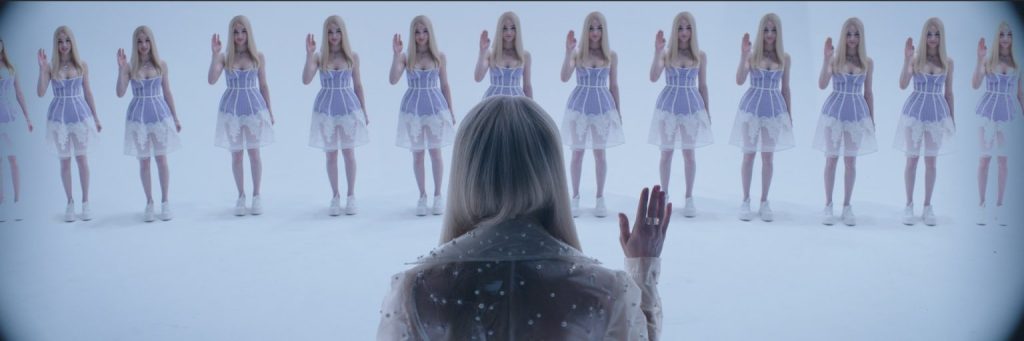
Upon signing, Aura begins digesting her entire digital footprint. She is told she will finally be free. No more anxiety, no more doubt. A montage of concert and video footage plays like a flashback, and in a white void, a line-up of Poppy clones begins quoting her old YouTube videos:
“Hi, I’m Poppy!”
“It’s 3:36? Oh no, I’m late!”
“I wonder what this plant thinks.”
All the clones wear identical purple dresses, except one, dressed in a jacket and facial pearls, who steps forward and begins evaluating the others. “Poppy loves you all,” she says, as imperfect clones fall through a hole in the floor. “But only the most perfect can be Poppy.” Again, I saw myself. The feeling of not being “wrong” but still somehow always “not quite right.” The pressure to constantly refine, correct, perform. The real Poppy stares into the mirror with the Aura device ready to wear. Her thoughts no longer belong to her. Aura speaks for her, assuring her that she is “the most perfect perfect person.”
Later in the film, we descend into the pit of rejected clones. They chant “We are the forgotten ones,” and whisper to each other, “We’re not wrong, we’re just not right.” That line broke something open in me. That’s the feeling of growing up autistic in a world where correctness is coded through neurotypical standards. Where you can function, mask, and assimilate and still be labelled “off”. When the real Poppy is overwhelmed by internal voices during a live interview, the collapse is public. The criticism is immediate and merciless. It reminded me of the unique pain autistic people face when they falter in social settings how easily that moment of sensory overload or vulnerability gets interpreted as failure. Poppy stares again at her own reflection in the mirror, the takeover of Aura Poppy is too much, while reiterating “Just say sorry”. Leading to Poppy grabbing the device out of her ear.
Back at the Aura office, the executives present a new solution: a physical, embodied Poppy clone. It greets her with a familiar smile: “Hi, I’m Poppy. I love you.” The real Poppy responds unflinchingly: “Good luck”. The film closes on a billboard of the perfected clone with the tagline: “Most perfect perfect person.” But then, the camera pulls back. We hear a gentle melody. A new figure appears, still Poppy, but with flowing dark hair, casual clothing, and no extravagant makeup. She is no longer masking. No longer bound to performance or public expectation. This is Poppy, unfiltered, unburdened. Amalgamated to her own perfection. This film isn’t just a reclamation of a persona. It’s a reclamation of self. And for me, it’s also a quiet revolution against the perfectionism that shadows many autistic lives. Poppy’s journey resonates not just as a pop star navigating identity, but as someone who knows what it’s like to be misunderstood, misrepresented, and still rise by her own hand.
She’s not a puppet. She’s the artist.
And in her story, I see my own desire. Not to be perfect, but to be understood, unmasked, and whole.
Beyond this film, Poppy is not only moving forward as a prominent voice in her own creations, but she is also now clearly surrounded by a team both creative and technical, that deeply understands and amplifies her unique vision. Whether in music, visual art, or film, her spark is no longer being diluted or misrepresented but being celebrated and elevated. The addition of Trillo into this mix has resulted in an exceptionally well-crafted and emotionally resonant project, arguably one of the most cohesive and powerful expressions of her identity to date. As an autistic individual, watching this film was a deeply personal experience. There’s a precision to its tone, a meticulousness in its visuals, and a clarity in its emotional arc that mirrors how I often perceive and process the world. An exuberant reminder that self-definition is both possible and powerful, even when others have tried to write your story for you. In many ways, this film becomes more than just an artistic achievement. It stands as a symbol of agency, resilience, and transformation not only for Poppy, but for those of us who see ourselves reflected in her defiance and reinvention.
Watch a preview right here.
All images via Asteria Film.
Directed by Paul Trillo
Screenplay by Paul Trillo, Poppy
Produced by Poppy, Asteria, Ed Saatchi, Geno Imbriale
Starring Poppy, Corey Landis, Ryan Barrier, Zach Song
Premiere Date: November 23, 2024
Running Time: 17 minutes


 Cinema from the Spectrum
Leave a comment