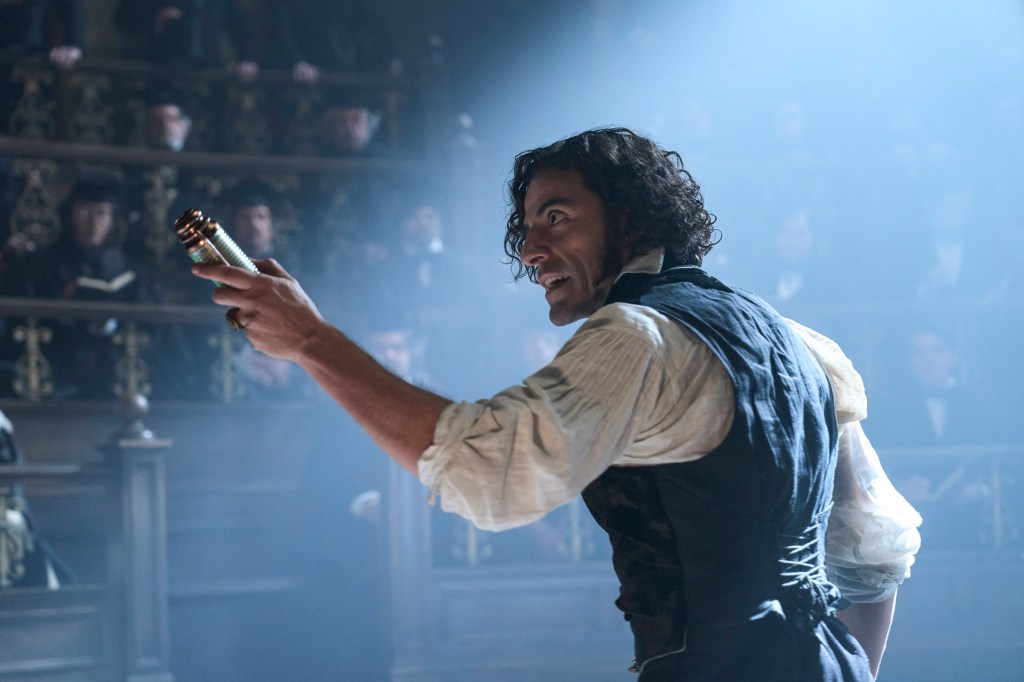

Mary Shelley’s Frankenstein maintains a ubiquitous presence throughout cinema’s history, whether it be in the form of James Whale’s adaptations starring Boris Karloff as the monster, or in parodies like Mel Brooks’s Young Frankenstein. That wouldn’t be enough to deter Guillermo del Toro from wanting to make his own spin on the familiar tale, as this had been a passion project for the Academy Award-winning filmmaker. Of course, for a filmmaker like Guillermo del Toro, whose longstanding love of fantasy and science fiction can be felt through his whole career, Frankenstein is a story that feels perfect for his sensibilities. This is felt, not just through how del Toro presents this familiar story as his own, but in his faithfulness to Shelley’s text.
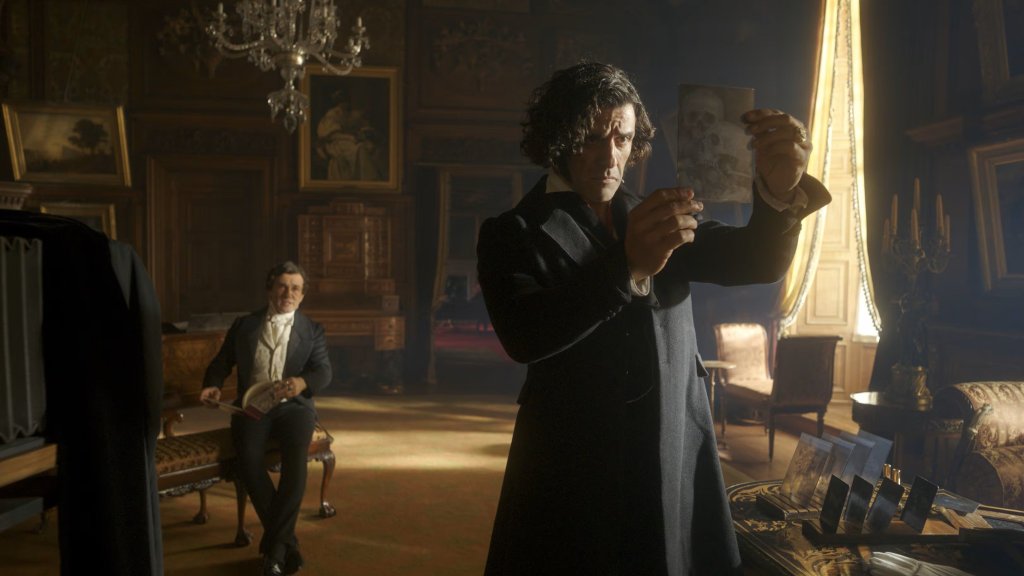
Unlike the previous adaptations of Frankenstein, Guillermo del Toro’s take on the Mary Shelley story is one coming at the story from two vastly differing perspectives. We know the story very well: the ambitious scientist Victor Frankenstein (Oscar Isaac) takes on an experiment that transcends the boundary between life and death. The end result of this is a creature having built from the parts of decomposing corpses (Jacob Elordi), first believed to be dangerous, but capable of understanding the best and worst of humanity. The film is, accordingly, split into two chapters which emphasize Frankenstein and his creation’s role in a greater tragedy. It’s a change that feels welcome, considering how much of Shelley’s original story has been eschewed in past adaptations. This is also where del Toro’s love for the source, given its iconic status, allows an opportunity to see the story through his own means.
I’m a very big fan of Guillermo del Toro, so naturally the idea of him making his own spin on Frankenstein would be very enticing to me. In all of his best films, we get to see him making the most out of a gothic influence in his own storytelling, as seen in early films like Cronos leading Pan’s Labyrinth and The Shape of Water. The very premise of Frankenstein is something that feels like a perfect match for del Toro, especially when we’re seeing him show the beautiful costumes and sets; courtesy of New Zealand costume designer Kate Hawley and Canadian production artist Tamara Deverell. Accompanying this is cinematography from Dan Laustsen, who also shot The Shape of Water and Nightmare Alley, ensuring that every fine detail of these sets is shown off with such grace.
Even while del Toro hews faithfully to the tone of Shelley’s novel, he isn’t one to keep his whimsy out of the picture. Every minute of this take on Frankenstein unfolds with the same fairy tale-esque approach that gave life to his most famous works. This might also be where I find that he’s also re-entering familiar territory once more, without really offering much new to the table. The relationship between monster and humankind is something we’d seen beautifully done in The Shape of Water, but in Frankenstein’s case it almost seems like it renders the titular role and his creation into the most simplistic characterizations. Victor Frankenstein being an ambitious scientist with little regard for people around him is one way to approach this role, but it’s a very literal-minded read that boils down the morality play to its most obvious. Nonetheless, it’s fun to watch what Oscar Isaac does with this part: because he feels like he lives and breathes this role.
However, Jacob Elordi’s role as Frankenstein’s creation is one that feels revelatory. It feels revelatory in the sense that we’re seeing Elordi push himself as an actor, allowing a very soft-spoken quality that emphasizes the both the beauty and most frightening aspects of a newly created life form. It’s one thing to note that he might be under heavy makeup as required for this part, but Elordi’s take on a familiar monster never shies away from the tragic qualities that Mary Shelley’s text had called for. When the film shifts its focus on his perspective, it seems like this is where del Toro gets to really show his love for Frankenstein on the whole. He’s someone who feels greatly for Frankenstein’s creation, down to highlighting the manmade horrors that the creature witnesses, even as he’s capable of learning the best of humanity. There’s a very beautiful scene he shares with David Bradley, who’s perfectly cast as the Blind Man, that highlights all of del Toro’s best instincts. And in service of this story, it works perfectly.
From first frame to last, you can really tell that this is a movie that Guillermo del Toro has wanted to make for a very long time. And as such, it may be the director’s most ambitious work to date, given that he had initially sketched out Frankenstein as an epic; which is felt in its massive running time. I can’t say that it always works, because I had found myself feeling the length more often than not. But when Guillermo del Toro gets to show off how much he loves the text, you sense that many of his best instincts as a storyteller are at play. This may not be the definitive screen adaptation of Frankenstein, but it’s hard to deny that this movie was crafted with immense love from beginning to end. By the end, I just simply let myself be swept away by it: I think though, that there are many ideas here which Guillermo del Toro had done better in past films.
Watch the trailer right here.
All images via Netflix.
Directed by Guillermo del Toro
Screenplay by Guillermo del Toro, based on the novel Frankenstein; or, The Modern Prometheus by Mary Shelley
Produced by Guillermo del Toro, J. Miles Dale, Scott Stuber
Starring Oscar Isaac, Jacob Elordi, Mia Goth, Felix Kammerer, Lars Mikkelsen, David Bradley, Charles Dance, Christoph Waltz, Lauren Collins
Premiere Date: August 30, 2025 (Venice)
Running Time: 149 minutes

 Cinema from the Spectrum
Leave a comment