
It’s hard to believe that after nearly 30 years in the industry, Dust Bunny marks the feature directorial debut of Bryan Fuller. For anyone familiar with his career, Fuller has long been one of television’s most distinctive voices. He began writing for Star Trek: Deep Space Nine, later becoming a staff writer, story editor, and eventually executive story editor on Star Trek: Voyager. Decades later, he returned to the franchise to create Star Trek: Discovery, which concluded last year.
After Star Trek, Fuller developed a string of television series that earned cult followings, including Dead Like Me, Pushing Daisies, and perhaps his most celebrated work, Hannibal. That show reimagined the iconic character of Hannibal Lecter from the novels of Thomas Harris and became a rare network drama that tested the limits of what could be shown on television.
Hannibal also helped introduce Danish actor Mads Mikkelsen to a broader North American audience. Though he had already made an impression as Le Chiffre in Casino Royale, his performance as Lecter solidified his international reputation and opened the door to a long and varied film career.
Still, if you had told me that Bryan Fuller would one day make a film in the vein of Jean-Pierre Jeunet or Tim Burton and that it would actually be family friendly, I would have owed you money. You can immediately tell that Dust Bunny draws on the quirkiness and visual charm of Fuller’s earlier work like Pushing Daisies and Dead Like Me, while staying far lighter in tone than Hannibal.
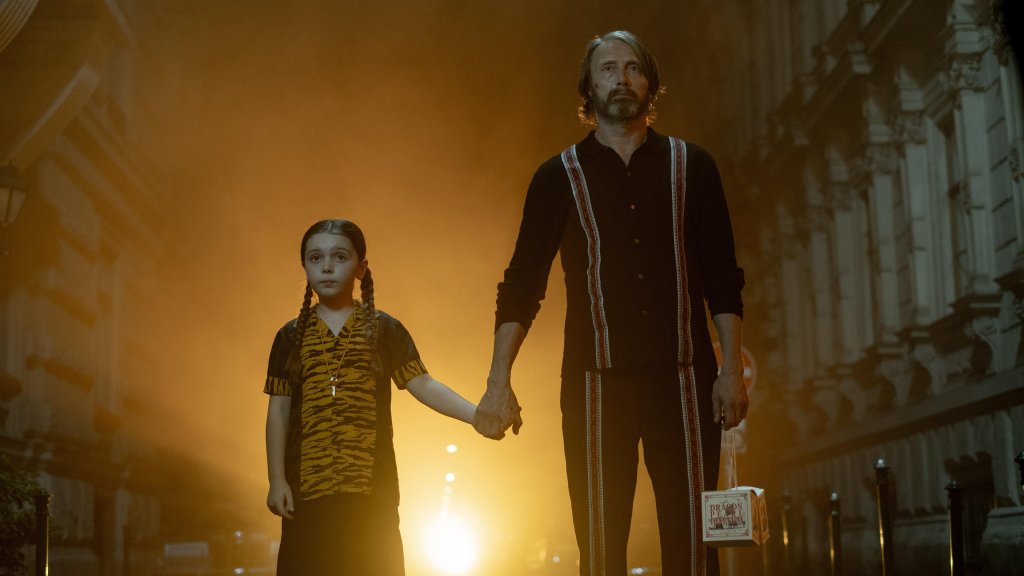
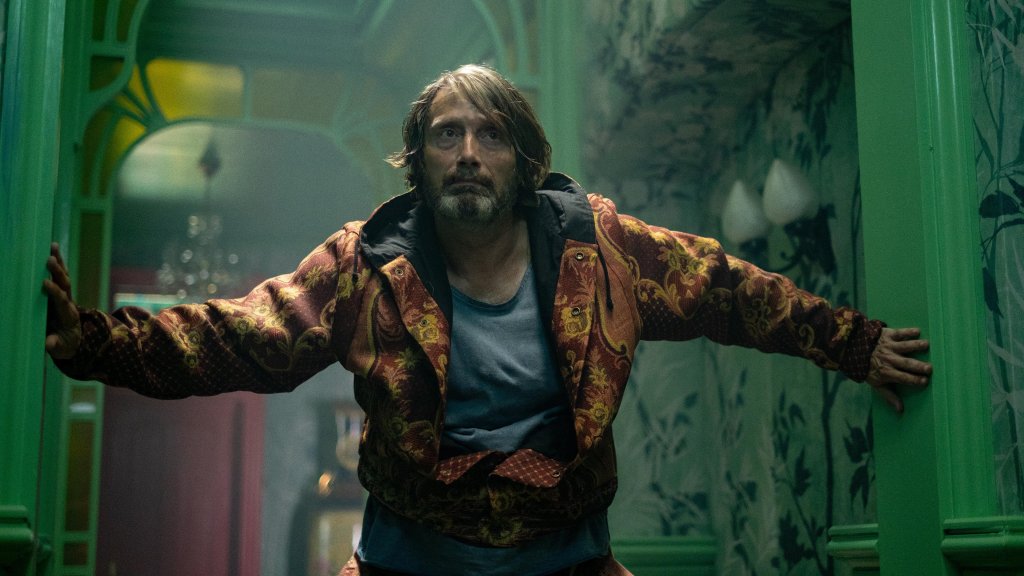
Mads Mikkelsen plays a nameless hitman, credited simply as “Intriguing Neighbour,” who lives in the same apartment building as Aurora (Sophie Sloan, in her debut). After Aurora’s family is killed by a monster living under her bed, it soon becomes clear that the creature does not just lurk beneath her mattress but within the very floorboards of her home. In some ways, Dust Bunny takes the childhood game “the floor is lava” and transforms it into a surreal, nightmarish concept that works both as fantasy and metaphor.
What truly makes the film stand out is its visual palette and Jeremy Reed’s richly textured production design. I mentioned Jeunet earlier, and that influence is unmistakable in the bright, saturated colors and the whimsical clutter that make the world feel as if it’s being seen entirely through a child’s eyes. One of the funniest props is a chicken with a lightbulb coming out of its rear end, meant to represent an egg, which perfectly captures Fuller’s offbeat sense of humor. That same spirit carries into smaller moments, like a dinner scene where the characters share dim sum, with some delightfully strange dishes created by Hannibal’s food consultant Janice Poon.
It’s a simple and somewhat ridiculous premise that, in the hands of another director, could have been forgettable. But Fuller writes sharp, playful dialogue, and Mikkelsen’s dry, deadpan performance grounds the film in something emotionally real. Sophie Sloan, meanwhile, is a revelation. After the Midnight Madness premiere, Fuller revealed that Sloan has a thick Scottish accent and spent five months perfecting an American one. It never once slips through, which is a testament to both her preparation and her natural screen presence.
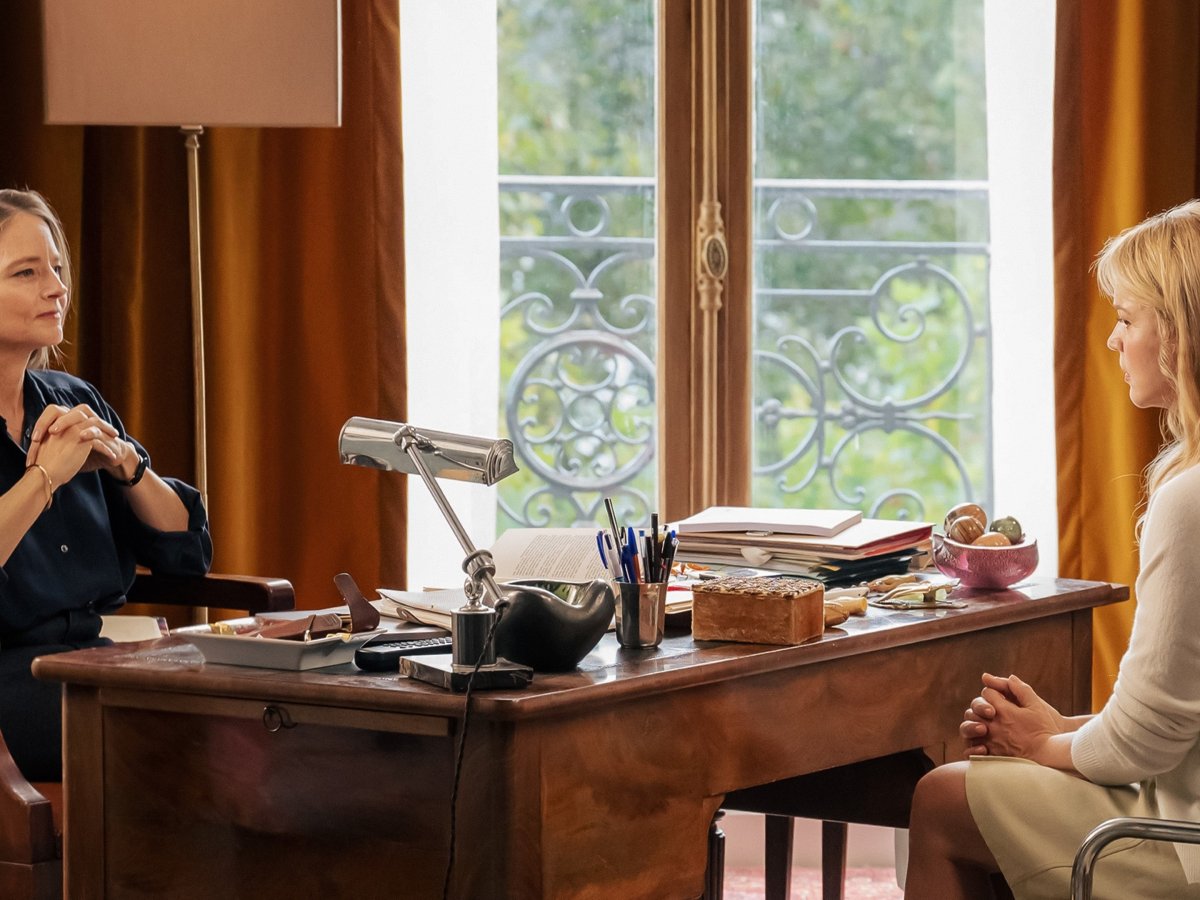
Along the way, Sigourney Weaver appears as Laverne, a mysterious handler to Mikkelsen’s Hitman who seems to have her own connection to the creature. Weaver brings a presence that immediately steadies the film, grounding its stranger moments in a kind of weary authority. She plays the role with a dry wit that fits perfectly within Fuller’s heightened world.
As the story unfolds, Dust Bunny balances its darker moments with a real sense of wonder. The film moves at a brisk pace, and while the plot occasionally leans on sentimentality, it feels sincere rather than forced. Fuller’s command of tone is impressive; he manages to create a film that is visually rich and thematically playful without losing its emotional core.
The creature design is another standout. Rather than relying too heavily on digital effects, Fuller opts for a tactile, almost storybook quality that recalls the practical ingenuity of Pan’s Labyrinth or Coraline. The monster itself feels like a manifestation of childhood fear, existing somewhere between the imaginary and the real. It is scary enough to unsettle but still rooted in the fantasy logic of the film’s world.
By the time the credits roll, Dust Bunny feels like the kind of debut that only a veteran storyteller could make. It carries the visual flair of Jeunet, the macabre humour of Burton, and the narrative precision of Fuller’s best television work. Most importantly, it shows that Fuller has successfully translated his distinct sensibility to the big screen without losing what made his earlier projects so beloved.
It is an odd, tender, and deeply sincere piece of work that proves Bryan Fuller has just as much to say in cinema as he ever did in television. Dust Bunny might be small in scale, but it is bursting with imagination, and it feels like the start of a fascinating new chapter for one of TV’s most distinctive creators.
Watch the trailer right here.
All images via Lionsgate.
Directed by Bryan Fuller
Screenplay by Bryan Fuller
Produced by Basil Iwanyk, Erica Lee
Starring Mads Mikkelsen, Sophie Sloan, Sigourney Weaver, David Dastmalchian, Rebecca Henderson, Sheila Atim
Premiere Date: September 9, 2025 (Toronto)
Running Time: 106 minutes

 Cinema from the Spectrum
Leave a comment