
Bradley Cooper has had a long and storied career as an actor. Recently, he has moved behind the camera as a director with A Star Is Born and Maestro, both of which received significant critical acclaim and multiple Oscar nominations. With his new film Is This Thing On?, he still appears onscreen, but in a far more restrained capacity. The film itself is smaller and more intimate, narrowing its focus almost entirely onto a single relationship. Cooper’s filmmaking here is notably controlled and pared back, adopting a cinéma vérité–inflected approach that privileges behavioral detail and emotional proximity over heightened dramatic emphasis.
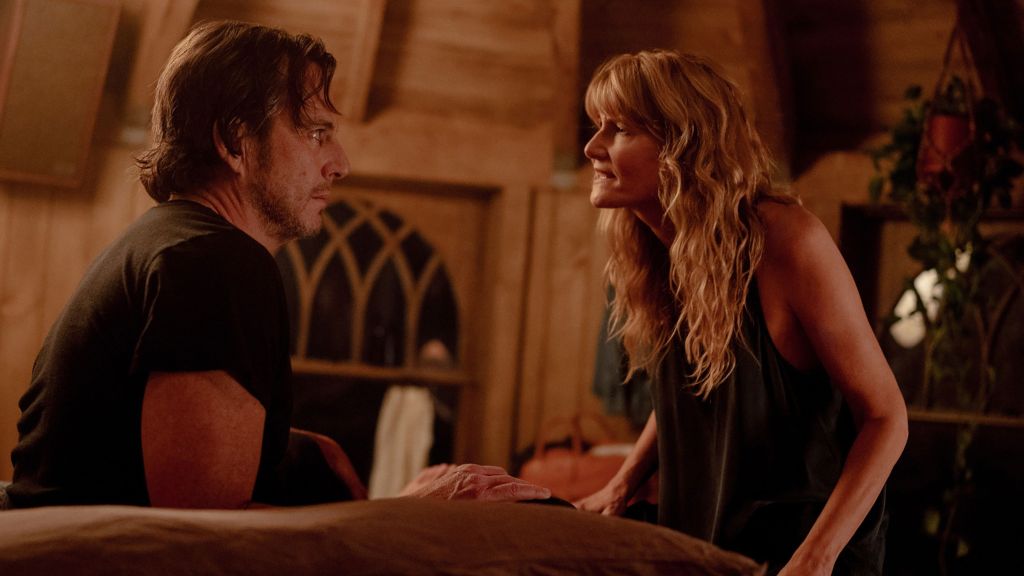
Is This Thing On? follows Alex Novak (Will Arnett) and Tess Novak (Laura Dern), a couple who decide to separate. Much of the film centers on Alex and how he navigates the emotional fallout of that decision, not only in relation to Tess but also their children, Felix and Jude (Blake Kane and Calvin Knegten). Arnett is an especially strong choice for the role. His career has often drawn on personal pain, particularly his struggles with alcoholism, which he explored openly in Flaked and BoJack Horseman. That background lends a quiet authenticity to his performance here, allowing comedy and vulnerability to coexist without strain.
The film is loosely inspired by the life of British comedian John Bishop, particularly his experience translating personal upheaval into stand-up material, a tension that becomes central to the film’s emotional logic. It opens in a quiet suburb outside New York City, It opens in a quiet suburb outside New York City, establishing the central conflict with minimal exposition. We see Alex and Tess for the first time as they brush their teeth one night, when Tess quietly asks, “Should we call it?” The line lands with precision, suggesting a relationship already past saving, its end treated not as a rupture but as an exhausted recognition.
The separation is amicable, and the couple attends a gathering with close friends. Among them are Christine (Andra Day) and Alex’s best friend Balls (Cooper), whose marriage is clearly faltering. Also present are newlyweds Stephen and Geoffrey, played by Sean Hayes and Scott Icenogle. Together, the group forms a quiet cross-section of marriage in various states, from stability to strain to collapse.
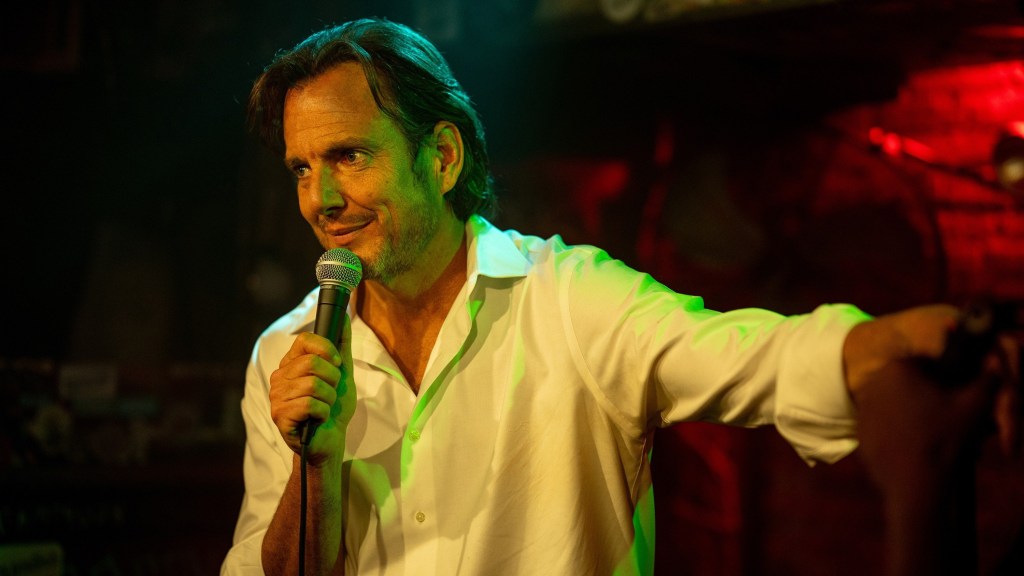
In the aftermath of the separation, and after consuming a marijuana cookie, Alex wanders into the Comedy Cellar and puts his name down for an open mic when he realizes he cannot afford the bar’s cover charge. What begins almost accidentally soon becomes routine. Performing stand-up becomes a form of therapy, a way for Alex to process his divorce and slowly reconstruct a sense of who he is outside the marriage.
While stand-up comedy becomes a crucial outlet for Alex, the film never presents it as a cure. Onstage, Alex is articulate, funny, and in control, able to shape his pain into something consumable. Offstage, he remains emotionally stalled, repeating familiar patterns rather than moving through them. Cooper seems less interested in celebrating self-expression than in questioning its limits. This contrast becomes especially clear when Tess wanders into a comedy club and finds herself watching Alex publicly recount the most private details of his life, unaware that he is performing material drawn directly from their shared history. What plays as confession for an audience registers as distance for those closest to him. Public expression offers Alex release, but it also allows him to sidestep the harder work of private intimacy, where there is no audience and no laughter to soften the truth.
Matthew Libatique’s camera work further reinforces this restraint. Having shot Cooper’s previous two films, Libatique brings a distinct visual texture to the film, shooting New York in a style reminiscent of 1970s New York filmmaking before shifting to a more intimate handheld approach inside the Comedy Cellar. One recurring visual motif is a lion dance associated with Chinese New Year, traditionally meant to symbolize good fortune, prosperity, and the warding off of evil spirits, a gently ironic bit of symbolism given what Alex and Tess endure.
While Alex remains the film’s primary emotional lens, Tess is granted a degree of interiority that prevents her from functioning merely as a point of contrast to his struggles. We learn that she is a former volleyball player talented enough to compete at an Olympic level, a path she ultimately set aside to raise a family. Now in her mid-fifties, Tess has transitioned into coaching. She also goes on a date with her longtime friend and fellow coach Laird, played by Peyton Manning, who comes across as natural and relaxed, recalling the ease he displayed during his stint hosting Saturday Night Live.
The film’s emotional quietness feels purposeful rather than evasive. Cooper avoids staging immediate confrontation, allowing restraint, avoidance, and unresolved feeling to accumulate before finally breaking open in the third act. When the tensions between Alex and Tess finally surface directly, they feel exposed rather than manufactured. Alex does not arrive at sudden clarity, but he does reach a different emotional position than where he began, one shaped by acknowledgment rather than performance. The resolution offers neither easy catharsis nor total reinvention, instead suggesting a tentative forward motion rooted in honesty and acceptance. By privileging emotional process over narrative payoff, Is This Thing On? mirrors the slow, often unglamorous way people actually live through rupture. It is a film less concerned with transformation than with emotional presence, and more interested in sitting with discomfort than rushing toward closure.
Watch the trailer right here.
All images via Searchlight Pictures.
Directed by Bradley Cooper
Screenplay by Bradley Cooper, Will Arnett, Mark Chappell
Produced by Will Arnett, Bradley Cooper, Weston Middleton, Kris Thykier
Starring Will Arnett, Laura Dern, Andra Day, Bradley Cooper, Scott Icenogle, Sean Hayes, Ciarán Hinds, Christine Ebersole, Amy Sedaris, Peyton Manning
Premiere Date: October 10, 2025 (New York Film Festival)
Running Time: 121 minutes



 Cinema from the Spectrum
Leave a comment