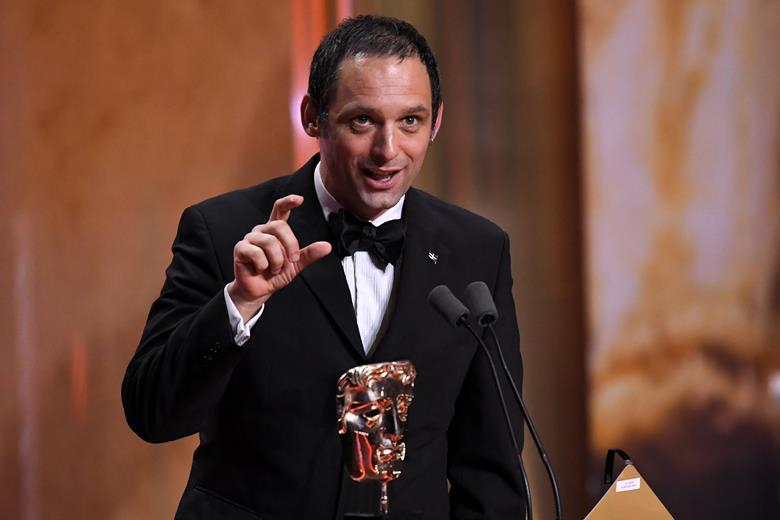

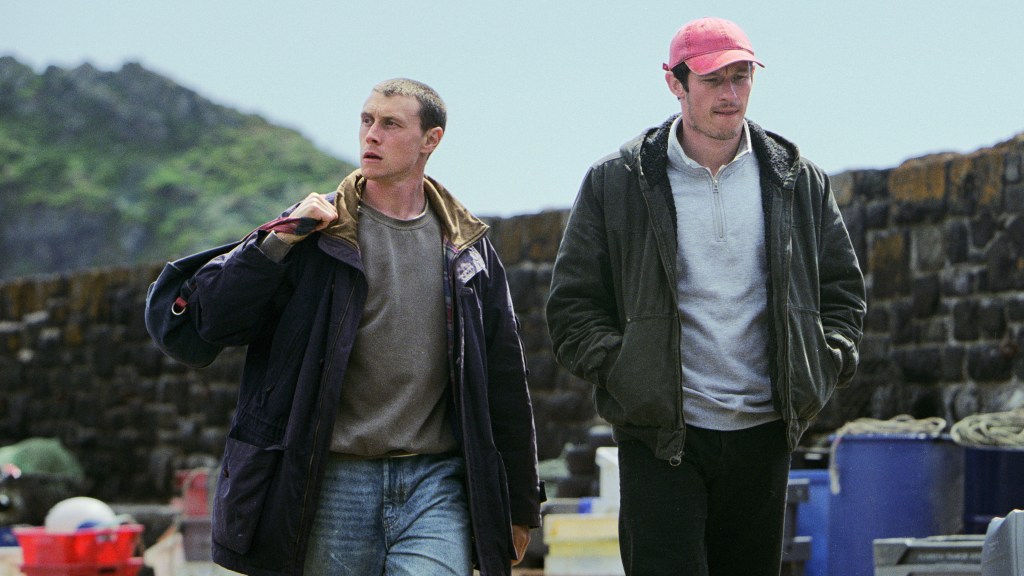
A few weeks ago, I had the pleasure of speaking with BAFTA-winning filmmaker Mark Jenkin about his film Rose of Nevada, which opens in Toronto this coming weekend. Best known for the films Bait and Enys Men prior, his third feature film stars George Mackay and Callum Turner as two fisherman who board a fishing vessel that was lost thirty years prior, later finding themselves transported through time. Below is our conversation.
I want to start by asking, where did the idea for this film come from?
Well, I’ve had the idea for the opening scene for a long time: the idea that this boat had come back to a harbor thirty years after it was lost with all the crew. And I’d never really done anything with the idea, it was just a little sequence that I had in my head. I could see all the shots, and they’d been there for a long time. I actually didn’t shoot it exactly the same as how I’d had it in my head, because of the constraints of the location, so it was not exactly how I saw it. But the feeling had been there for a long time.
But it was during the pandemic, and my previous film, Enys Men, was supposed to be made, and we got shut down. Then I thought, while we’re all locked up in the house, I need to write something. And Mary (Woodvine), my partner who’s also in the film, said to me, “You got any ideas?” I said, “Well, I’ve got that ghost boat idea about a boat coming back from thirty years ago.” And she said to me, “What happens after it comes back?” Then I said, “Well, that’s the problem, I don’t know. That’s why I never developed it into a bigger story.” She said to me, “What happens if not everyone in the community is surprised that the boat has come back?” And that was the moment that opened up for me, where I said “That’s really interesting.” At that point, it stops being about a mystery about why the boat has come back. It starts being a mystery about why not everyone in the community seems to be surprised. From that moment, I wrote it from there, me and Mary batted idea backwards and forwards. We created this whole world based on that opening scene that I’d had in my head for a long time. I have no idea where I got that opening scene from. It just came into my head.
And it’s a great, very distinct opening scene too. Since you brought up Enys Men, I wanted to mention that I was a great admirer of that film. I saw it when it opened theatrically over here and I’ve been telling most people I know up close that they needed to see it once they got the chance. But I also wanted to make a note that compared to Enys Men, Rose of Nevada is a bit of a bigger film in terms of scale. I wondered if you could talk a little bit more about what moving into something bigger has felt like for you.
In some ways, it’s much bigger. There’s big changes. And in other ways, it’s exactly the same. I think if you’ve wandered onto the set of Enys Men and Rose of Nevada and hung around with me while I was shooting the film, you wouldn’t notice much difference. Rose of Nevada was still me working with a clockwork 16mm camera, and around my neck was a light meter, and then over my shoulder was a big with rolls of film. So what I was doing was kind of exactly the same on Enys Men.
We had a much bigger art department on the production side of things. Our producer Denzil Monk had a much bigger team to produce the film. So as the money goes up, based on the demands of the script, then the production does get bigger and bigger. But I was really protected from that. Denzil really made sure that I could make the film in the way that I wanted to make it, which was very much in the same ways as Enys Men. I think then, if it was different in any other way in terms of expectations, there may be more. As it’s going to open wider in cinemas, it’s going to take more money, there’s more press to do, and luckily, I really enjoy doing all of this. I think it’s a big change, but not one that I’m resisting. I think the thing I’m really grateful for, is that I’ve got a really amazing producer in Denzil Monk, who recognizes where my strengths are. And he knows what I want to be doing, sometimes before I realize. He knows what’s important to me before I’ve even articulated what’s important to me. So he protects me from anything changing that would be damaging to the way that we work.
I agree, it’s great to have a producer who will always look out for you. I also read that, to my understanding, you also view this film as part of a trilogy together with Enys Men and Bait. Was that something you always had in mind?
No, I never had that in mind. This is another example of me being a bit behind from everyone else. So the BFI in the UK distributed Bait, Enys Men, and then they bought Rose of Nevada after we premiered in Venice last August. I think it was Stuart Brown from the BFI, a good friend of mine, who was part of the team who bought the movie. And he said “We’re going to complete the Cornish trilogy.” I think that was the first time I had heard it said. The first time, I said “I don’t think of it as a Cornish trilogy.” It sounds like the end of something, completing a trilogy. And my first instinct was, “Well, I don’t want it to be the end of it.”
But then I thought, actually, my outlet, who’s normally quite positive, well, if it’s the end of that, that means it’s the beginning of something else. And now I’ve totally embraced the idea of a Cornish trilogy. And also, it’s handy for marketing. In the UK, there’s going to be a Blu-ray box set released which is called “the Cornish trilogy.” It will have all three films and lots of extra features, and all the short films I made during the time of making the Cornish trilogy. So I am referring to it as the Cornish trilogy now.
Like Enys Men, you also utilize film stock. I want to know more about your relationship with using film.
All of my feature films are 16mm. I do hope to make a Super 8 feature film at some point. There’s not enough rolls yet. I use a Bolex H16 camera, made in the 70s to shoot 16mm, so it’s in the Academy ratio of 4:3. I’m going to be shooting a road movie at some point over here in the States. And I’ve got another Bolex that’s been adapted for Super 16 to get a wider image. So this was Kodak color negative, processed by Kodak. When I shoot black-and-white, I normally process it myself. But when we’re shooting this amount of colour, I get the lab to do it. I love 16mm because I love a grainy image. And I find that Kodak 35mm stock is now so amazing, the grain is so fine.
So I started shooting on 16mm out of necessity because it was cheaper. Now, it’s definitely an artistic choice because I love the grain of the 16mm image.
I’m going to make a wild guess, and assume you will eventually hope to shoot on 35mm?
I don’t think so. As long as I can keep shooting on 16mm, while it’s still available, I’ll use it. I have got a 35mm camera, which, when I got it, I fully intended to shoot something on it. But I’d never done it, because every time I want to shoot something, I just reach for the 16mm.
My last question is about your relationship with your actors. You also feature Edward Rowe and Mary Woodvine, and directing them alongside George Mackay and Callum Turner. I want to know if your approach to directing actors changes a little bit, especially when you’re working with actors who are far more widely recognized.
Not at all. Everybody is the same. I talk to people differently if I know them, and if I don’t know them. My core team of actors whom I work with on all the films is Mary Woodvine, who’s also my partner, Edward Rowe, and the other person is Mae Voogd, who plays George’s wife in the film. She’s (Voogd) been in all of my films to a greater or lesser extent. And she’s also worked on the crew in the art department. So the three of them I know really well. And I have a way of interacting with them.
What I needed to do on Rose of Nevada was to get to know George and Callum, and the rest of the cast whom I didn’t know, as well as everybody else, so that I could direct them in the same way. We had a prep week, before I started shooting. That was quite intense, because I spent a lot of time working with George and Callum. We just took time getting to know each other. We weren’t rehearsing necessarily, we weren’t even discussing the film a lot of the time. We were just going down to the beach and going for a swim, and hanging out. So then all of my personal interaction barriers were broken down. I’m quite introverted a lot of the time. I need to get to know the people before I can be relaxed with them. But once I am at that level, then direction is exactly the same. And I think George and Callum and the rest of the cast learned a lot from Ed, Mary, and Mae. Ed, Mary, and Mae worked a lot with me. I’ve worked in Cornwall, I’ve done this process before, and in a lot of ways, I think they took a lot from my regular contributors.
All images via BAFTA and 1-2 Special.


Leave a Reply