
✯✯✯✯✯
When The Wind Rises opened in 2013, Hayao Miyazaki once said that it would be his swan song. The same can also be said about the time when Miyazaki said he planned to retire after Howl’s Moving Castle, but it’s a bit too clear that every time he’s said this, it’s clear he loves the medium so much for him to truly retire from filmmaking. But the pause in between The Wind Rises and this film, The Boy and the Heron, makes it feel like Miyazaki is using the medium to look back at his own journey into adulthood. And given how late into his career he is right now, it also gives The Boy and the Heron a bittersweet angle just as he’s accomplished in all his best films.
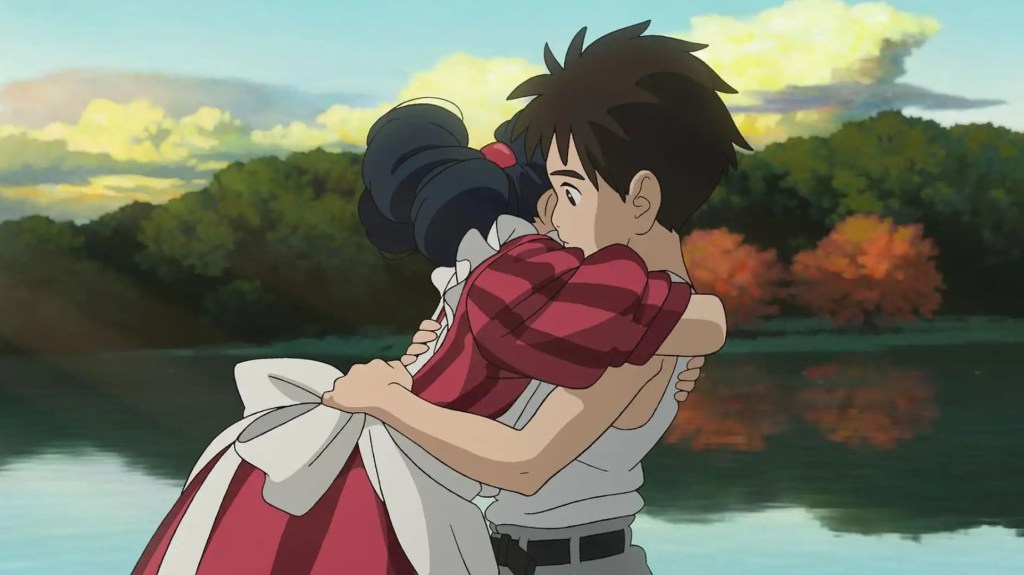
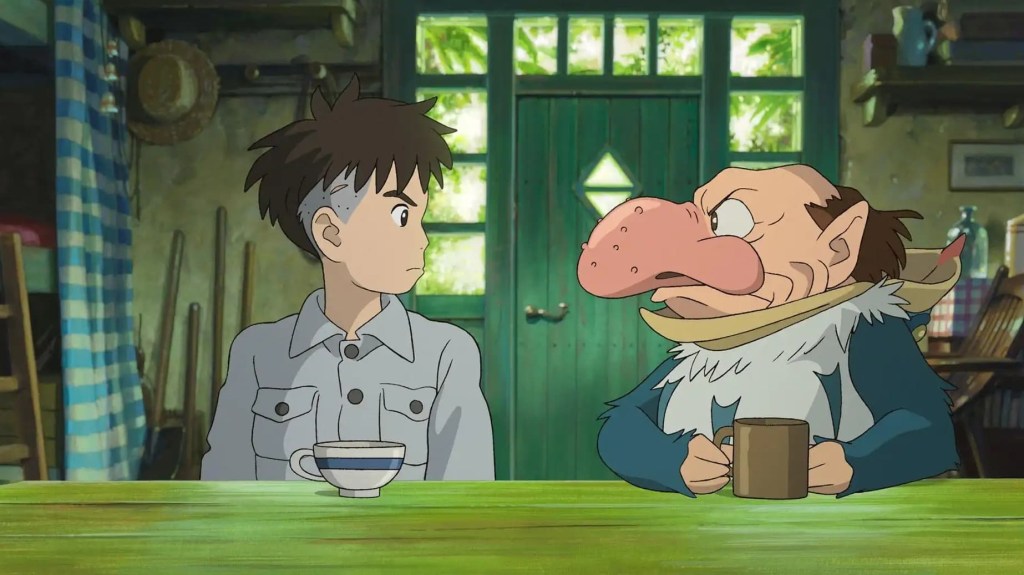
Set during WWII, The Boy and the Heron tells the story of the young Mahito Maki (Soma Santoki), a twelve-year-old boy haunted by the death of his mother. After relocating from Tokyo to a rural home, he is taken aback by his new stepmother’s (Yoshino Kimura) resemblance to his mother. But while there, strange things start happening around himself, first with a gray heron (Masaki Suda) proclaiming he is the “long-awaited one.” Deciding to follow along with the strange circumstances, he soon is led on a journey that allows him to better understand the people whom he loves most. Borrowing its original Japanese title, How Do You Live?, from the novel of the same name by Genzaburo Yoshino, what Miyazaki sets out for with The Boy and the Heron feels like the legendary Japanese animator at his most self-reflexive, as a long-awaited follow-up from The Wind Rises would have it.
It should be no surprise that Hayao Miyazaki’s art style has never stopped looking as beautiful as ever all throughout the years. Perhaps it might be evident that this homely style has become as easy a trademark as ever for someone like Miyazaki, but The Boy and the Heron still captures that feeling of childlike wonder as he’d perfected all through the years. Whether it be in films like Castle in the Sky, My Neighbor Totoro, Spirited Away, or Ponyo, one of Miyazaki’s strongest points throughout his career is his ability to speak towards how youth are able to see the world around them, and always strive to make it better for the people whom they care about. For something like The Boy and the Heron, it also feels like Miyazaki is positioning himself as a filmmaker wanting to reckon with what he never was able to properly understand as a child, before asking the question of how he’ll continue to live on afterward.
Like The Wind Rises which preceded this, Miyazaki also looks back at the stories that he’s become very well-known for in the West and molds another journey out of familiar threads with another light. In how The Wind Rises finds beauty in the creation of the airplanes that Japan would use to fight during WWII, The Boy and the Heron speaks to how Miyazaki looks back at his own storytelling, in order to show the viewers the sort of person that he had grown up to become over the years. A lot of this is reflected in how the young Mahito’s journey through a fantastical world with a strange heron as a guide of sorts helps him better grasp what’s going on with the people whom he loves greatly. But this also works to create a picture all about the legacy that he wants his own loved ones to have, especially when they’re being immortalized on the screen. And just as Miyazaki has managed to reach out to children all through the years, he’s making a movie all about who he was at heart, and his need to bring these stories out to the world.
But even though Hayao Miyazaki’s primary audience through his days at Studio Ghibli has more often than not, been children, he’s no stranger to making his films fittingly dark in a way that invites adults. All this has been clear through films like Princess Mononoke and The Wind Rises, some of Miyazaki’s forays into making animated films for adult audiences. Yet The Boy and the Heron feels as if it were inviting adults to experience what they remembered seeing from his films as they’ve grown up with him over the years, to understand the real world through fantasy. All this is made clear through sly elements that teeter towards almost frightening areas going through many different realms of reality, as children come to understand the world around them. Sometimes it’s frightening, especially when we look back at the memories we’ve made for ourselves as kids, but as adults, Miyazaki shows that the confrontation of them is absolutely necessary in some form or another.
Many have gone on to talk about how it could be possible that The Boy and the Heron may very well be Hayao Miyazaki’s last film, especially after it was long thought that The Wind Rises may be that. Even though we know Hayao Miyazaki has continued to work on more new projects for the world to see in the coming days, it’s clear through his love of the medium that The Boy and the Heron is a culmination of what he’s wanted to share with us over the years. He doesn’t want us to think he’ll be going anytime soon, because there are more stories to tell about the world we know as is. It’s a coming-of-age tale unlike any other, there’s not a moment without visual beauty in The Boy and the Heron, but it feels like childhood catching up to us in the best way possible. And even if he were to say “goodbye,” it’s clear that Miyazaki wants us to be happy that we experienced his art while we could.
Watch the trailer right here.
All images via Toho.
Directed by Hayao Miyazaki
Screenplay by Hayao Miyazaki
Produced by Toshio Suzuki
Starring Soma Santoki, Masaki Suda, Aimyon, Yoshino Kimura, Shohei Hino, Ko Shibasaki, Takuya Kimura (Japanese version)
Starring Luca Padovan, Robert Pattinson, Karen Fukuhara, Gemma Chan, Christian Bale, Mark Hamill, Florence Pugh, Willem Dafoe, Dave Bautista (English dub)
Release Date: July 14, 2023 (Japan)
Running Time: 124 minutes

 Cinema from the Spectrum
Leave a comment