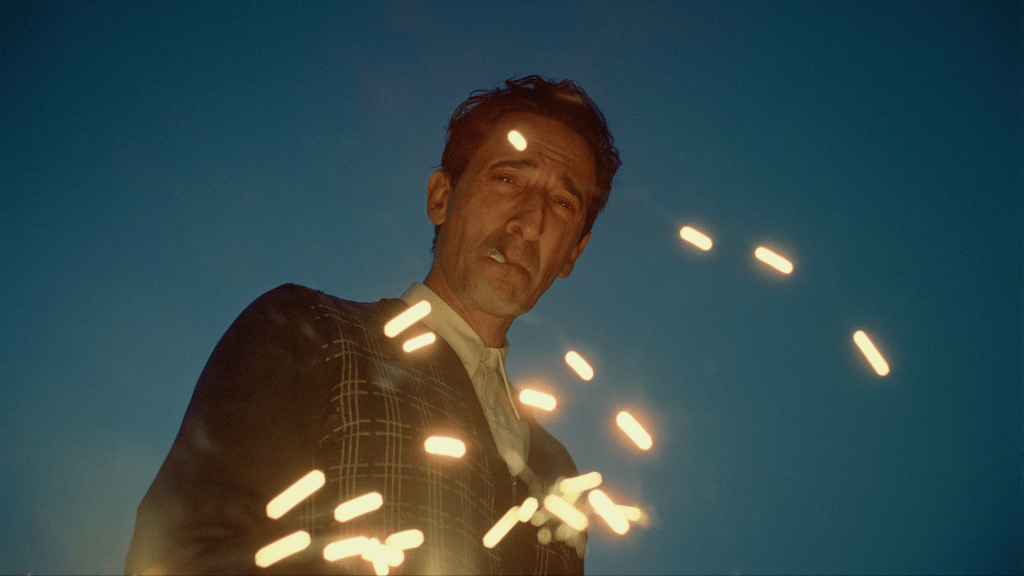

The sheer scope of The Brutalist is a sight to behold. It’s a movie that encompasses the foundations of the United States of America as we know it now, but also how post-war European immigrants are looked upon entry. Perhaps that might be one among many things you’ll take away from watching The Brutalist, but as a portrait of post-WWII America and the means that Holocaust survivors go through in order to thrive after they’ve been displaced from a land that they’ve known for so long. It all unfolds in a manner akin to a great novel, but impressively, Corbet isn’t even adapting anything – we’re seeing him show us America just the way he knew it too. And that alone might be something to account for.
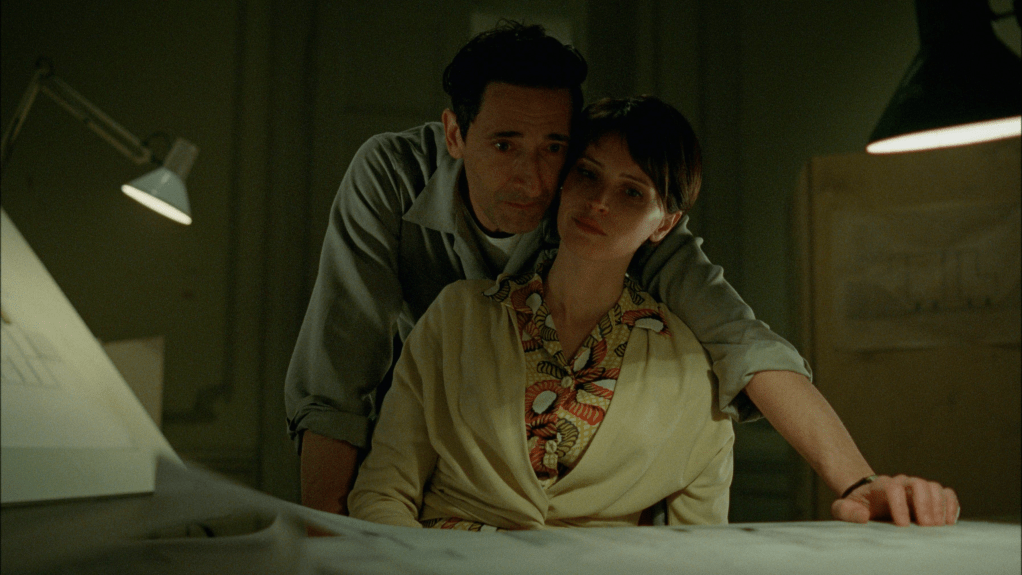
Adrien Brody stars László Tóth, a Jewish Hungarian architect living in Budapest together with his wife Erszébet (Felicity Jones) and niece Zsófia (Raffey Cassidy) in Budapest during World War II. Eventually, he is forcibly separated from them as a result of the Holocaust and eventually he emigrates to Philadelphia, where he is taken in by an eccentric and wealthy industrialist Harrison Lee Van Buren (Guy Pearce). From here onward, László’s life could only find itself changing for the better, for he finds an opportunity to prosper through the American Dream – for it’s exactly what would be expected of many who come into the United States around that time, but it’s also the system which Brady Corbet is interested in interrogating.
Ever since 2015’s The Childhood of a Leader, Brady Corbet has wanted to establish himself as a new auteur of American cinema of sorts after having started his career in acting. But it’s also a style of filmmaking that feels indebted to the epics by way of David Lean or Francis Ford Coppola, which relatively few filmmakers can pull off successfully (perhaps one of the only contemporary American filmmakers to accomplish such is Paul Thomas Anderson). That Brady Corbet hopes to be seen within a similar calibre is one thing, but with The Brutalist it seems like he’s trying to harken back to another era with a time capsule of sorts. And for that alone, it’s hard not to get swept away by the sheer scope of this film – for it’s also one of the most beautiful films of the year.
What’s most impressive about the sheer beauty of The Brutalist, in addition to Brady Corbet’s clear ambitions to make the biggest possible film that he can, is the fact that he’s working with a very modest budget too. Compared to the over $100 million budgets of recent epics like Oppenheimer or Killers of the Flower Moon, The Brutalist only cost a meager $10 million to make – yet it still feels like there’s a much bigger world being captured on the spot. It’s a world that extends far past the foundations of the United States, but given how the film starts within post-war Hungary, it feels like you’re watching a film that was made for much more than what it actually cost to make. That Brady Corbet was able to bring forth an epic of this sort with so little, only feels like an indictment of the studio system that constantly churns out blockbusters without a distinct visual panache and the ridiculous amounts of money spent on said films in turn.
And yet, the story itself is one that warrants both its massive scope and gargantuan running time. With a running time of 215 minutes with the inclusion of a 15 minute intermission, it’s a film that really brings you within the roots of the reality that is the American Dream – while it’s constantly touted as being the ideal gateway to paradise according to many wealthy American citizens, we’re also seeing it as a form of exploiting the United States’ immigrant population, especially within the shadow of the Holocaust. While soldiers constantly are branded as heroes of war for saving the Jewish population from concentration camps, many of the same citizens as we are seeing in here are struggling to make ends meet for themselves – even László Tóth at that.
This also involves the rise of Zionism within the United States, and the formation of Israel as a means of allowing the Jewish population a chance to return to what they believe to be the homeland. But even seeing all of this unfold through László’s perspective, we’re seeing how even his talent for architecture is being undermined by Harrison Lee Van Buren, with the latter deeming his superiority as the result of his wealth. Yet there’s only so much that László can do within the moment given the promise for a prosperous life for Jewish people following the Holocaust, especially while his family are continuously suffering under the guise that they will receive the better life for their efforts.
It all culminates in one of the most heartbreaking performances of Adrien Brody’s career – perhaps the most impressive he’s been on the screen since his Oscar-winning role in The Pianist. Most of the film is carried on his shoulders, much like the elaborate architecture which he’s building, but it also feels like a statement made about an artist’s relation with a system that exploits them. Perhaps this might be how Brady Corbet ultimately views this pursuit in the long run, but to frame it all as an epic story of this scale only goes to show what such an accomplishment can do to your life. Especially when everything seems up close to you as promised, but you’re being pulled further away from what makes you happiest.
Everyone in this film is fittingly enough giving the film their all, whether it be Guy Pearce or Felicity Jones. But this film is one that indeed belongs to Adrien Brody, who brings forth a character who wants nothing but the opportunity to make things better for those he loves, even if it always comes at the behest of a cruel financier. Fittingly enough, Brady Corbet is doing everything he can to make the most out of László’s art, with the fact cinematographer Lol Crowley shot the film in VistaVision, so as to recreate the scope of an epic like The Searchers or The Ten Commandments. And it all looks so dazzling from beginning to end.
A film like The Brutalist feels like a rarity within today’s cinematic landscape. The fact that Brady Corbet sought after making an epic of this scope is one thing, but the fact he accomplishes it with such grace and intimacy is another. There’s not a minute that feels wasted, because we’re always going to feel absorbed within this world motivated by capitalism as it takes in the beauty of what’s left in the world as we know it. But this is also a very sad film more than anything, one that really gives you a sense of what it’s like to pursue the creation of something so beautiful, especially when financiers dictate everything. It feels like Brady Corbet’s response to the turn of the film industry, a perfect statement about the lasting legacy of art, and at that, one of the year’s defining films.
Watch the trailer right here.
All images via A24.
Directed by Brady Corbet
Screenplay by Brady Corbet, Mona Fastvold
Produced by Trevor Matthews, Nick Gordon, Brian Young, Andrew Morrison, Andrew Lauren, D.J. Guggenheim, Brady Corbet
Starring Adrien Brody, Felicity Jones, Guy Pearce, Joe Alwyn, Raffey Cassidy, Stacy Martin, Emma Laird, Isaach de Bankolé, Alessandro Nivola
Premiere Date: September 1, 2024 (Venice)
Running Time: 215 minutes

 Cinema from the Spectrum
Leave a comment