
Wes Anderson’s particular brand of humour has always remained so distinctive over the years, but so has the look for all of his films. That he’s stuck with it for so long effectively has branded him as an auteur among many cinephiles. Yet even as this has become his most enduring trademark one can only wonder if he’s ever been willing to do something more inventive with it. As such, The Phoenician Scheme feels like it’s the embodiment of Wes Anderson trying to make a movie that would seem out of his wheelhouse. But I think after watching a film like The Grand Budapest Hotel, perhaps the idea of Wes Anderson making an espionage story wouldn’t be out of the picture after all.

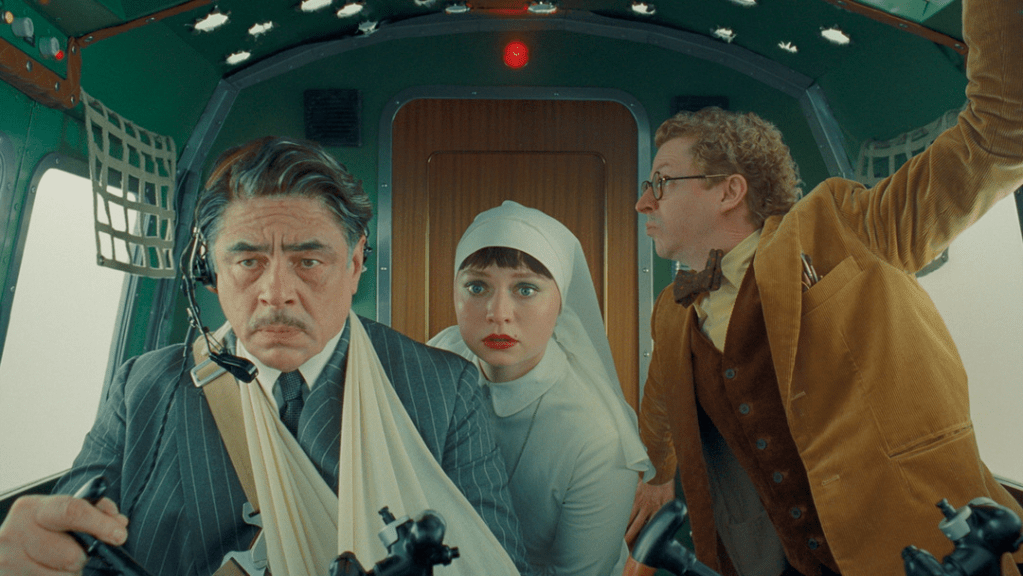
Looking at a synopsis for the film on Letterboxd, it might seem everything is laid simply: The Phoenician Scheme is“The story of a family and a family business.” The family business in question is owned by none other than Anatole “Zsa-Zsa” Korda (Benicio del Toro), who survives another assassination attempt at the film’s start. In an effort to stop himself from constantly running away, he attempts to mend his own relationship with his Catholic daughter, Sister Liesl (Mia Threapleton), in order to set her up to become the successor to his own business. Given the nature of Korda’s own business practices, many government agents try to find a means of putting an end to his lack of ethics, and embroil in numerous conspiracies to keep him from getting his way. As such, it’s an espionage tale done by Wes Anderson, but it’s not that far removed from what we’ve familiarized ourselves with in his works for so long.
As one could expect with any new Wes Anderson movie, the symmetrical visual style has only remained so alluring. This shouldn’t come off as any surprise to anyone who’s been consistently sticking by his work, but perhaps ever since The Grand Budapest Hotel, it would seem he has only grown more assured. In The Phoenician Scheme, it would seem as if Wes Anderson’s own aesthetics and accompanying set design have taken on a new form, especially as he’s working to make an espionage tale about a growing family business. Zsa-Zsa Korda doesn’t want anything more than to make right with his estranged family members, allowing The Phoenician Scheme to resemble the sort of film that Wes Anderson has always been best at. But of course, in typical Wes Anderson fashion, everything has to become more extravagant somewhere.
In recent memory though, it might seem like Wes Anderson’s own aesthetic has become so quickly identifiable. Anderson is acutely aware of this, and the artifice where these stories exist within has also become a part of his work. It’s part of what made his most recent Asteroid City into arguably his best film since The Grand Budapest Hotel, so it shouldn’t seem like much of a surprise that he goes to a more conventional fare here. But perhaps that’s where the greatest disappointments with The Phoenician Scheme come about, because the best Wes Anderson films have always been more than a simple aesthetic. Even with all the globetrotting, as typical for any great piece of espionage fiction, it never really becomes as adventurous as Wes Anderson had been at his best. It’s fun, but even the pastel aesthetic can’t hide how it seems like Anderson is juggling between ideals that never always work.
There’s still fun to be had, thanks to the film’s ensemble. Among the many players who have joined Wes Anderson’s crew of regulars are Jeffrey Wright, Tom Hanks, and Bryan Cranston – all of whom deliver regardless of their brief screen time. Michael Cera is a fun addition to Wes Anderson’s crew, playing a Norwegian tutor named Bjørn with a very exaggerated Scandinavian accent. He’s always very enlightening to listen to, at least until a major reveal – where things might only be made even funnier afterwards. However, the real star of this show is none other than Mia Threapleton, representing another inside conflict from her own devotion to her Catholic faith contrasting her father’s unfettered capitalism. There’s a lot of heart to her role in the film, but evidently it shows itself to be the sort of thing that a film like this needs to work most effectively.
Wes Anderson hasn’t quite made another film to that same degree of success that The Grand Budapest Hotel had accomplished since, but he’s always going to remain a lot of fun to watch. It’s nice to see him try and adapt his trademark aesthetic to a darker setting compared to his previous films, but there’s a part of me wondering how comfortable he really feels moving away entirely. It might be the most politically conscious effort that Wes Anderson has made, but it’s not without the same intimate qualities that have made his work resonate over the years. But knowing the sorts of highs that Wes Anderson has hit in the past, you also can’t help but feel like something is still missing. At best, it’s still as beautiful as any of his other movies, and at worst it feels like Wes Anderson might be on autopilot.
Watch the trailer right here.
All images via Focus Features.
Directed by Wes Anderson
Screenplay by Wes Anderson
Produced by Wes Anderson, Steven Rales, Jeremy Dawson, John Peet
Starring Benicio del Toro, Mia Threapleton, Michael Cera, Riz Ahmed, Tom Hanks, Bryan Cranston, Mathieu Amalric, Richard Ayoade, Jeffrey Wright, Scarlett Johansson, Benedict Cumberbatch, Rupert Friend, Hope Davis
Premiere Date: May 18, 2025
Running Time: 105 minutes

 Cinema from the Spectrum
Leave a comment