
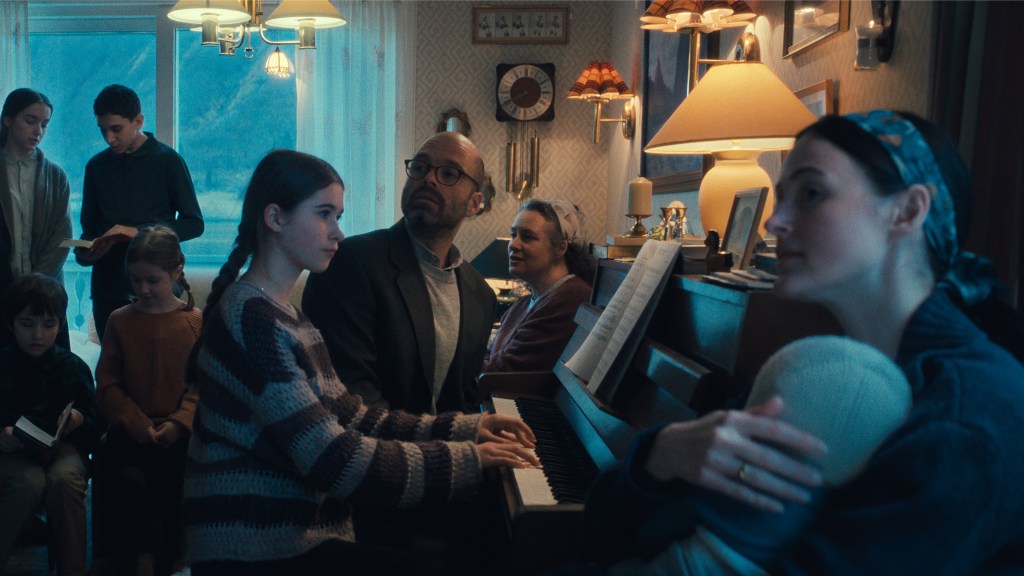

In late 2015, Norwegian child welfare services (Barnevernet) took away the children of Romanian computer specialist Marius Bodnariu and his Norwegian wife Ruth from their custody on the basis of alleged mistreatment. The Bodnariu family raised their children in a fundamentalist Christian environment, which clashed with the progressive values of their neighbours. This case inspired Cristian Mungiu’s Fjord, which puts the audience in an uncomfortable position of grappling with the limits of their own empathy. It makes for challenging work, which confronts us with complicated questions about upholding progressive values.
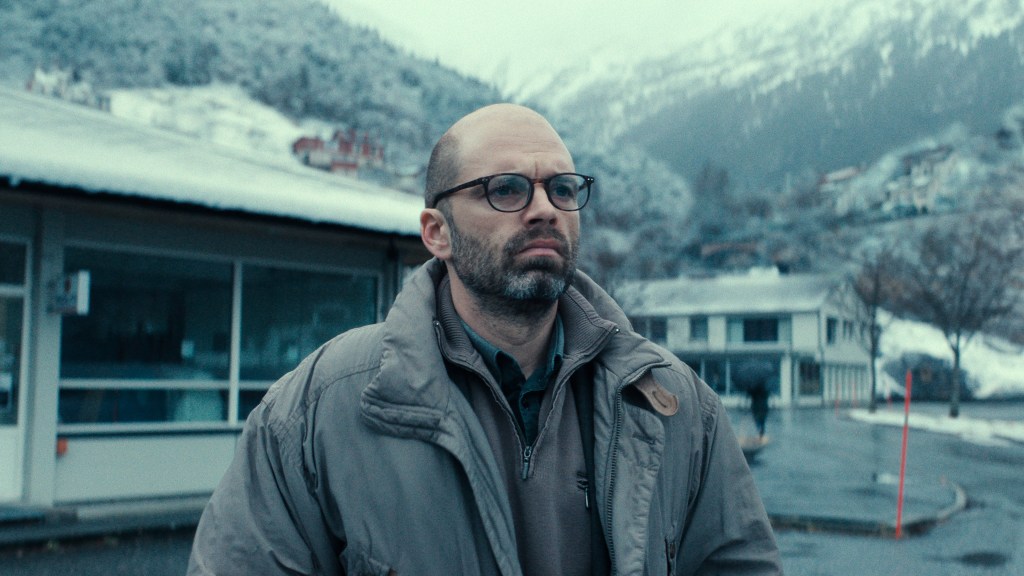
Sebastian Stan and Renate Reinsve star as Mihai and Lisbet Gheorgiu, a conservative Christian couple who have relocated from Romania to Lisbet’s former village in Norway. With five children, they maintain a strict routine that rejects modern amenities, including video games and YouTube, and enforce daily Bible studies. Despite having ideological differences with their neighbours, the Gheorgius find themselves welcomed with open arms. All of this changes after two incidents at their children’s school, when one of their daughters shows up with bruises on her body, and another makes a homophobic remark towards another student. Soon, the Gheorgius find themselves caught in a legal battle concerning the custody of their children, with tensions escalating as they are suspected of abusing their children. In telling this story, Mungiu manages to find nuance in a firm belief in the humanity of the Gheorgius, especially when audiences leaning left-of-centre would carry negative assumptions off the bat. It’s not unjustified, but it seeks to challenge ingrained biases that stem from how we’d view such people.
Mungiu isn’t telling this story expecting all audiences to see eye to eye with the Gheorgiu family, for their beliefs have only fostered the rise of authoritarianism in other parts of the world (case in point: the United States). Yet, when working with a scenario where such people are recognized as the minority, we’re also made to reckon with the injustices caused by an overly rigid belief in “right” and “wrong.” Mungiu complicates this case accordingly, given that we witness bureaucratic cruelty separating the Gheorgiu children from their parents. However, with Mungiu choosing to tell this story from the parents’ side, we see more direct consequences stemming from how Mihai handles the situation. It’s unnerving, but Mungiu shows that this all comes naturally to someone like him.
From here, you sense that Mungiu seeks to ask questions about how politics are funnelled into extremes. That’s not to say Fjord advocates from a centrist position, but it feels like a natural extension of ideas tha Mungiu approached with regard to how people perceive immigrants as depicted in R.M.N. before this. It’s not a conversation that many are equipped to handle, as Mungiu’s refusal to settle for easy answers also means that this film does not pander to any specific ideological group. Instead, we’re placed in a spot where we reexamine our commitment to a certain ethos, especially as we see one form of cruelty unfolding. At that point, it’s worth asking, how should we expect these people to respond? Knowing their controversial allies, whom Mihai eventually engages with, can we really expect anything good to come from the pressure this family is under? By that point, it’s also worth thinking about how the children are feeling, if Mungiu is not showing them for extended periods of time.
As Mihai, Sebastian Stan turns in some of the best work of his career. We understand Mihai as the headstrong patriarch of this family, wanting nothing but the absolute best for his children, even if his methods are questionable at best. Regardless, Mungiu never loses sight of Mihai’s desperation to see his children again. Balancing against him is the always impeccable Renate Reinsve, whose Lisbet feels Mihai’s frustration but never loses sight of her love for her children. Given how much she cares about the people around her, you feel how hurt she is by these allegations, as she tries to make things right. Both performers add more dimension to such complex characters, so that we start to understand them on a completely human level.
Cristian Mungiu isn’t looking for the easy way out; he wants his audiences to understand these cracks in such rigid beliefs that end up pushing others out. This is not to say he’s expecting us to ideologically agree with the Gheorgiu family, but he’s also examining the cracks existing within a supposedly liberal doctrine that can end up veering towards authoritarianism. As we feel these tensions arise over the course of the film, we also sense that the Gheorgius’ love for their children is what motivates them above all else. That Mungiu explores this all with great nuance turns Fjord into a more contemplative work, one that puts us in a spot where we have the chance to confront our biases within.
Watch the trailer right here.
All images via NEON.
Directed by Cristian Mungiu
Screenplay by Cristian Mungiu
Produced by Cristian Mungiu, Tudor Reu, Andrea Berentsen Ottmar, Dyveke Bjøkly Graver
Starring Sebastian Stan, Renate Reinsve
Premiere Date: May 18, 2026 (Cannes)
Running Time: 146 minutes
Other Writers Say…
Nathan Sherwood
Cristian Mungiu’s latest feature Fjord is a slow burn legal thriller featuring stellar performances from Sebastian Stan and Renate Reinsve. As the credits roll I couldn’t help but think how the five children are the real victims in the legal system and shake the bleakness off. Fjord is going to be not only divisive with audiences but also one that starts a conversation about what is “right” parenting and “wrong” parenting.
Jack Cox
Cristian Mungiu remains a master of tension, but what makes Fjord so unsettling is his restraint. He allows his characters’ contradictions and worst decisions to emerge naturally without telling us exactly how we should feel about them. Sebastian Stan disappears into Mihai Gheorgiou, never pushing him toward obvious villainy, while Renate Reinsve is equally devastating as Lisbet. Even against the natural beauty of Norway, Mungiu never loses sight of the people at the centre of the film. Fjord is patient, realistic and deeply uncomfortable, understanding that tension doesn’t need to be manufactured when the characters, their choices, and their consequences feel this real.
Connor Walsh
The ambiguity may be frustrating for some but I found it to be a fascinating insight into the political landscape. Nuance within politics has largely been ignored and as a result it has impacted the way other cultures are able to adapt to one that’s very different from their own. Fjord won’t be loved by everyone, but it will be remembered for how it represents a fractured family.




Leave a comment