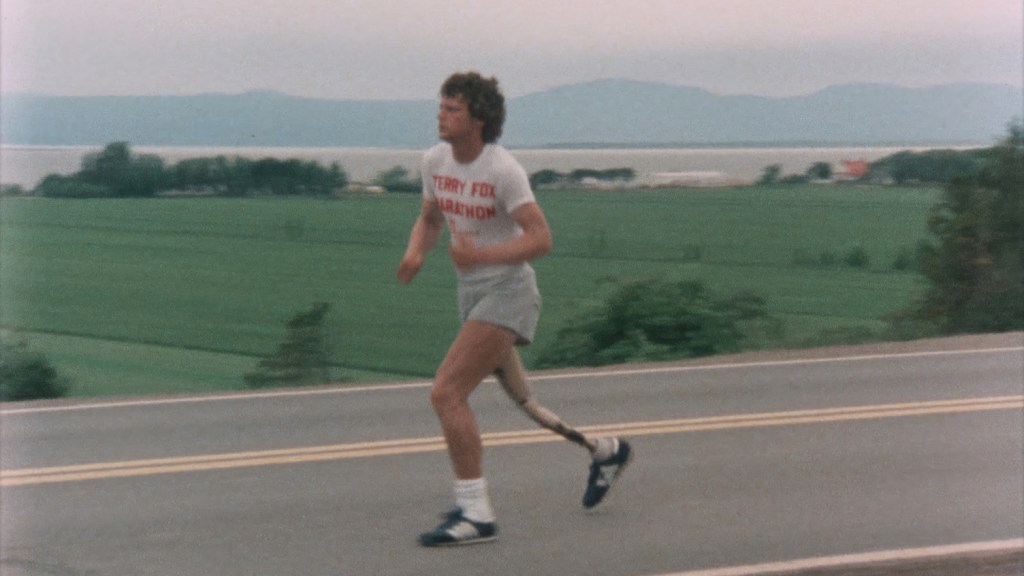

Terry Fox is perhaps one of the most inspirational Canadian icons in Canadian history. Not only did he not let his cancer diagnosis stop him from pursuing his passion, but he also wanted to help millions of people who were also quietly struggling with cancer. Being the voice of those fighting cancer themselves or families who have lost or have members diagnosed with it. Terry started his Marathon of Hope run in 1980 to help spread awareness and raise money with a humble goal of $1,00,000, eventually raising over $23,000,000. While Terry was lost tragically too soon, Terry’s message of hope and inspiration still resonates nearly 50 years later.
Told through newly discovered footage, director Sean Menard teleports audiences back to 1980s Canada to reintroduce us to Terry Fox. Through interviews from his best friend Doug Alward, his brother Darrel, and former Toronto Star journalist Leslie Scrivener, audiences get a new glimpse at the 5 month journey of Terry Fox’s run. Not only do audiences get a firsthand account from the trio, but we get to witness Terry’s run closer than ever before.
We open on a historical moment in St. John’s, Newfoundland and Labrador. It is April 12, 1980 – the beginning of the Marathon of Hope. Most have seen the iconic video of Terry dipping his prosthetic leg in the Atlantic Ocean numerous times, but with this new footage, the energy of that moment brims with a new kind of radical optimism. Revisiting it like this, in this new film, makes that feeling even more potent. When he started his race, the documentary reminds us how divisive the country felt. Terry’s dedication and strength to go through with his mission reignited people’s hope in the common good again. Where Run Terry Run thrives though, is providing that hope to audiences now by revisiting this moment of time.
Sean Menard makes an interesting choice in how he conveys this historical canon: instead of using talking heads for Doug, Darrel, and Leslie sitting down in your typical documentary storytelling, Menard has them tell their stories solely through voiceovers. Usually in documentaries, the use of voiceover narration is typically due to two main reasons. One being they couldn’t be present at the time of filming, and the other being that the interviewee is long gone. In this case, the trio are still alive and well and more than capable of sitting in front of the camera. What this voicework does though, is allow audiences to hear their experiences during the run while not losing focus on the true main character, Terry Fox.
Through these narrations, we hear about Doug’s friendship with Terry and how much he meant to him, from their friendship long before in school to the very end of the marathon. We hear some of Darrel’s fond memories on the run that gave them a break from worrying about Terry, such as Doug getting cake in the face by Terry. And we hear how Leslie first heard about Terry Fox, and followed along closely from her office in Toronto when Terry was starting out East. Along with these narrations, audiences also get to see Terry run without anyone telling us how to feel about him in the new raw footage. The music put to these otherwise silent scenes, scored by Tom Caffey, is rousing and uplifting, just like Terry himself was. The footage and the music work together to display just how impressive and how determined Terry was on this run, without ever feeling overwhelming or forced. All this is done without de-emphasizing that Terry is the one in the spotlight. Menard’s film also gives us deeper insight into Terry’s youth and what he went through on his marathon.
Menard also showcases the struggles during the run Terry faced that are not talked about a lot. His unwelcome visit in Quebec during the height of wanting to separate from Canada is shown with sobering bluntness during the documentary, showing not just disinterest but hostility, such as when some residents tried to literally drive him off the streets. The documentary gives context that many may not have had earlier, describing the Quebec situation being due to two factors: 1) they did not speak Canadian French and 2) the news of the run not reaching the province. Menard smartly uses the footage to show a bigger picture of what Terry faced on his cross-country run. He shows Terry’s frustration during these tense moments but also across the whole marathon. It is easy to forget that Terry Fox was just barely 22 years old when he embarked on this ambitious campaign. That Menard manages to humanize a man who has since become a symbol to a nation since his untimely death is an impressive feat.
Run Terry Run is the documentary that truly honours this young man. 45 years after his passing, Terry continues to be a beacon of hope and inspiration to millions of people battling cancer and their families. As this new film proves, we still have more to see when it comes to who exactly this icon was and what he means to people today.
Watch the trailer right here.
All images via Elevation Pictures.
Directed by Sean Menard
Written by Sean Menard
Produced by Sean Menard, Molly Ye
Featuring Terry Fox
Premiere Date: September 19, 2026 (Toronto)
Running Time: 108 minutes



Leave a Reply