
Video game adaptations often stumble trying to capture the appeal of the games they are adapting when the interactivity is removed. They are faced with adapting a plot that is purposely elongated and stretched out. The difficulty not only stems from the length of the narrative but how to capture the interactive elements; which can only be adequately captured within a game. The question then becomes do you adapt the narrative itself or do you adapt the world the video game is set in?
Resident Evil is both a successful video game and film franchise. Mostly directed by Paul W.S Anderson and led by Milla Jovovich as a star of the franchise, Alice, these films have grossed over one billion dollars at the box office. Despite its financial success, these films were unable to achieve critical success with both fans and critics alike panning these adaptations.

What followed Paul W.S. Anderson’s films was a more faithful adaptation of the games in Welcome to Raccoon City and an under-seen Netflix series simply called Resident Evil. The former was a relatively faithful and chronological adaptation of the first two games–the response was critically mixed. Released very closely after the acclaimed remake of Resident Evil 2, this failed to recapture the same excitement. The latter is an adaptation set in a different continuity of the games and two branching timelines, this would eventually be canceled after just one season. The result of these two relaunches found Resident Evil as a multimedia series in a difficult place, they had to change things up if they wanted to keep audiences interested.
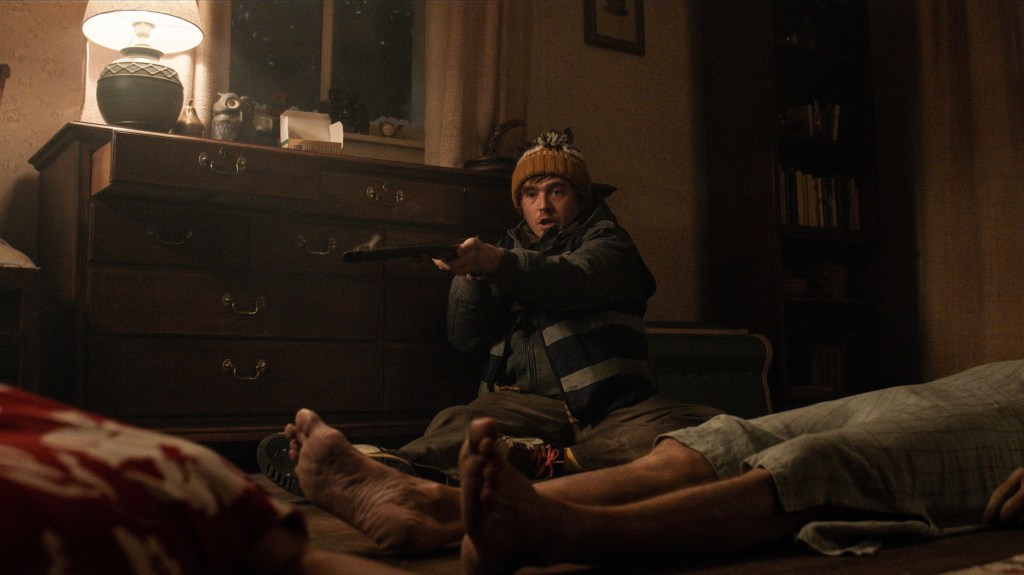
Which then brings us to Zach Cregger’s 2026 film Resident Evil. Rather than attempting a 1:1 remake, Cregger opted for a unique approach to exploring Raccoon City’s outbreak. Instead of adapting the narrative of the games directly, Resident Evil strips the concept down to its basics, centering around a man, a medical courier named Bryan tasked with making an emergency delivery to Raccoon City. The film follows a structure similar to Resident Evil: Biohazard and Resident Evil: Village in which you are a man with seemingly no connection to the story of Resident Evil and find yourself thrown into hell. The film mirrors Resident Evil 7 by following a protagonist not well adept towards survival. This is felt even more so through the progression of the film utilizing weapons as an upgrade system not too dissimilar to the games. As Bryan moves from weapon to weapon, he gains experience and learns how to use these tools more effectively as the film progresses.
In an effort to emulate the video game, Zach Cregger utilizes first-person perspectives in quite a few moments in the film. Not only does this homage the newer games but it creates an unnerving and stressful experience for the audience, by placing them firmly within the characters perspective. The original fixed camera perspective occurs naturally because that video game aesthetic is derived largely from cinema of the past. A third-person like perspective also occurs as the camera becomes tethered onto Bryan during tracking shots matching his pace, movement and physicality. These elements demonstrate different stages of tension and escalation of the events taking place. In addition to this methodology towards camera work sonically the film has a Carpenter-like influence in that the score is constantly ramping up in intensity. When moments are more frantic and chaotic, the score is louder and more aggressive. The low health audio indicator of the games can’t fully be recaptured, but through the use of music the film finds a way to fuel your adrenaline as Bryan races on to the next goalposts.
Hays and Ryan Holladay the composers are a brotherly duo who have known Zach Cregger for a majority of their lives, having been in bands together, with Zach Cregger’s pursuit into filmmaking, naturally they quickly followed. By being frequent collaborators they have a sense of rhythm that matches the intensity the film requires. The industrial new metal sound found within survival horror games of the 2000s has the adaptation of it to modern times feel natural.
Watching Resident Evil is an interesting experience because iconography is constantly toyed with. Health sprays and herbs appear in the background, as well as a quick nod to the iconic save icon (a typewriter) of the early games and remakes. Rather than adapt a singular game this film serves as a greatest hits of sorts by including many sections one would find in various incarnations of the series. One element that stands out for me in particular is the inclusion of a dog enemy type and how it recaptures the jump scare of a zombie dog breaking through something that was originally iconic within the first game.
Resident Evil doesn’t necessarily capture the feeling of playing the game, instead it captures the feeling of watching a streamer experience a survival horror game. In most horror games within the gameplay the character is often quiet or panicked. In Cregger’s Resident Evil, the main character, Bryan often vocalizes every instance of what he comes across; even making reference to the elements that feel like a video game. The humour, while good, lightens the stakes and can make this feel more like a parody of the games than a straight adaptation. As a result it becomes a little uneven and could strike more of a balance without shifting closer to a parody of Resident Evil. Moments where a semblance of a more serious narrative fall apart because of this. The film introduces Bryan being an expected father, having left his girlfriend behind to work this highly dangerous job. While I appreciated the comedy-horror hybrid at times the balance between gags and scares tips more towards the former. The antagonists do not have much depth and while they are funny, they feel like a shift from the over the top but memorable villains the series is known for.
Resident Evil excels in delivering a solid visual aesthetic surrounding the journey of Raccoon City. The outbreak now occurring during winter allows the film to differentiate itself from other zombie films. Not only does one have to fight obstacles such as stalkers, dogs and zombies, they also have to fight the elements. The pairing of Dariusz Wolski and Zach Cregger creates a lived-in atmosphere. Everything from the woods to the sewer system is visually arresting and harkens back to the original Resident Evil 2 wherein the player navigates alley ways and deteriorating streets in order to escape Raccoon City.
At the end of the day, Resident Evil had an uphill battle. After years of adaptations with mixed results, the series found itself forced to find a new way to adapt the series of the past. While none of the adaptations were strict and super faithful, this new version decided to attempt what the others failed to do–recreate the experience of playing a video game. Some fans may be upset to see this out of continuity of the games, but this largely remains a positive; by doing this the film can stand out the games as its own experience. Full of comedic elements with many laughs to be had and some solid jump scares, Resident Evil is a good time. For me most of my issues stem from how the film attempts to balance the comedic and horror aspects. Zach Cregger in such a short time has proven himself as a horror filmmaker in a relatively short amount of time and as he continues throughout his career I remain curious as to how his career evolves.
Watch the trailer right here.
All images via Sony.
Directed by Zach Cregger
Screenplay by Zach Cregger, Shay Hatten, from the video game series published by Capcom
Produced by Robert Kulzer, Zach Cregger, Roy Lee, Miri Yoon, Victor Hadida, Carter Swan, Asad Qizillbash
Starring Austin Abrams, Zach Cherry, Kali Reis, Paul Walter Hauser
Premiere Date: September 15, 2026
Running Time: 94 minutes
Other Writers Say…
Jaime Rebanal
You can’t really be faithful when making a film adaptation of Resident Evil especially if it results in something like Welcome to Raccoon City. It’s this element which Zach Cregger understands perfectly, especially when lifting from the feeling of playing the video games and making a movie from there. It’s really easy to get on board with the film building itself around some Joe Schmoe trying to survive through Raccoon City while delivering something to the Umbrella Corporation; because Cregger sees the Abrams character akin to any other player of the games moving through the worlds. I feel like that’s where he perfectly captures the essence of Resident Evil, because if you’re playing as Leon S. Kennedy, Chris Redfield, or Ethan Winters in the games, the game may show them as action heroes, but it’s all up to your input. Austin Abrams’s Bryan functions like a player, down to him messing up the gunshots before getting confident with them as the film goes on. I also like how Cregger includes little jokes in the familiar game iconography like the typewriters in “save rooms” or the green herbs which end up going unused (because come on, if you’re playing the games, that’s the first instinct that comes to mind).
I think I’m maybe less amused by Bryan’s characterization as an anxious soon-to-be-parent. Only because that character template feels all too hackneyed in the horror genre by this point. Yet, I still feel like the total physicality which Abrams lends to this role helps sell the idea that this is the same world of Resident Evil we remember from the video games. Naturally, I’m someone who loves the games dearly, so I feel like this film has done enough to satisfy me there. Though for as much as fans of these games may not get the same enjoyment out of the Milla Jovovich movies, there’s a particular unhinged quality to them which I think I’d have liked more of in here. Nonetheless, I like that Zach Cregger is doing his own thing with a series like Resident Evil, and I’m open to a sequel.






Leave a Reply