

Among the many pressing issues in the United States has been the wrongful incarceration of Black men, many of whom have been convicted through a justice system that has, at times, relied on coercive police tactics. One of these cases is examined in detail in director Dawn Porter’s (John Lewis: Good Trouble and Luther: Never Too Much) newest film, When A Witness Recants. The film was executive produced by, and features, author Ta-Nehisi Coates and the documentary opens with Coates recalling the case that became known as the “Harlem Park Three,” those being Andrew Stewart, Ransom Watkins, and Alfred Chestnut.
The documentary examines the murder of 14-year-old DeWitt Duckett, who, while walking with two other students through Harlem Park Junior High School in Baltimore, Maryland, in November 1983, was accosted by a man with a gun and two others. Duckett was wearing a valuable Georgetown University jacket. An altercation ensued and the man in question shot Duckett in the right side of the neck, eventually succumbing to his injuries. It was the first murder in the history of Baltimore City Public Schools.
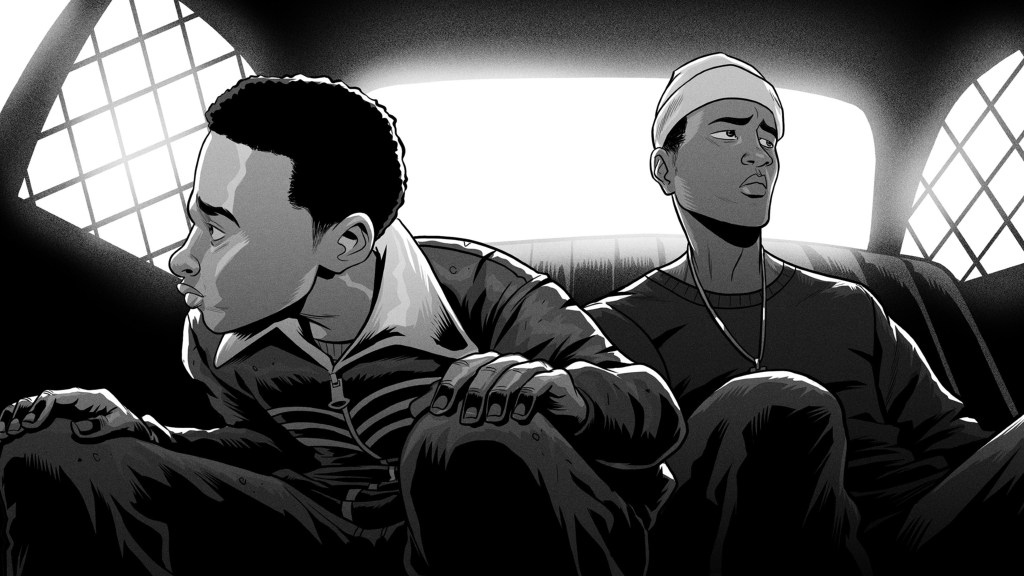
Dawn Porter tells the story chronologically through a mix of interviews and archival footage. Since the three men were imprisoned at just sixteen years old and spent over thirty years behind bars, there isn’t much visual material available from that period of their lives. To bridge that gap, Porter uses illustrations by comic book artist Dawud Anyabwile to bring some of those moments to life. I thought it was a clever way of handling a situation where there simply wasn’t much footage to work with, and the artwork fits comfortably within the documentary. The pacing was never an issue for me. I’ve always enjoyed true crime stories and documentaries about miscarriages of justice, so I never found myself checking the runtime. Instead, Porter steadily builds the case piece by piece, allowing the interviews and evidence to speak for themselves.
Although Ta-Nehisi Coates is one of the film’s executive producers, the documentary is driven almost entirely through interviews rather than a traditional narrator. Coates serves as the audience’s introduction to the story, reflecting on growing up in Baltimore, hearing about the Harlem Park Three case, and eventually discovering the truth behind it. Once that foundation is laid, Porter lets the documentary unfold through the people who lived it.
The documentary is less interested in reopening the case than in showing how a wrongful conviction happened in the first place and what it ultimately took to overturn it. The turning point came when key witness Ron Bishop formally recanted his testimony, allowing former Baltimore State’s Attorney Marilyn Mosby and her office to move the exoneration process forward. From there, Porter examines the police tactics that led investigators to pressure a teenager into identifying three innocent boys.
Unsurprisingly, the interviews with Stewart, Watkins, Chestnut, and their families are the documentary’s emotional backbone. Hearing them describe what was taken from them over more than thirty years leaves you with a mixture of anger, sadness, and frustration. The film’s most powerful scene comes near the end, when the three men confront Ron Bishop face-to-face. It’s a raw, brutally honest conversation that makes it abundantly clear their pain didn’t end when they walked out of prison. Even after their exoneration, they’re still living with the consequences of a lie that stole more than thirty years of their lives.
Dawn Porter has made both a great documentary and an important one. There are undoubtedly other cases like this across the United States. While wrongful convictions affect people of all backgrounds, Black Americans have been disproportionately impacted, making films like this all the more important. There are foundations and organizations dedicated to helping overturn these convictions, but the situation is more dire in states where the death penalty still exists because some innocent people may never get the chance to prove their innocence. When a Witness Recants is a powerful reminder of why these cases need to keep being brought to light.
All images via HBO Documentary Films.
Directed by Dawn Porter
From the New Yorker Magazine article by Jennifer Gonnerman
Produced by Dawn Porter, Miriam Weintraub, Jennifer Oko
Featuring Alfred Chestnut, Andrew Stewart, Ransom Watkins, Ron Bishop, Ta-Nehisi Coates, Marilyn Mosby
Premiere Date: January 27, 2026 (Sundance)
Running Time: 112 minutes


Leave a Reply