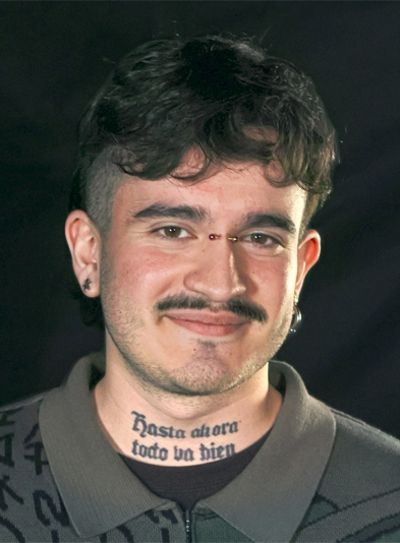

Diego “Mapache” Fuentes is a Chilean filmmaker who made his debut in 2025 with Matapanki, the absurdist low-budget superhero(?) film with shades of Japanese cyberpunk. As part of our coverage from the Fantasia Film Festival this year, I had the privilege of speaking with Fuentes about his unique creative process, but also what motivates him – especially given the politics which he tackles in this project. Below is our conversation, which has been edited for clarity.
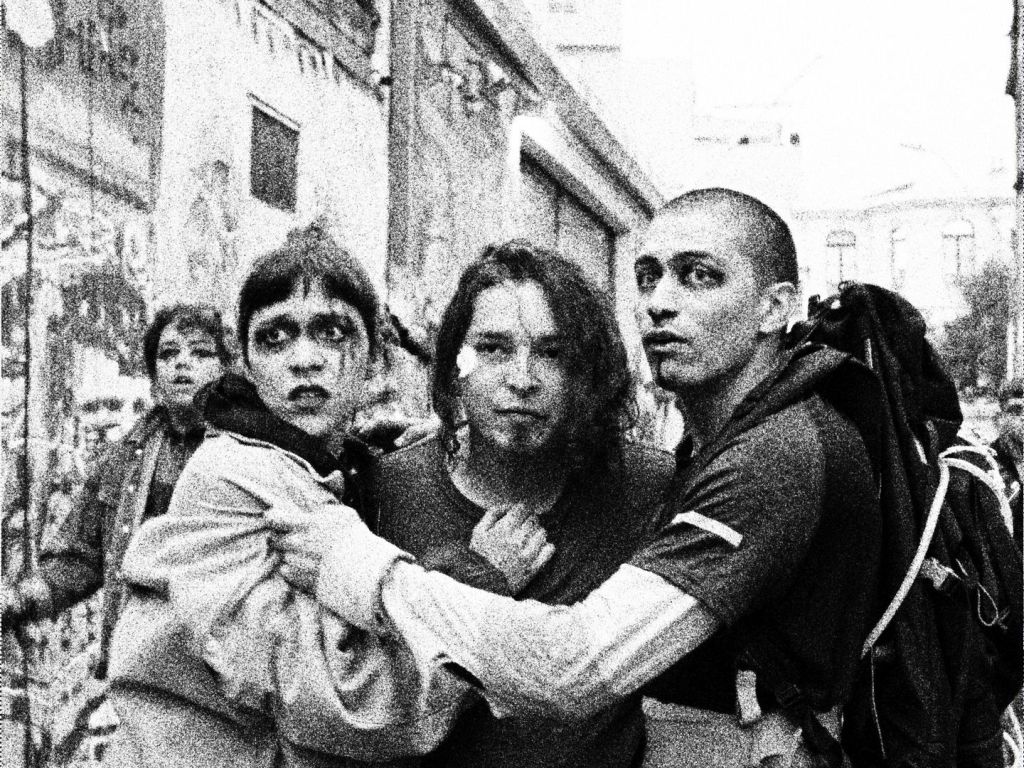
Jaime Rebanal: I just want to say that I was very taken in by your choice of aesthetic. So can you tell me what inspired these choices and what went through your mind as you decided that this was the perfect look for your film?
Diego “Mapache” Fuentes: Well, it all starts when we’re doing the development of the movie. Matapanki is also my thesis. Yes, yes, it was my thesis. So when we’re doing it, I watched Japanese film called Electric Dragon 80,000V from Gakuryu Ishii, and I absolutely love that film. And I’m a big fan of Shinya Tsukamoto’s Tetsuo: The Iron Man and that kind of stuff. I was really inspired by those movies, and the little comics that we in the punk scene do. So in really early development of the film, we all know that we wanted to do a really gritty black-and-white film. We thought that the aesthetics of the film has to do a lot with the message, and we couldn’t do like a punk movie that has 4K resolution and stuff like that.
JR: What really strikes me about Matapanki is not only the fact that you’re inspired by Japanese cyberpunk movies, but you also engage with how young people respond to the political scene. I wonder how you feel about what’s presently occurring in Chile, especially with the recent election, but also its relation to the United States. How do you bottle up these feelings into this work?
DMF: Well, I think that my biggest inspiration is that the punk scene in Chile is very nerdy. Everyone who is like a punk in Chile knows a lot of culture: video games, anime, and movies. So I feel the political message of the movie has a lot to do with a lot of these things. So I feel like it was kind of hard at the beginning because we have a lot of topics that we wanted to do approach. But I think that we do a satire in the film ;a lot of humour, so it was the only way to put that all of those topics and the political things that are in the film.
JR: And I think that it I think that it’s a perfect response to how people in power, especially right-wing governments, say that young people don’t young people don’t know what they’re doing when they’re engaging with politics. And I appreciate that you’ve highlighted how important the punk scene is towards getting making sure that everything is better for the for an entire community too.
DMF: And I think that in Chile, all the young people are very responsive to politics. So everyone is like very informed. Everyone is trying to do good things, not falling to the right-wing agenda, so we thought that Matapanki was a necessary movie to do as more than a thesis, or for the grade. We think that it was necessary, something that was deep in your heart.
JR: I read another interview with you where you stated that this whole project started as a joke before you eventually turned it into a serious pursuit. So, how did you go about it from there?
DMF: Well, it was a long trip because in the early development, Matapanki was a much crazier film. Ricardo (Ramón Gálvez) had more superpowers. It was more humorous. But in a moment, I think that we started to think that making films in Chile is a privilege. Like you gotta have a lot of money, and I don’t come from a family of artists or people that have a lot of connections or a lot of money. So I think that having the privilege of doing a movie is important to do the things that are important. I couldn’t just do a Homeric movie or a satirical movie and couldn’t just put the things that I think that are important to me in a political way.
JR: In that same interview, I read that you’re neurodivergent, and I wanted to start by saying that because I’m somebody who’s on the autism spectrum, I’m always on the lookout for fellow neurodivergent creatives. And how does your own neurodivergence shape the way you engage with art, but also your own art style.
DMF: Well, it’s therapeutic, because I have a Tourette syndrome and I have to talk, so I feel like there are a lot of aesthetics and something like with the music decision that shapes from that way. I have an addiction. But I have a lot of things that have to do with the aesthetic of something. So I feel Matapanki was really therapeutic in that way because there were a lot of things that I wanted to develop, but I couldn’t do in other types of arts. I think that really helps in a way.
JR: And in a way, the world that you’ve created in Matapanki is quite dystopian, considering your influence from Japanese cyberpunk films. But it’s also not one that’s far removed from reality. So, what helps ground your work so that we as audience members still understand that this all this could happen like anytime, anywhere?
DMF: Well, I think that it’s because I’m Chilean. Chilean people and Chile is really weird, you know. It’s a really weird place. I think that Latin America as a whole is this really weird place. So it was funny because when I was writing the script, I think that all of this could happen like tomorrow. So in Chile, we have an extreme right-wing president right now, and it’s kind of sad that I’m seeing the movie and I’m thinking this could happen tomorrow. But I think that what the world needs is that. Chile is a weird place, you know, and a lot of stuff that happened in the movie like happened to me when I was younger. So I think that it’s a connection with the world.
JR: I really love how you have both an American president and the Chilean president as your as your primary villains too. So, how did you develop the idea for the for them to all have their own superpowers?
DMF: Well, a lot of things that have to do with the real political state of Chile. We had a dictatorship in the 70s, and it was orchestrated by United States of America. So we have a lot of, I don’t know if I’d say enemies, but a lot of bad things happened because of that country. So I think that was the main inspiration to say that hey, we need to put not only the Chilean president, but also the gringo villain.
JR: I have one final question for you, and it’s coming from one neurodivergent person to another. What’s one piece of advice that has stuck with you through most of your life that continues motivating you as an artist?
DMF: For me, it’s being honest with the things that I want to do because Matapanki was my first movie. It was my first time directing. I have never directed a short film or something like that when I was in film school. I do a lot of executive producing, so it was my first time in everything. And now that I’m developing my second film, it’s much bigger. People will start changing some things, and you know there is more money. And I think that the more important thing is like knowing what I have to do to develop, what I have to express, what I think that is important, like the feelings. There are some things like the antifascist movement that for me are really important. So I feel like being honest with you and being real is the most important thing when you’re an artist, because that’s what we do.
JR: I know I said that was my last question, but since you brought up that you’re working on another movie right now, can you tell us? Can you tell tell us a little bit more? Not a full-on spoiler or anything, but can you tell us a little bit more about what you’re what you’ve got cooking up?
DMF: Well, it’s about a girl who emerges from a cocoon and starts developing like a mod style. Like a metamorphosis and starts falling in love with a couple of guys, but it’s more like a road trip. It’s more like a fantasy movie. It’s not in black-and-white. It has other themes. But I think that has a lot of the spirit that I put in Matapanki.


Leave a Reply