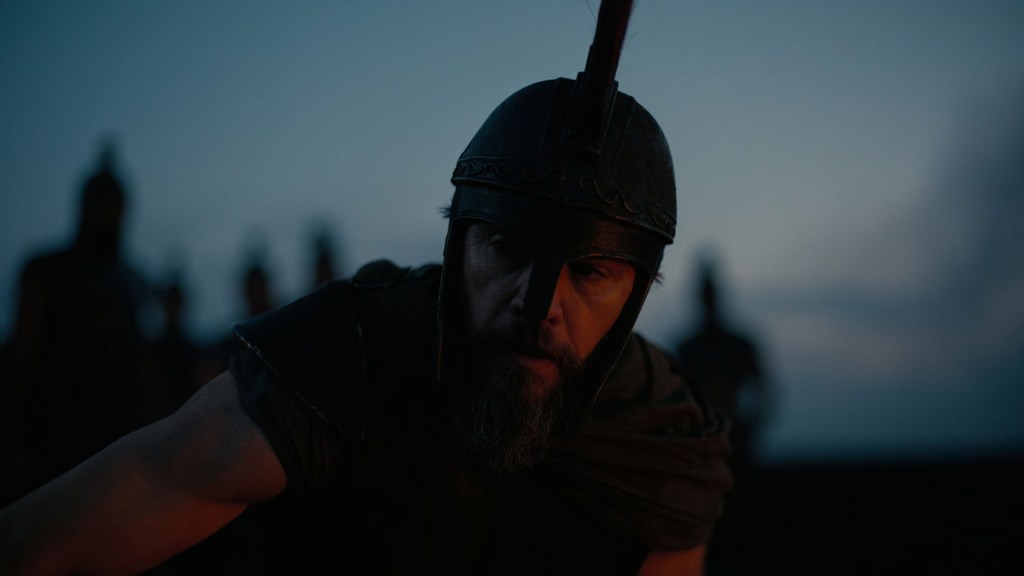

Emily Wilson’s translation of The Odyssey starts with “Tell me of a complicated man.” The man being none other than Odysseus, whose story is recounted by a bard after having wrecked the holy town of Troy, in his absence from Ithaca. When taking on such a foundational text like the Odyssey, it’s daunting, but Wilson’s translation allowed introspection from Odysseus’s position as we understand the man to be a great warrior wanting to return home. This helps inform the kind of story that Christopher Nolan would make out of adapting The Odyssey, which has arguably become his biggest project to date. Channelling the likes of David Lean and William Wyler, Nolan aims higher than he’s ever done before, delivering one of his best films.
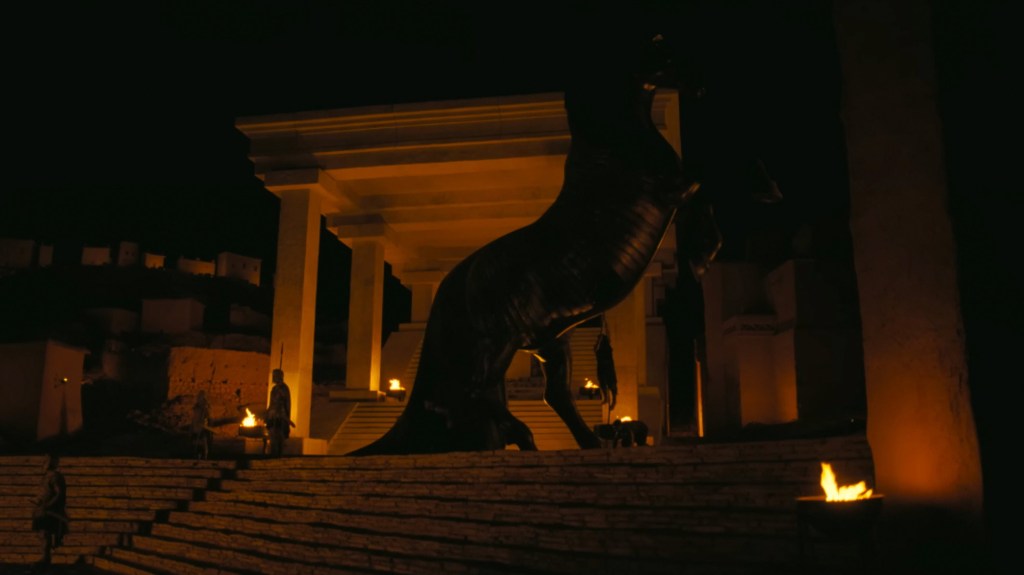
As the film opens, a bard (Travis Scott) recites the story of Odysseus (Matt Damon) as his wife Penelope (Anne Hathaway) and son Telemachus (Tom Holland) await his return from the Trojan War. In Odysseus’s absence, the kingdom of Ithaca has devolved into chaos, as several suitors – namely Antinous (Robert Pattinson), attempt to court Penelope to claim the throne, believing that Odysseus will not return. It’s an appropriate start for this adaptation of Homer’s epic poem, given Nolan’s always been one to toy around with linearity, especially when observing the violence of Odysseus’s journey and its aftermath on the people he’s left behind. Yet within the context of Nolan’s recent works, mostly having moved back through time, these observations about humanity’s bloodlust only reverberate thoroughly here.
Obviously, adapting a poem like the Odyssey would inevitably mean deviations from the source material, because Homer’s verse is not exactly suited to a conventional narrative. Nolan simplifies it, but never loses sight of why the Odyssey has remained popular through time. The core essence of Homer’s writing is still present, in Odysseus’s ill-fated journey and his eventual nostos to Ithaca. Yet in doing so, he also leaves his viewers the chance to contemplate the end result of a vicious pursuit. Violence is frequent, as exhilarating as we see in action movies, but with a devastating scope. Highlights include the encounter with Polyphemus and the siege of Troy, among many scenes which push Nolan’s devotion to realism to the test as he embraces fantasy.
Given Christopher Nolan’s commitment to creating complete immersion in the cinema, it’s no surprise that The Odyssey looks every bit as grand as it does. However, he also goes the extra mile by having every frame shot with IMAX film cameras, after having used them sparingly through his work to emphasize the spectacle. With how Nolan captures the surrounding landscapes, he and cinematographer Hoyte van Hoytema surround Odysseus and his men with an endless void, one that almost feels suffocating and oppressive. While we’re going to be taken in with spectacle, it never comes secondary to the fact that the human beings fighting the Trojan War all feel small. It’s one among many aspects to The Odyssey that inspire awe, with how beautiful the film looks, but it all feels like it could collapse at any moment.
Contrary to the Classic Hollywood period epics which influenced Nolan, the heightened theatricality many would associate from them is gone. Where Nolan does away with historical accuracy, he makes up for it in spectacle. With how many times The Odyssey has been retold through the years, Nolan’s modernization of Homer’s writing resembles a feeling of permanence to his words. Taking specifically from Emily Wilson’s adaptation of the poem which was written in plain English, Nolan’s choice to utilize contemporaneous English feels like his way of showing how The Odyssey constantly transforms itself over the years. It’s an inspired choice, one that may take some getting used to, but it also helps us identify with the struggles of Odysseus and the people he loves on a ground level.
This is how Nolan manages to get great work from his cast. If any other writer or director had brought Odysseus to the screen, with consideration for all the action unfolding here, he would come off as a generic action lead. That’s not what Nolan brings out from Matt Damon, who creates an inverse of that action movie hero image we’ve seen from him in the Bourne films. Yet with the large ensemble that Nolan has gathered in here, smaller parts all leave a tangible impact. Among the first that come to mind is Elliot Page as Sinon, the infantryman who plays a pivotal role in the siege of Troy. Though seeing how these people exist in relation to Odysseus’s journey becomes crucial to Nolan’s own rendering of Homer’s poem for the screen. Several deaths surround Odysseus, many by his own hand – even if he survives the ordeal, what place is there for him in Ithaca?
Will this go down as the definitive adaptation of The Odyssey by Homer? It’s hard to say, but there’s no denying that Christopher Nolan’s means of doing so are best suited for the changing times. And it might be that this particular rendition of The Odyssey can only make a case for the staying power of such a story through the years, but Nolan makes a case for its necessity to be retold. If we’re not going to learn from history, we just may as well be trapped in an unending cycle of violating Zeus’ law, which we’ll only be too late to climb out from. It’s a very bold choice for someone like Christopher Nolan to adapt something as daunting as The Odyssey today, but maybe there might be no better filmmaker to take on such a task.
Watch the trailer right here.
All images via Universal Pictures.
Directed by Christopher Nolan
Screenplay by Christopher Nolan, based on the Odyssey by Homer
Produced by Emma Thomas, Christopher Nolan
Starring Matt Damon, Tom Holland, Anne Hathaway, Robert Pattinson, Lupita Nyong’o, Samantha Morton, Zendaya, Charlize Theron, Jon Bernthal, Himesh Patel, Bill Irwin, Elliot Page, Benny Safdie
Premiere Date: July 6, 2026
Running Time: 173 minutes
Other Writers Say…
Nathan Sherwood
The Odyssey is Christopher Nolan’s most ambitious film to date. From the massive practical sets to the thrilling action sequences, Nolan knows how to get audiences seated in a theatre. Right from the start you are immersed in the world of Greek mythology with stunning visuals on IMAX 70mm. The Odyssey is one not to miss on the biggest screen possible.
Jack Cox
Nolan is our modern-day David Lean, a director who has become a brand all on his own and whose films have grown increasingly ambitious. There are images in The Odyssey that I’ve never seen put on screen before, including some striking horror imagery. I hope Nolan eventually takes the plunge and makes a full horror film.
Connor Walsh
Christopher Nolan’s The Odyssey joins the pantheon of films based on Homer’s epic but defines it through a look comprised entirely of IMAX Film Cameras. While I felt this brought a lot to the film it also set back the uniqueness of the format and the restraint I look forward to within most of Nolan’s works. Ever evolving and changing, my curiosity remains in how Nolan channels his concerns about the state of the world in the films that follow.



Leave a comment