
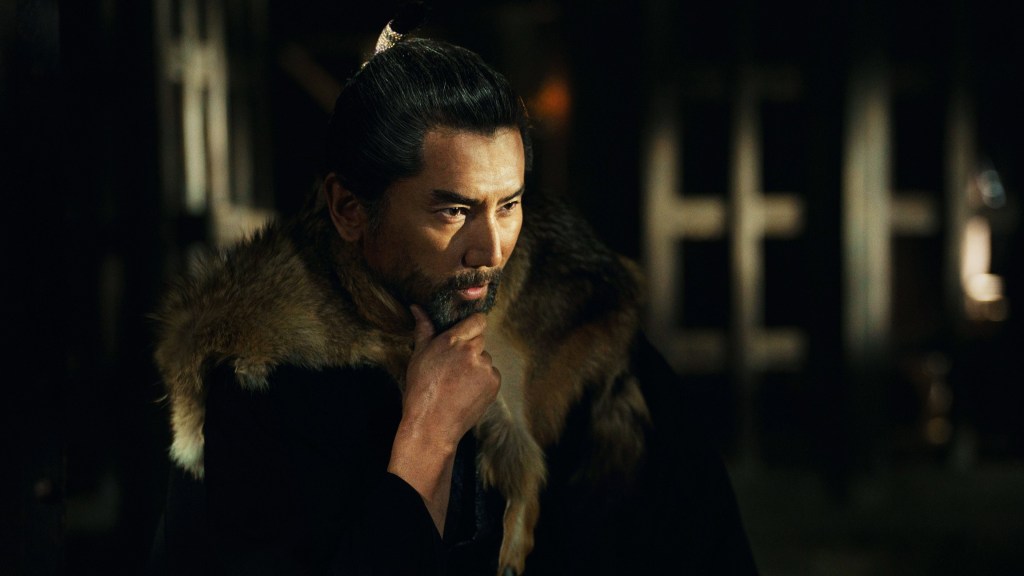

For the first time in his long career, Kiyoshi Kurosawa gets the chance to channel the other renowned auteur who shares his name, but he approaches things differently. Kurosawa’s first jidaigeki film is a complex thriller, encouraging us to rethink the codes of honour which samurai have lived by throughout history. In doing so, The Samurai and the Prisoner starts to resemble the works of Masaki Kobayashi more than they do the other Kurosawa, given how he establishes the dynamic between the titular characters. This might be the perfect means of channeling the Golden Age of Japanese cinema which Kurosawa had been deeply influenced by – and it’s all the more astonishing.
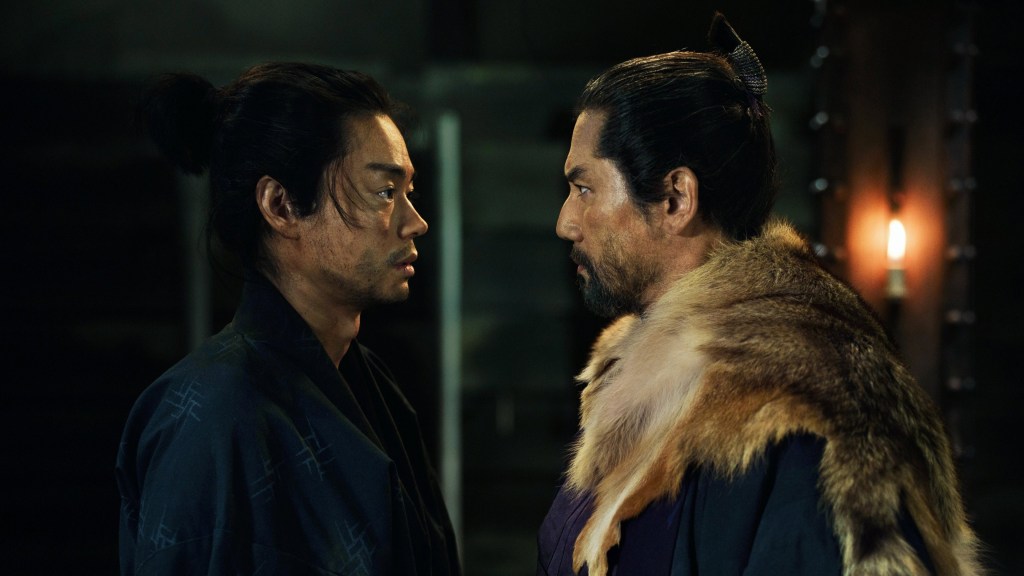
Structured over the course of four seasons in 1578, The Samurai and the Prisoner tells a story leading into the siege of Arioka Castle. The lord of the castle is Murashige (Masahiro Motoki), who has rebelled against the warlord Oda Nobunaga in response to his cruelty. Murashige’s desire to be a merciful lord and his refusal to kill clash with the code of the samurai, which maintains that death is essential towards maintaining their honour. When a young boy whom he spared is murdered, Murashige realizes that there is a traitor in his midst. He forms an alliance with Kuroda Kanbei (Masaki Suda), a prisoner in his dungeon who might understand this world better than Murashige does. As the film unravels over each season and new incidents within the castle grounds, it’s a point of reckoning for Murashige – as his pacifism comes at a deathly cost.
Kurosawa’s adaptation of Honobu Yonezawa’s novel plays out like a murder mystery – one in which Murashige finds himself constantly being tested by a world marked by ubiquitous violence. Kurosawa’s critical look at feudal Japan cohabitates with the set pieces of a great action film, as his interests lie in the morality that creates the soldier archetypes that have permeated images of Japanese history. The code of honour might protect a samurai’s legacy, but it’s not enough to protect their lives, let alone what they stand for.
Alas, this is where the general scenario grows more tense with every passing second. Murashige’s pacifism can leave him culpable for the deaths of his people. This is where Kurosawa employs a more contemplative tone, especially because of how sparingly he utilizes action. Yet, those moments where violence comes forth are never exciting in the same manner as jidaigeki films would inspire, but nonetheless shocking. It’s shocking, for Kurosawa leaves us to think about how this all looks from Murashige’s perspective, given the inner dilemmas he faces owing to his refusal to kill.
Nonetheless, Kurosawa builds off that impulse by reminding us what it really means to be honourable in a world that’s ruled by contradictions. That’s just human nature after all, especially if the contrast between Murashige and Kanbei were any indicator. However, we’re also made to rethink our understanding of who has more power as each season passes, before Arioka Castle were to meet its downfall. Kanbei is a strategic samurai, who senses that Murashige is only entering a lose-lose scenario by nature of this rebellion. And in turn, that only makes him more reliable for Murashige – especially as he’s constantly trying to weed out the traitors in his midst. The performances by both Masahiro Motoki and Masaki Suda help allow this dynamic to come alive, especially as we start to test our understanding of Murashige’s own commitment to nonviolence.
Like Kurosawa’s horror films, The Samurai and the Prisoner carries a sense of doom. Yet, in the case of The Samurai and the Prisoner, we’re sensing this doom coming forth because of human nature. Violence is treated as honourable, but we’re now being put in a position where we get to look at the world differently. And yet, even with the code of honour at play, it also makes us rethink our understanding of what power it really is able to grant. For Murashige, we know that he was only set to meet his downfall because Arioka Castle would be raided soon after. Yet, this form of rebellion ends up leaving him lonely by the end. In a way, it feels like the perfect analogue to Japan’s own political history in recent memory – remaining in a feudal state.
Watch the trailer right here.
All images via Janus Films.
Directed by Kiyoshi Kurosawa
Screenplay by Kiyoshi Kurosawa, based on the novel by Honobu Yonezawa
Produced by Junyuki Shimoba, Tsutomu Tsuchikawa
Starring Masahiro Motoki, Masaki Suda, Yuriko Yoshitaka, Munetaka Aoki
Premiere Date: May 19, 2026 (Cannes)
Running Time: 147 minutes
Other Writers Say…
Jack Cox
The Samurai and the Prisoner feels a bit like Kiyoshi Kurosawa doing an Agatha Christie murder mystery set in 16th-century Japan. I really admire that Kurosawa never seems to make the same film twice, and there are stretches here where the mystery works quite well. Masahiro Motoki and Masaki Suda are both excellent, especially in the scenes they share. There’s a real tension between them as Motoki’s Murashige keeps turning to a man he has imprisoned for help solving what is happening inside the castle. I wish I had connected with the film more, though. As much as I admired parts of it, I found myself trying to get through it more often than getting caught up in the mystery.
 Cinema from the Spectrum
Leave a comment