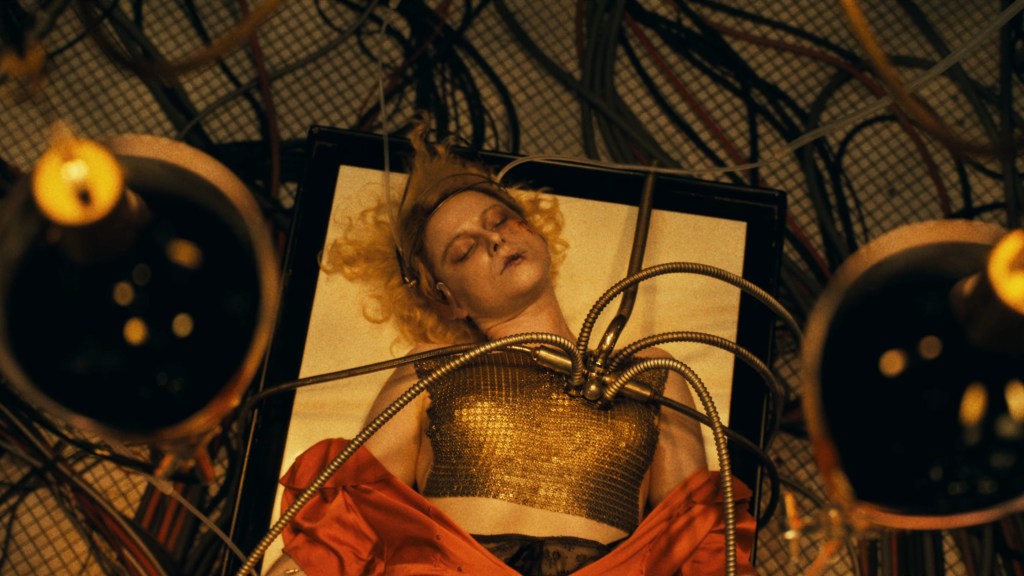

Maggie Gyllenhaal has long been one of our finest actors, but at this stage in her career, she’s more interested in directing. Her debut feature, The Lost Daughter, based on the novel by Elena Ferrante, released to critical acclaim, earning her an Academy Award nomination for Best Adapted Screenplay and bringing nominations for Olivia Colman and Jessie Buckley. Five years later, Gyllenhaal reunites with Buckley and brings aboard Christian Bale and Annette Bening in this reimagining of The Bride of Frankenstein.
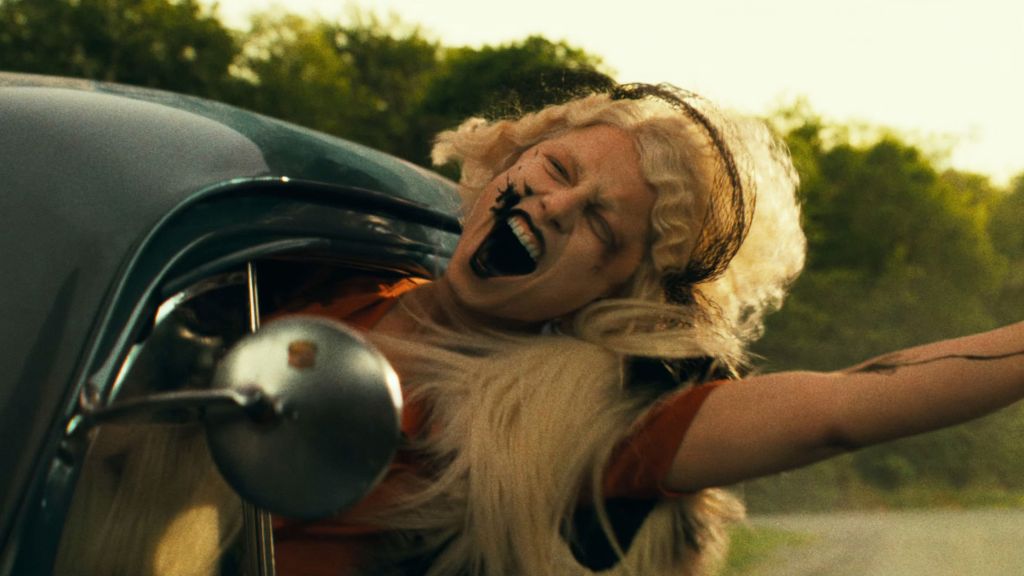
The premise is fascinating: Mary Shelley (Buckley) narrates from a black and white afterlife, possessing a woman in 1936 Chicago named Ida (also Buckley). She meets an unfortunate end before being resurrected as the film’s titular Bride, the Companion that Frank (Christian Bale) has been waiting a century for. To say this movie is unusual is an understatement; it’s wholly ambitious blending Gothic horror, gangster film, romantic drama, and the road movie into its DNA. Perhaps that is intentional, given that Frankenstein’s monster was fashioned out of different pieces, but much like that monster the film never synthesizes those elements into a coherent narrative, jumping between genres rather than letting them build.
The Bride! (stylized with the exclamation point at the end) has style and confidence and some really inspired sequences, like Frank taking the Bride to the movies to watch his favourite star Ronnie Reed (Jake Gyllenhaal). It’s also not too hard to see the parallels to a high end version of Bonnie and Clyde, with the nightclub scenes and a crime spree occurring all over America.
Jessie Buckley proves once again why she’s one of our greatest actors, essentially playing three different roles and juggling them with complete conviction. It’s her performance alone that makes the film worth watching, even if the film isn’t exactly great. The movie is clearly trying to explore identity and how it is imposed by others, which we see through her multiple identities: Ida, The Bride, Penelope Rogers and even the part of her inhabited by Mary Shelley. While the multiplicity deepens the character and gives Buckley space to explore the many facets of this woman, the film never explores the central idea of identity as something imposed, one of the more interesting threads that is left underdeveloped.
Annette Bening is also worthy of praise as Dr. Euphronius, hers is the most consistently strong performance in the film. It’s an incredibly unusual and heightened role for Bening, who is typically not known for genre film roles, although more recently she has begun to explore that space. She brings a mix of intelligence and obsession, helping us understand some of the film’s wilder ideas, especially the attempts to fuse identity, resurrection, and self-creation.
Once again, I find myself wondering what has gone wrong with Christian Bale. Aside from a small role in the English-language version of The Boy and the Heron, he hasn’t been in a good film where he’s actually on screen since 2019’s Ford v Ferrari, and that streak continues here. Early on, he works as this strange, tragic figure who just wants companionship, but as the film progresses, it loses interest in him entirely, shifting its focus to the Bride. In doing so, it sidelines what could have been the film’s emotional anchor, and Bale’s more heightened, almost camp performance feels out of sync with a film that is, paradoxically, becoming more grounded around him.
The pacing drifts in the second half, and I can almost pinpoint the moment where the film’s tone shifts wildly and leaves me wondering what happened. Said moment is a hotel party sequence that goes on far too long and feels increasingly erratic, including a dance sequence that references Young Frankenstein. From there, the film moves away from the intimate, character-driven foundation and into spectacle, with The Bride! taking on a more symbolic role that feels less connected to the person we had been following.
Gyllenhaal clearly has an eye for striking images and unusual character work, but The Bride! is ultimately overpopulated with ideas and characters that don’t fully serve a clear purpose. Actors come in and out without leaving much of an impact, almost like cameos. They include Peter Sarsgaard as Jake Wiles, a police detective on the trail of Frank and The Bride, Penélope Cruz as his assistant Myrna Malloy, Zlatko Burić as the crime boss Lupino, and Jeannie Berlin as Euphronius’ maid Greta. All established performers, yet they’re given little to do which gives the sense the film is more invested in introducing ideas than developing them.
Even smaller details point in that same direction. The names Ida and Lupino are clear nods to Ida Lupino, a prominent filmmaker who carved out her identity within a restrictive system. It’s a reference that fits neatly in with the film’s interest in imposed identity, but like so much else here, this remains more of an idea than something the film is interested in exploring. In the end, this film is not a fully realized vision but a collection of compelling ideas that never gel into something meaningful.
Watch the trailer right here.
All images via Warner Bros. Discovery.
Directed by Maggie Gyllenhaal
Screenplay by Maggie Gyllenhaal, from the novel Frankenstein; or, The Modern Prometheus by Mary Shelley
Produced by Maggie Gyllenhaal, Emma Tillinger Koskoff, Talia Kleinhendler, Osnat Handelsman-Keren
Starring Jessie Buckley, Christian Bale, Peter Sarsgaard, Annette Bening, Jake Gyllenhaal, Penélope Cruz
Premiere Date: March 6, 2026
Running Time: 126 minutes


Leave a comment